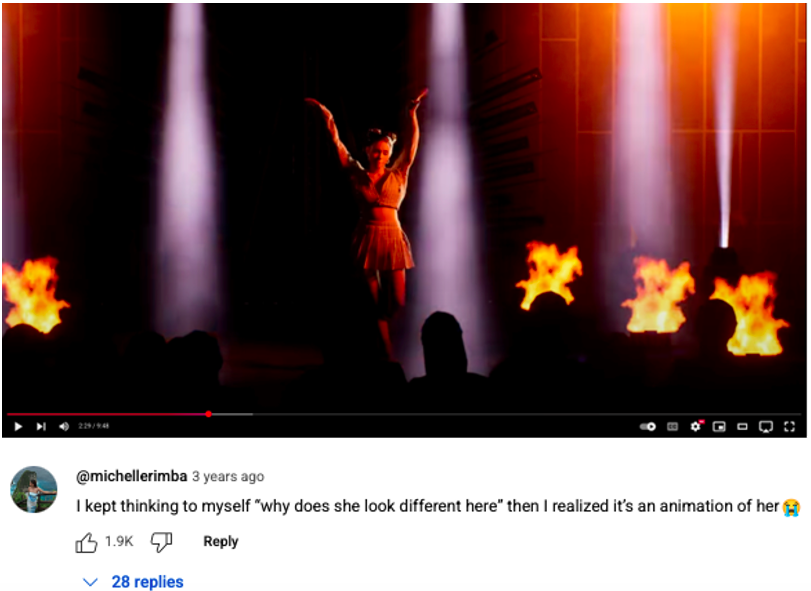
“Wait, she’s not real?”
“Hold on, the whole stage is not real?”
“I can’t believe the audience is also virtual!”
These were the reactions of my colleagues who saw the Madison Beer Virtual Reality Concert for the first time! As a developer deeply involved with AI and immersive technologies, I couldn’t help but smile. AI was reshaping the landscape of creativity right before our eyes.
Until a decade ago, creativity was largely tied to operational skill. The measure of an artist’s worth often came down to how skillfully they could manipulate their medium—paintbrush, guitar, or even digital software. Then came an evolutionary shift. Technology integration became fundamental, turning designers into tech-savvy collaborators. Conversations shifted to, “Can you share the wireframes on Canva?” or, “Let’s collaborate via Figma.” But now, we’re standing at the brink of a creative revolution.
The operational integration of technology inevitably produced enormous volumes of data, much of which was previously overlooked or undervalued. The revolution lies precisely here: Data has become the cornerstone of creativity. By harnessing domain knowledge—human intuition—and coupling it with AI’s unprecedented capacity for pattern recognition and content generation, creativity is experiencing an exponential leap.
At Findability Sciences, we see and enable this transformation. Here are a few ways in which AI-powered creativity has materialized in our projects:
- Marketing campaigns for small businesses have been a long-term limitation. Small businesses often grapple with limited budgets and tight timelines. Leveraging generative AI, we provide tools that can rapidly ideate and prototype marketing campaigns tailored specifically to each business’s unique voice, promotion, and customer base.
- Conversational websites represent yet another frontier of creative AI application. Traditionally, websites have been static, requiring significant time and resources to update and maintain. By transitioning to conversational AI, we empower websites to dynamically interact with visitors in real-time, providing personalized experiences and immediate responses.
- Recently, we worked on Jewelry Designs. While investing thousands of dollars in rings, necklaces, and bangles, users rarely get a say on designs beyond the available templates. By analyzing conversational input, a top jewelry brand in Asia is providing real-time designs and visualizations that traditional methods cannot match.
Yet, amidst all these advancements, the human role is becoming more critical than ever. AI thrives on the structure of data and the sharpness of human direction. It can draft initial concepts, suggest variations, and explore countless permutations in seconds. However, human creativity injects emotional resonance, ethical consideration, and cultural relevance—dimensions AI alone cannot fully grasp.
The balance lies in embracing a hybrid approach. Human experts bring domain expertise, emotional intelligence, and ethical oversight. AI brings speed, efficiency, and scalability. Together, they represent a powerful creative synergy that neither could achieve alone.
Navigating this hybrid approach also comes with challenges, particularly in ethics and authenticity. Ensuring that AI-generated content respects intellectual property rights and maintains transparency about its origins is crucial. At Findability Sciences, ethical AI usage remains paramount. We carefully train our AI models on ethically sourced datasets, ensuring respectful and compliant outcomes.
In the broader scheme, creativity now pivots towards domain-specific expertise, supported by AI as a partner in retrieving data, optimizing outcomes, and streamlining content generation. The new creative directors will be those who skillfully blend human intuition with AI capabilities, steering projects with clarity, creativity, and ethical responsibility.
This creative revolution is not a competition between humans and machines. It is a profound collaboration that enhances human potential and unlocks entirely new creative landscapes. It’s about recognizing that the future of creativity lies in the strategic partnership between human intuition and AI innovation, reshaping the boundaries of imagination and possibility.
(Views are personal)