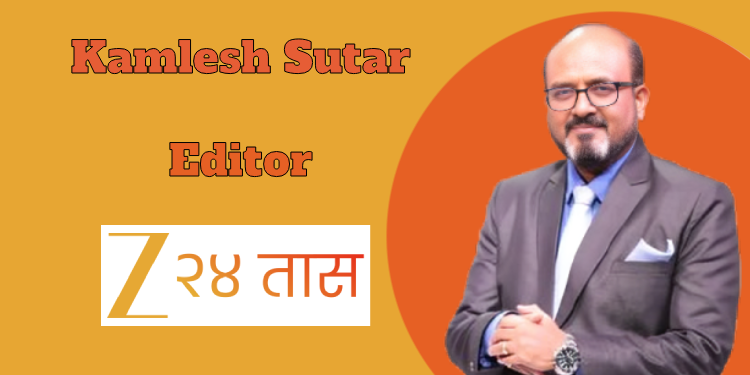
Kamlesh Damodar Sutar, Editor of Zee 24 Taas, is a veteran journalist and acclaimed author with over two decades of experience in Indian news media. Known for his sharp insights into Maharashtra’s political and social landscape, Kamlesh has worked with top networks like India Today, Aaj Tak, and Times Now. His book 36 Days is a political bestseller now being adapted into a web series. Under his leadership, Zee 24 Taas reaches 40 million viewers weekly, delivering credible, people-centric journalism.
In this exclusive conversation with MediaNews4U, Kamlesh shares how the channel blends innovation, integrity, and regional relevance to shape news that truly matters:
Where does Zee 24 Taas currently stand in the competitive landscape of Marathi news channels?
Kamlesh Sutar: From a numbers perspective, Zee 24 Taas is well-positioned in the Marathi news space. However, it’s important to acknowledge certain structural challenges that impact fair competition. For instance, the top two channels in terms of reach include one that’s present on landing pages and another available on DD Free Dish. These factors inevitably skew viewership metrics. That said, I believe strongly in evaluating performance through “time spent” rather than just reach.
We’re in close competition with ABP Majha, and over the last few months, we’ve typically rotated between the third, fourth, or fifth positions in the rankings. A significant shift happened recently with BARC transitioning to unrolled data reporting. This change has made the playing field more equitable, allowing weekly performance to reflect more immediately in viewership numbers instead of relying on four-week rolling averages. As a result, we’ve seen consistent week-on-week growth — even a half-percent jump in the news genre is considered a strong performance, and we’ve achieved that for the past three weeks.
More importantly, Zee 24 Taas has made a conscious effort to pivot back to in-depth content. Over the past 18 months, we’ve reintroduced long-form, packaged news formats to television — stories that run two to three minutes, with detailed reporting, strong visuals, and responsible storytelling. This was a much-needed departure from the trend of hyper-speed news formats (e.g., 50 stories in 50 seconds) that had become prevalent across the Marathi news space.
Today, Zee 24 Taas can proudly claim to be among the strongest content-driven channels in the segment. We’ve not only redefined storytelling but also influenced others to follow suit. Our contemporary language, evolved presentation, and engaging formats are helping attract a younger audience and reshape how news is consumed on Marathi television.
What are the key editorial themes Zee 24 Taas is focusing on currently, especially aftermath of the Maharashtra State Elections?
Kamlesh Sutar: Post-election coverage cannot be viewed in isolation from the groundwork laid during the pre-election phase, where Zee 24 Taas ensured extensive and content-rich programming. We focused on delivering robust political coverage without making it monotonous or overly dense, understanding that audience preferences—especially in Marathi news—are deeply rooted and resistant to abrupt shifts.
Currently, our editorial strategy revolves around making political content more engaging and accessible. While approximately 70–80% of the news content in regional channels remains politics-driven, we recognize that conventional political reporting often fails to engage broader and younger demographics. It tends to be heavily male-skewed and analytically heavy, which doesn’t resonate with all segments.
To counter that, we’ve adopted a new-age storytelling approach that draws from digital media trends. Our effort is to present political news in a format that is contemporary, culturally relevant, and infused with social media language and references. For instance, we often integrate trending digital topics with political narratives—be it the viral resurgence of the cult Marathi horror character Tatya Vinchu from Zapatlela, or creatively relating trending phenomena like “Aura Farming” to local political developments.
This approach helps make political news more palatable and relatable to younger audiences without alienating serious political viewers. We aim to strike a thoughtful balance—retaining analytical depth for those interested in nuanced political discourse, while also making the content appealing to digital-savvy and rural audiences alike.
At Zee 24 Taas, the editorial mission is to build inclusive storytelling that doesn’t just inform, but also engages across generations and geographies—especially critical in the evolving political landscape of Maharashtra.
What role do you think Marathi news channels play in shaping the political discourse of Maharashtra vis-à-vis national channels?
Kamlesh Sutar: To be candid, the role of Marathi news channels in shaping political discourse is both distinct and critical, especially when contrasted with the approach of national channels. Over time, many national news networks have leaned heavily into polarising content. Debates around religious identity or communal divides have unfortunately become a staple in their programming.
In Maharashtra, however, the media landscape is shaped by a very different audience expectation. The Marathi TV audience—rural or urban—is intellectually inclined and discerning. They do not appreciate sensationalism or shallow narratives. Consequently, Marathi news channels, including Zee 24 Taas, avoid the kind of overtly polarising debates that are common on national platforms. For instance, even when covering sensitive issues such as the use of loudspeakers at religious places, we focus on a balanced presentation—exploring all perspectives, incorporating historical and contextual analysis, and anchoring the discourse in factual and researched reporting.
Marathi viewers, much like their counterparts in West Bengal or Karnataka, belong to an upwardly mobile, middle-class demographic with a refined taste in news content. They expect their news to be substantive—more like a well-prepared meal than fast food. That’s the editorial standard we strive to uphold at Zee 24 Taas.
Moreover, Maharashtra is a state of tremendous regional diversity, comprising five distinct regions—Konkan, Northern Maharashtra, Western Maharashtra, Vidarbha, and Marathwada. Our editorial strategy ensures inclusive representation across all these areas. We produce multiple district-specific bulletins such as Apla Jilla Apli Batmi (My District, My News), ensuring daily coverage from all 36 districts. We further segment our coverage to reflect metropolitan cities (like Mumbai and Pune), urban centers, semi-urban towns, and rural villages.
In addition, Zee 24 Taas is proud to be one of the few regional channels with a dedicated agriculture bulletin, Peek Pani, which caters specifically to the rural farming community—a significant constituency in the state.
Through this inclusive and intelligent content strategy, Marathi news channels like Zee 24 Taas play a vital and responsible role in shaping the political discourse of Maharashtra—grounded in facts, respectful of diversity, and committed to public interest over sensationalism.
How has the digital transformation of news impacted content planning and delivery for Zee24 Taas
Kamlesh Sutar: The digital transformation of news has significantly influenced both the content strategy and delivery formats at Zee 24 Taas. Traditionally, television news adhered to a very structured and formal presentation style. In contrast, digital media has introduced a more conversational, informal, and colloquial way of storytelling—one that resonates strongly with younger and online-first audiences.
Having been closely involved in launching Mumbai Tak, a Marathi digital venture under the India Today group, I’ve witnessed first-hand how digital platforms have changed the dynamics of content. While television cannot adopt the same level of casualness or editorial informality as digital, we at Zee 24 Taas have consciously incorporated elements of digital storytelling—particularly in the way we present packaged news formats. These are more visually engaging, personality-driven, and narrative in style, which makes them more relatable and immersive for our evolving audience base.
Another critical shift driven by digital media is the demand for clarity and accountability in editorial positioning. Digital channels often take a definitive stance—either leaning left or right. While television journalism traditionally aimed to remain neutral and balanced, there are moments—especially around people-centric issues—where taking a principled editorial stand becomes necessary.
For example, a recent incident involving the state’s Agriculture Minister, who was caught playing rummy on his mobile phone inside the legislative house while farmer distress remains a critical issue, compelled us to take a bold editorial position. Rather than offering a sanitized, overly balanced view, Zee 24 Taas took a strong line—calling out the insensitivity of the situation in no uncertain terms. We firmly believe that credibility in journalism today lies not just in presenting both sides but in holding power accountable when the facts demand it.
Digital transformation has also raised audience expectations for immediacy, context, and authenticity. Therefore, we’ve evolved our newsroom practices to reflect a hybrid model—borrowing the agility, responsiveness, and tone of digital while upholding the journalistic rigour and responsibility that television demands.
What’s your take on the balance between breaking news and solution-oriented journalism in today’s high-speed news environment?
Kamlesh Sutar: In today’s fast-paced news cycle, it’s essential to balance real-time reporting with journalism that drives accountability and change. At Zee 24 Taas, we remain committed to both. While we cover breaking news with urgency, we also focus heavily on investigative, people-centric journalism.
Our flagship show Panchnama is a prime example. It’s one of the few regular investigative shows in Marathi news, backed by a dedicated Special Investigation Team. Recently, our exposé Biometrics of Ghosts revealed how deceased individuals were fraudulently receiving ration supplies. The story, based on RTI documents and a month-long investigation, led to debate in the state assembly.
We’ve covered other impactful issues too—like the growing stray dog menace, which had serious public health implications, and exposed fake dialysis centres that were misusing government funds. These stories have created real awareness and pressure for change.
At Zee 24 Taas, we believe journalism must go beyond headlines to highlight deep-rooted problems and advocate for solutions. Panchnama reflects that mission—bringing investigative rigour to television news. In a world chasing speed, we ensure that substance and public interest are never compromised.
With so much misinformation circulating in regional languages, how do you safeguard editorial integrity and public trust?
Kamlesh Sutar: At Zee 24 Taas, safeguarding editorial integrity and maintaining public trust are non-negotiable priorities, especially in an era where misinformation—particularly in regional languages—spreads rapidly across social media.
We have a highly experienced and vigilant senior editorial team that actively monitors emerging narratives. While we may not have a full-fledged deepfake verification unit, we do conduct regular fact-checks on viral claims that can be verified using publicly available documents and evidence. These include “viral check” segments where we examine the authenticity of trending information and clarify what’s true and what’s misleading.
Moreover, we actively leverage our robust digital ecosystem to counter misinformation. Our YouTube channel, with close to 9.5 million subscribers, and our strong presence on Instagram, serve as vital platforms to amplify verified information and counter fake narratives swiftly and effectively. This ensures that fact-based journalism reaches both our television and digital audiences in real time.
By combining credible reporting with a proactive digital strategy, we continuously work to uphold the standards of responsible journalism and ensure that our audience receives news they can trust.
Is Zee 24 Taas experimenting with AI or data-driven storytelling in its newsroom operations?
Kamlesh Sutar: Zee 24 Taas has been at the forefront of adopting AI and data-driven storytelling in the regional news space. In fact, we were the first Marathi news channel—and part of the broader Zee Media Group—to introduce an AI news anchor during the recent election seasons.
Our AI anchor, Zeenia, made her debut during the Lok Sabha elections and was a key part of our election coverage. Zeenia presented pre-election surveys, exit polls, and real-time results entirely in Marathi, making her the first AI anchor to do so in the language. The response was overwhelmingly positive, with our election day coverage, featuring Zeenia, becoming one of the most-watched election broadcasts on YouTube—garnering millions of views in a single day. We extended the use of Zeenia again during the Vidhan Sabha elections, reinforcing our leadership in AI-powered news presentation.
In addition to AI, we are also committed to embedding data journalism into our editorial workflow. While not necessarily producing heavy statistical reports daily, we frequently integrate relevant and contextual data into our storytelling—typically two to three times a week, and often even more. For example, during the recent public debate around the Marathi language, we explored the linguistic demographics of Mumbai using credible datasets, and followed that with data-led stories on Marathi-medium schools across Maharashtra.
The goal is to present data in a way that’s accessible, relatable, and adds depth to the story without overwhelming the viewer. Whether it’s linguistic trends, education statistics, or electoral analysis, our data-driven approach ensures our content is not only informative but also rooted in factual, people-centric insights.
Both AI and data integration are helping us create more engaging, innovative, and impactful news experiences for our audience—blending cutting-edge technology with journalistic rigour.
Do you believe having a prominent anchor face adds value to a news channel—particularly in the regional space like Zee 24 Taas?
Kamlesh Sutar: It’s a nuanced answer—both yes and no. In traditional television news, particularly in the Marathi media landscape, having a recognisable anchor face often adds value, especially during major news events. At Zee 24 Taas, we have senior anchors who have been the face of the channel for over a decade and a half. These experienced journalists bring a sense of continuity and trust, which is critical when viewers are tuning in for big or complex stories.
There is a certain reassurance that viewers feel when a seasoned anchor or an editorial leader presents key news developments. The credibility and gravitas that come with years of experience help build confidence in what’s being reported. On days of high news impact—elections, crises, or major policy announcements—a familiar and trusted face enhances the channel’s credibility and strengthens viewer engagement.
At the same time, we also maintain a healthy mix of young and dynamic anchors who connect well with evolving viewer preferences, especially in the digital-first environment. Today’s audiences are platform-agnostic and often driven more by content quality than by presenter identity. On digital platforms, newer and younger faces—if backed by strong storytelling and journalistic clarity—can command attention and credibility just as effectively.
Ultimately, the presence of a prominent anchor can certainly be a value-add, particularly for legacy television audiences. But in the digital era, where content, tone, and format matter equally—if not more—it’s the strength of the journalism that truly defines a channel’s identity and relevance.
With the festive season approaching, can you share Zee 24 Taas’ content and coverage plans—particularly around Ganpati Pandals—and how this period aligns with advertiser engagement?
Kamlesh Sutar: The festive season in Maharashtra truly begins with the holy month of Shravan, which marks the onset of several major cultural celebrations—Dahi Handi, Raksha Bandhan, Ganesh Chaturthi, Navratri, Dussehra, and Diwali. This three-month window is a deeply festive period for our viewers across the state and presents a unique opportunity for Zee 24 Taas to engage with audiences in a different tone and format.
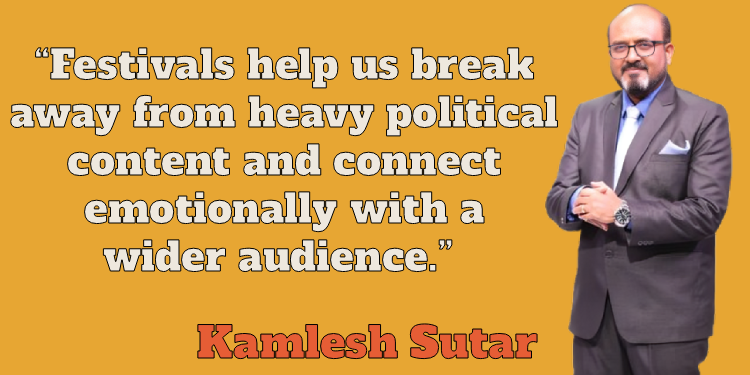
Our focus during this time shifts toward capturing the spirit and regional vibrancy of these celebrations. Festivals such as Ganpati and Dahi Handi are culturally rich and widely celebrated across rural and urban Maharashtra. They allow us to step away from the heavy political content that dominates the news cycle and offer light-hearted, emotionally resonant coverage that brings families and communities together.
For Zee 24 Taas, this is also an important strategic period in terms of audience expansion. Festivals cut across demographics—urban, semi-urban, and rural; across age groups and socio-economic classes. It’s also one of the few times in the year where we see heightened engagement from typically underrepresented viewer segments in news media, such as women and younger audiences. The perception that news channels skew toward a predominantly male audience is something we actively challenge, and festivals give us a perfect opportunity to bring more inclusive and family-centric content to the forefront.
From an advertiser’s perspective, this festive window is extremely valuable. The heightened viewership and celebratory mindset make it an ideal time for brands to connect with diverse audiences in a positive, emotionally engaged setting. We’re leveraging both our television and digital platforms to ensure wide and interactive coverage—whether through immersive ground reports, live pandal coverage, community engagement initiatives, or interactive digital content that reflects the mood of the season.
Our aim is not just to report on the festivities, but to become a part of them—making Zee 24 Taas a cultural companion to the viewer during this special time of year. It’s an exciting and high-impact phase for content creation, viewer engagement, and advertiser visibility alike.