I spent most of my formative years in Madras (now Chennai), studying in schools spread across different areas. The college I passed out from was also known for its share of campus spirit, and one of the ongoing friendly rivalries was always between fans of Rajinikanth and Kamal Haasan. These scuffles of words and pride would peak whenever their films were set to release — and back in those days, it was pure fun.
Other than snacks, savouries, and new clothes on festive days like Pongal, Diwali, and Tamil New Year’s Day, the entire state would take on a celebratory look. In the pre-satellite television era, Tamil Nadu would witness what felt like a David vs Goliath battle every time Rajini and Kamal films released, creating a charged, almost combative atmosphere in theatres.
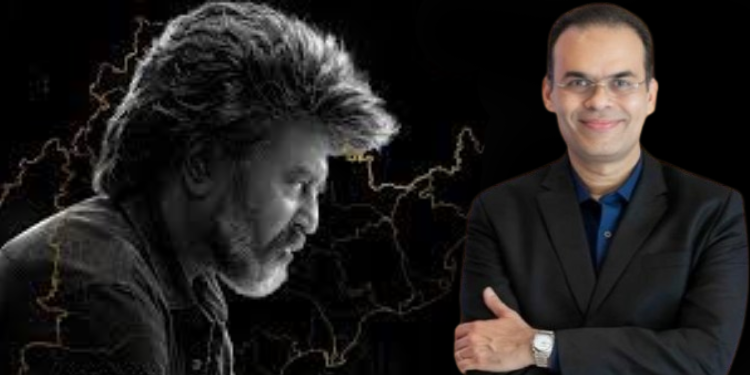
I’ve been a Superstar fan for as long as I can remember watching him on the big screen. The moment he appeared, we would be exhilarated, our hearts racing with excitement. For those new to Rajini, the now-iconic “Super Star Rajini” title card music was created during his hit film Annamalai. The title “Super Star” itself was first bestowed upon him around 1981 by the well-known producer Kalaipuli S. Thanu.
Out of the 165+ films he has acted in, the number of washouts can be counted on two hands. Even today, at this age, he continues to dazzle audiences just like he did in the ’70s.
Why do we love him? It’s the on-screen persona, the relatable “guy-next-door” charm, the unique style, the fights, and the sheer energy. The list could go on.
I’ve been fortunate to have had a few personal interactions with him. Once, during a birthday celebration for him, I mentioned quietly that people had even written wishes for him in blood. He was visibly shocked and responded with a surprised “Appidiya?” (“Is it so?”).
Another occasion was during the celebrations for 50 years of the legendary director K. Balachander — the man who introduced Rajini to cinema. In fact, the name “Rajinikanth” was given to him by Balachander himself, around Holi in 1975. Both Kamal and Rajini deeply adore and respect Balachander, treating him as their mentor.
Before that event, I visited Rajini’s home along with my boss to invite him as the Chief Guest. At the time, Chandramukhi was about to release (2005), and he said he would try to attend. He spent more than an hour with us, and I couldn’t resist telling him I had watched Baasha more than 10 times. He blushed and said, “Maybe it’s a great film.” On the day of the event in April 2005 at Nehru Indoor Stadium, around 6:30 pm, he surprised us by turning up. The crowd of over 15,000 went absolutely berserk. Kamal Haasan was there too, and both of them were seated on either side of their mentor, K. Balachander — a moment that was photographed and cherished widely.
More recently, just last year, he called to wish me for Diwali. His energy and aura were still the same. In fact, when his office first called, I was driving and asked if he could call back the next day. True to form, they did.
I remain in awe of him. In the last two decades, I’ve rarely missed a first-day, first-show of his films. It’s something I make it a point to experience, no matter where I am.
Why do people love him so much? Perhaps because he’s simple, grounded, and never puts on an artificial image when visiting people or attending functions. He’s also known to be a producer’s delight. If memory serves, his 100th film Sri Raghavendra didn’t perform well at the box office, yet Rajini — though not the producer — personally compensated the distributors.
In an era when most film stars, directors, and musicians have embraced brand endorsements, Rajini remains an exception. I wish him continued success, good health, and happiness — and may he keep enthralling us like always.
His latest film, featuring a pan-India ensemble cast including Aamir Khan, Nagarjuna, and Upendra, is made on a budget of around ₹350–360 crore and has already garnered advance bookings of nearly ₹50 crore. By all accounts, it will touch nothing less than ₹1,000 crore.
Rajini isn’t just a pan-India star; he’s a pan-Asia icon — adored even in Japan, where he’s known as the “Dancing Maharajah.” I hope brands seize opportunities like this to amplify their reach beyond mainstream advertising. This is also the first Tamil film to release in over 100 countries — a milestone worthy of the Superstar himself.
(Views are personal)