Mumbai: Canva has released its annual State of Visual Communication Report, revealing a widening gap between how younger generations prefer to work and how most organizations are still structured. The study highlights that while 94% of Gen Z professionals in India say they do their best work visually, only 22% of organizations globally describe themselves as “design-led,” creating inefficiencies that hinder productivity and engagement.
The findings underscore that with four generations now working side by side, companies must reconcile diverse communication preferences. Leaders who embrace Gen Z’s visual-first style stand to improve efficiency, unlock creativity, and enhance talent attraction and retention.
For the first time, the report included a neuroscience component using Steady State Topography (SST) to track real-time brain activity. The results show that well-designed visuals significantly outperform text-heavy content, with:
- 74% faster memory encoding
- 26% greater emotional intensity in response to documents
- 21% greater emotional intensity in presentations
These findings explain why 91% of professionals say visuals communicate ideas more effectively than text, while 76% report losing interest in text-heavy communication.
Gen Z is driving the move toward AI-powered, visual-first workflows:
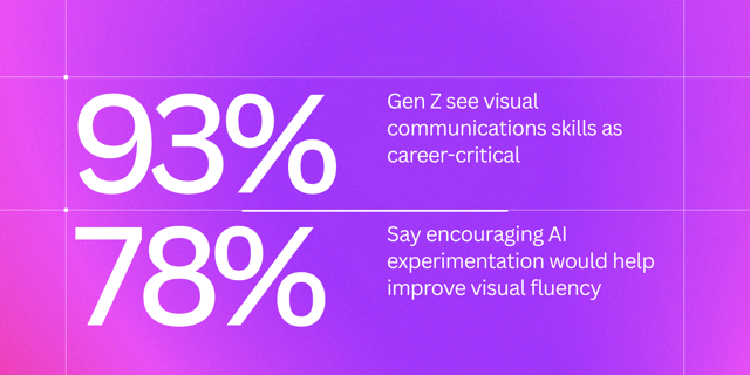
- 93% in India believe visual communication skills are critical to future-proofing their careers
- 69% in India want their companies to adopt a visual-first approach
- 78% in India say encouragement to experiment with AI would improve visual workflows
However, the report also highlights barriers, with 90% in India citing unhelpful tools as a constraint on creativity. As a result, 91% of Gen Z and 84% of their managers admit to using unapproved tools to complete creative work, with teams juggling an average of 11–12 platforms per week.
“Today’s workforce is redefining how India works, they think, create and communicate visually,” said Chandrika Deb, Country Manager – India. “Our research shows that when companies embrace a visual-first approach, they don’t just boost productivity, they also unlock creativity and attract the next generation of talent. Leaders who lean into this shift will not only keep pace but set the benchmark for innovation.”
The research reveals tangible benefits for organizations aligning with visual communication practices:
- 66% report clearer, more efficient communication of complex ideas
- 61% report stronger brand cohesion and differentiation
“In workplaces across India, where multiple generations collaborate side by side, embracing visual communication and experimentation with AI can bridge gaps in workflows and turn creativity into a strategic advantage,” added Deb. “When visual tools fit the way people instinctively work, they empower teams to thrive in India’s rapidly evolving and dynamic business landscape.”
Methodology
The study was conducted in partnership with The Harris Poll and Neuro-Insight, combining:
- A global survey of 2,475 business leaders and Gen Z professionals across the US, UK, Australia, Japan, India, France, Germany, and Spain.
- A neuroscience study with 63 professionals using SST to track brain activity as they viewed different types of business content.
With 85% of global business leaders acknowledging that poor visual communication causes delays and confusion, the report concludes that organizations that invest in visual communication infrastructure and AI experimentation will be best positioned to lead the next era of work.