Bharti Real Estate was established in 2003 with the intention of diversifying into new business sectors with the rapidly expanding Indian economy and the resulting demand for Grade-A real estate.
Cherryn Dogra has been serving as Chief Marketing Officer at Bharti Real Estate. She is leading the charge on the upcoming Worldmark, New Delhi, with focus on The Mall, an indoor destination for retail and entertainment, slated for a 2027 launch.
With ultra-luxury shopping, immersive family zones, and what the company says will be the country’s largest indoor entertainment complex under one roof, this project marks a step in redefining retail experiences in India.
Medianews4u.com caught up with Cherryn Dogra, Chief Marketing Officer Bharti Real Estate.
Q. Could you share some insights into the upcoming Worldmark projects, particularly The Mall planned for 2027?
The next phase of our development, which we refer to as Worldmark 2.0, represents a cornerstone of our strategic vision for the region. This second phase is a significant expansion, involving the development of Worldmark 4, 5, 6, and 7.
These new assets will introduce approximately 3.5 million square feet of new office space and an additional 3 million square feet of destination retail. The first tranche of offices are slated for delivery from Q3 of FY 26. Crafted to offer business, retail and entertainment experiences on par with the some of the best in the world at Aerocity, New Delhi and iconic Global Business District (GBD) is in the making, comparable to leading Global Districts around the world.
The centerpiece of this expansion will be “The Mall at Worldmark”, scheduled to debut by 2027 (tentatively). Preparing India to experience a new era of retail and entertainment, The Mall is set to become India’s most magnificent indoor destination, a visionary fusion of ultra-luxury retail, family-centric experiences, and the largest indoor-entertainment complex the country has ever seen – all under one spectacular roof.
This architectural marvel will bring together, for the first time, an elite luxury shopping precinct, a bridge-to-luxury boulevard, and an expansive family lifestyle zone, all within a singular, awe-inspiring space. Seamlessly integrated into the pulsating heart of Delhi-NCR’s Aerocity, this is more than a Mall, it is a world-class destination, a modern-day landmark of culture, commerce, and leisure.
World class offerings:
● The Haute District: A sanctuary of global luxury, housing the world’s most prestigious brands in a setting of timeless elegance.
● India’s Largest Indoor Entertainment Arena: A monumental entertainment universe offering immersive, multi-sensory experiences.
● Family Shopping & Recreation and Cinema Experience: An expansive and engaging zone catering to every generation, with premium retail, gourmet dining, and endless discovery.
Spread across approximately 2.8 million square feet, this iconic Destination Retail will be indisputably a symbol of aspiration and affluence, attracting not only the NCR elite but drawing discerning families and global travellers alike.
Q. How do you plan to disrupt the current retail experience and address the existing gaps in the market?
Our indepth market analysis/research has identified a pronounced gap in India’s luxury retail sector. Despite projections for robust market growth, a significant portion of affluent consumers continues to favor international shopping destinations.
Research indicates that over 70% of Indian luxury buyers aged 25 to 40 shop overseas, primarily due to delayed collection launches and a lack of personalised service domestically. Our strategy is to fundamentally disrupt this pattern by positioning The Mall at Worldmark as an experience-first destination. It is not merely a shopping destination, it is being designed as an emblem of the country’s evolving identity: dynamic, aspirational, and world-class.
Whether for the global traveller, the discerning connoisseur, or the modern Indian family, this is where experiences will be reimagined, moments will be celebrated, and legacies will begin.
We will address these market deficiencies by ensuring timely global collection launches, providing bespoke concierge services, offering exclusive private shopping experiences, setting-up entertainment universe offering immersive, multi-sensory experiences and gourmet dining, and endless discovery to one and all.
The scale of this development provides the necessary infrastructure for global brands to maintain significant inventory and invest in the high-caliber service that discerning customers demand.
It will attract a vibrant, daily workforce of over 200,000 professionals, boosting as a hub for forward-thinking global companies, trailblazers and established leaders. To add to this is a revolutionary multi-modal transit hub, connecting visitors from within a 100-kilometer radius in under an hour.
Q. What do you believe families are looking for in indoor entertainment, and how will Worldmark address these needs?
The modern family’s entertainment expectations have evolved beyond passive consumption; there is a well-laid-out demand for immersive, technology-driven, and collaborative experiences.
Market trends for 2025 indicate a significant shift towards virtual reality attractions and interactive games that allow for shared, social experiences. Our strategy is in direct alignment with these trends, where visitors from across the world will immerse themselves in experiences that fulfill dreams of recreation, fascination, and togetherness.
The upcoming Mall will house the largest indoor entertainment destination in the country, a space specifically engineered to host a diverse portfolio of attractions. This will include interactive art installations that respond to movement, dynamic performance areas, and cutting-edge location-based entertainment (LBE).
Our VR-based experiences will transport families to other worlds, while augmented-reality installations will overlay digital wonders onto the physical space.
The gamified zones are designed to bring families and people together, featuring collaborative challenges and even “retail-tainment” concepts where shoppers can virtually try on apparel in a fun, game-like environment.
By integrating this cutting-edge technology with well-designed communal spaces, our goal is to deliver a premier entertainment hub that meets the sophisticated demands of today’s families. For us, entertainment is reimagined and reinvented along with shopping.
Q. How do you plan to re-engage high-net-worth individuals (HNIs) and bring them back to physical retail in India?
A primary pillar of our strategy is to recapture the domestic spend of high-net-worth individuals. We recognise that the current luxury retail landscape in India has not been at par with their expectations, key challenges being delayed product availability, inconsistent service quality, average f&B and entertainment experience, which drives a majority of this segment to travel and spend abroad.
To regain their patronage, the retail offering must deliver on three fronts: world-class service, guaranteed product authenticity, and a palpable sense of exclusivity. Visitors from across the world will immerse themselves in experiences that fulfill dreams of recreation, fascination, and togetherness.
The Haute District, a dedicated luxury precinct designed to address these challenges head-on. It will feature global collections, ensure up to date inventory levels, and provide exclusive amenities such as private lounges, a dedicated concierge, VIP parking and a dedicated drop off area for the luxury shopper with a seamless, private ingress and egress to the store that define the exclusivity of the experience.
By pairing this with an array of gourmet dining options at premium restaurants and cafes and access to a major entertainment destination, we are creating a multifaceted value proposition that we are confident will repatriate a significant portion of luxury spending to the domestic market.
For enhanced customer experience, we have designed a range of thoughtful amenities from high speed internet to baby care, to in-mall digital experience, air quality monitoring, vip parking, cloakroom, travelators, valet parking, elder care to make the retail experience seamless and enjoyable.
Q. What role will Artificial Intelligence (AI) play in Worldmark 2.0, both for cost efficiency and the visitor experience?
Artificial Intelligence presents a significant opportunity within a development of this scale, and we are closely evaluating its application to enhance both operational efficacy and the visitor experience.
From an operational perspective, AI can yield substantial cost savings. AI-driven property management platforms are proven to increase rental yields and reduce maintenance expenditures. Within Worldmark 2.0, AI will be deployed for smart building management to optimize energy consumption, enable predictive maintenance, and manage occupancy loads efficiently.
For our visitors and retail partners, AI is a tool for enhancing the end-user experience. We envision AI-powered digital concierges and intuitive wayfinding applications to personalise a visitor’s journey through the campus.
For our tenants, AI-driven analytics on footfall and consumer behavior will provide invaluable data to inform merchandising and operational decisions. The overarching goal is to leverage AI to create an environment that is both seamless for the consumer and highly efficient to operate.
Q. How can AI be used to enhance the end-to-end customer journey at Worldmark?
Artificial Intelligence provides the capability to customise and enhance every stage of the customer journey, from initial online engagement to the on-site experience. In the pre-arrival phase, our digital platforms with AI-powered chatbots and virtual assistants for 24/7 inquiry management and lead capture. Predictive analytics will inform our marketing, allowing us to serve relevant content and promotions based on user behaviour.
We are also leveraging computer vision for virtual tours and augmented-reality previews, allowing prospective tenants and visitors to explore the development remotely. On-site, the experience becomes progressively intelligent. AI algorithms linked to our building management system will monitor foot traffic to modulate ambient conditions like lighting and climate control in real-time. This technology allows us to architect an intuitive, responsive, and deeply personalized journey for every individual who enters Worldmark.
Q. What role does predictive analytics play in the planning and development of a project this large?
Predictive analytics is integral to contemporary real estate strategy and is a tool we employ throughout the project’s entire lifecycle. In the initial planning phases, AI-powered platforms analyse vast datasets, encompassing market trends, historical sales, and demographic shifts to generate more accurate and rapid property valuations. In terms of leasing strategy, predictive models forecast demand across various retail categories, which is critical for curating an optimal and synergistic tenant mix.
Operationally, these analytics allow us to anticipate footfall patterns based on external variables like flight schedules or city-wide events, enabling proactive adjustments to security, maintenance, and staffing. This forward-looking capability extends to physical infrastructure, where AI platforms can predict equipment maintenance needs, thereby minimising downtime and operational costs.
Q. How have mixed-use developments evolved, and what are the key trends Bharti Real Estate is responding to with Worldmark 2.0?
The paradigm for mixed-use developments has fundamentally shifted. They have evolved from simple “work-and-shop” formats into complex urban ecosystems. Today’s consumers and corporate tenants demand superior convenience, demonstrable sustainability, memorable experiences, and a strong sense of community.
Worldmark 2.0 is our response to this evolution. We are integrating office, retail, dining, hospitality, and entertainment components into a cohesive, (approximately) 17 million-square-foot leasable space. We are addressing the key market trends by maximising connectivity, with a location at a major transit nexus, thanks to its express connectivity offering 100 km commute in under an hour.
Workspaces are designed for sustainability. With wellness and sustainability considerations at its core, the new campus of approx. 3.5 million sq.ft GLA is LEED Platinum across office buildings and pedestrian-centric public realms. Well placed atriums, building edges active with retail components, an experiential F&B street running through the heart of the building, they are all part of a seamless transition between the hierarchy of spaces.
Q. What are your current marketing priorities and the key pillars of your strategy?
Our marketing strategy is structured around four key pillars: Experience, Innovation, and Luxury, all underpinned by Sustainability. The primary objective is to cement Worldmark 2.0’s position as India’s first truly global business district, a premier destination where world-class commercial spaces converge with unparalleled luxury retail, entertainment and spectacular experiences.
To bring this to life, our communications will emphasise the project’s innovative aspects, from its smart-building infrastructure to its immersive entertainment offerings. We will highlight the unique experiential components and the project’s exceptional multi-modal connectivity.
The luxury proposition will be communicated through our curated brand mix and the exclusivity of The Haute District. Finally, sustainability and wellness are integrated into our core messaging to resonate with the increasing number of environmentally and health-conscious corporations and consumers.
Q. Could you describe your marketing budget mix and the role that SEO, social media, and influencer collaborations play?
Our marketing budget is significantly weighted towards digital channels, which is a direct reflection of where our target demographics: global corporations, urban professionals, travellers, and affluent families are most active.
While exact percentages cannot be disclosed, digital spends currently make up the majority of the budget. SEO and content marketing are fundamental to capturing high-intent organic traffic across our key business verticals of office, retail, and entertainment.
We utilise a judicious mix of social media platforms such as LinkedIn and Instagram for corporate communications, project updates, and community building. Our approach to influencer collaborations is highly strategic.
We prioritise partnerships with credible authorities in fields like architecture, gastronomy, and luxury lifestyle, who can provide authentic and knowledgeable commentary on the project’s specific attributes. This is complemented by traditional media, which plays a tactical role in building broad-based awareness within our primary catchment areas.
Q. What role does a traditional medium like radio play in your media mix today?
In the context of our overall media strategy, radio serves as a tactical and complementary channel. Its value lies in its hyper-local reach and its efficiency in reinforcing top-of-mind awareness among specific commuter audiences.
For a destination like Worldmark, which is situated in a major transit hub, radio allows us to deliver targetted messaging during peak travel times to our core audience of office-goers and travellers within the Delhi NCR. Its role has evolved from a primary to a supportive one.
We deploy it strategically to amplify our digital campaigns, drive traffic to online platforms, or promote specific on-ground activations, particularly during key launch periods and festive seasons.
Q. Are you leveraging immersive technologies like Augmented or Mixed Reality in your marketing, particularly in print?
Yes, we are actively leveraging immersive technologies as we believe they are critical for bridging the gap between a physical development and its target audience.
The adoption of Augmented Reality (AR) and virtual tours is a key component of our marketing innovation. We are developing AR-enabled print collateral, which will allow a user to scan a code and interact with a 3D model of the development on their device. This transforms static media into an engaging and interactive experience.
In parallel, comprehensive virtual tours and AR previews are being integrated into our digital platforms. These tools are invaluable for enabling prospective tenants and international audiences to experience the scale and quality of the project remotely, which market data suggests can significantly increase qualified inquiries.
Q. What kind of experiential marketing initiatives and community engagement plans can we expect?
Experiential marketing is fundamental to our strategy of positioning Worldmark as a destination. We are programming our public spaces to be active and engaging.
Our World St. thoroughfare, for instance, is designed not just as a retail street but as a dynamic venue for cultural programming, including open-air concerts, curated markets, and public art installations.
The objective is to create a vibrant public realm that encourages repeat visitation. Our indoor entertainment zone will feature a rotating calendar of events and experiences in partnership with leading global entertainment brands.
Community engagement is also a priority, with plans for wellness initiatives, workshops, and cultural festivals organised in collaboration with our tenants and local partners. The goal is to establish a robust, year-round calendar of events that establishes Worldmark as a central hub for culture, business, and leisure.
Q. In a market often driven by big names, what is your approach to celebrity endorsements versus influencer-led campaigns?
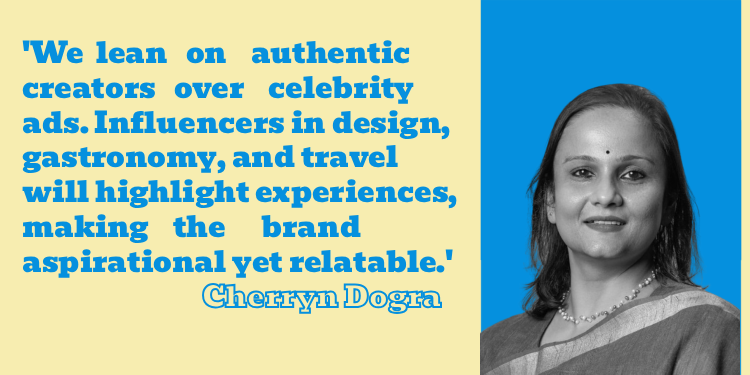
The real‑estate category often uses celebrity endorsements, but the Worldmark brand leans toward authenticity, experiences and relevance. While marquee events (launches, gala openings) may feature well‑known personalities to generate buzz, ongoing campaigns will prioritise creator‑driven storytelling.
Collaborations with architectural tastemakers, culinary influencers and travel bloggers allow us to highlight specific facets, design excellence, dining experiences or connectivity through credible voices.
User‑generated content from tenants and visitors will also be amplified to showcase real experiences. This approach ensures that the brand remains aspirational yet relatable, aligning with modern consumers who value genuine recommendations over generic celebrity ads.
Q. What is your current geographic focus, and do you have plans for expansion?
Our current geographic focus is firmly on the Delhi NCR, where the Worldmark brand has an established and successful presence in both Aerocity and Gurugram.
Our immediate priority is the execution and delivery of Worldmark 2.0, that represents a significant long-term investment as well as commitment. The performance of our existing assets has validated the market demand for high-quality, large-scale, integrated mixed-use developments.
Based on this, we are continuously evaluating strategic opportunities in other major markets across India that possess the requisite infrastructure and economic fundamentals to support projects of this scale. However, at present, no formal announcements regarding expansion have been made. Our focus remains on the successful delivery of our landmark project in Delhi NCR, the world’s best connected capital.