Chennai: Speaking at the 6th edition of Straight Talk – Brand Summit, organised by MediaNews4U, Neeraj Sharma, Managing Director and Head of Media & Entertainment Industry (APAC) at Accenture, delivered a thought-provoking keynote on “AI deployment in MarCom: Evolving beyond Attention Economy into Emotion Economy.”
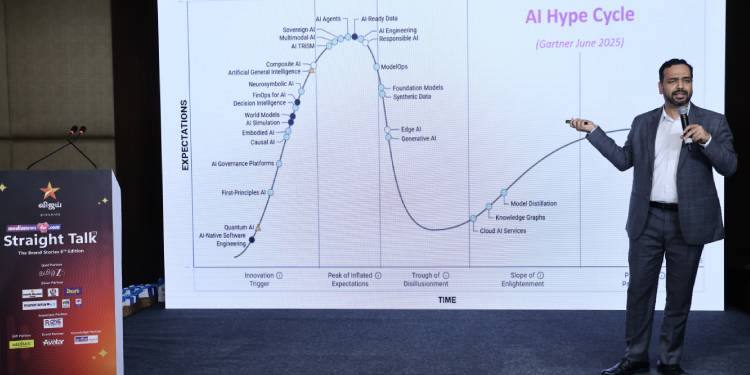
Reflecting on how far AI has come since ChatGPT’s public debut in November 2022, Sharma observed that while the technology has transformed the way we work and create, it has also entered the classic “hype cycle” described by Gartner.
“AI is magical, but it is not magic. Your craft is the magic — AI is just the tool that enables it,” Sharma emphasised, as he charted AI’s journey through phases of inflated expectations, disillusionment, and eventual maturity.
Generative vs. Agentic AI: The Reality Behind the Hype
Using Gartner’s hype cycle, Sharma noted that generative AI has already passed its initial peak of inflated expectations and is now descending into a period of realism. Meanwhile, agentic AI — the emerging frontier where AI acts autonomously on behalf of users — is at the crest of the hype wave.
He illustrated this point with examples from creative industries, showing how AI-generated ads, like the Apple iPhone 17 concept videos made with Google’s Veo 3, demonstrated technical capability but lacked emotional resonance.
In contrast, he cited Simon Meyer’s satirical “iPhone 17 Pro” spoof, which cleverly used multiple AI tools, storytelling, and cultural cues to create a memorable piece of content.
“AI alone doesn’t make great work — human intent and narrative do. The technology amplifies creativity; it doesn’t replace it,” Sharma remarked.
Building Your Own AI Stack
Acknowledging the explosion of new AI tools in the market, Sharma advised professionals to focus less on chasing every new launch and more on building a personalised AI stack relevant to their domain.
“Whether you’re in marketing, finance, HR or supply chain, identify the 10 to 12 recurring activities you perform and choose one or two tools that enhance each. Build your own stack and stay consistent,” he said.
Beyond Attention: The Decline of the Attention Economy
Transitioning to the concept of attention, Sharma discussed the growing challenges brands face in capturing and retaining consumer focus.
“Not all attention is worth leveraging,” he cautioned, sharing a personal anecdote about being shown ads while anxiously tracking a delayed food delivery. “I was hungry and frustrated — that was not the right moment to show me an insurance ad.”
He highlighted three key problems plaguing the attention economy:
-
Difficulty in identifying valuable attention,
-
Oversupply of content leading to numbness, and
-
Digital fatigue — with per-capita digital content consumption dropping for the first time, including a 28% decline in social video viewing, according to Accenture’s research.
“People have realised short-form videos are like dopamine hits. They don’t want to be digital druggies anymore,” he quipped.
From Attention to Emotion: The New Differentiator
In an age where attention is scarce and oversupply has dulled engagement, Sharma argued that emotion is the only currency that cuts through.
He spotlighted Bombay Shaving Company, Atomberg, and Rainmatter (Zerodha’s investment arm) as examples of brands leveraging emotion and authenticity to stand out.
-
Bombay Shaving Company, led by Shantanu Deshpande, uses creative, conversation-driven content such as The Bridge, a show pairing CEOs with Gen Z voices.
-
Atomberg, operating in the traditionally dull fan category, has built a ₹1,000-crore brand through consistent, authentic storytelling that mirrors its founders’ philosophy.
-
Rainmatter connects emotionally through its Founders’ Run initiative, fostering real-world relationships among entrepreneurs rather than just digital engagement.
“These brands treat their business itself as a creative medium,” Sharma noted. “They’re putting their enterprise at the intersection of culture and commerce.”
Emotion as the Enterprise Philosophy
According to Sharma, successful modern brands distinguish themselves by infusing personality into professionalism — evolving from a managerial tone to an editorial one, and from planning and analysis to insight and vision.
He concluded that while emotion-driven initiatives may appear gimmicky at first, consistent application leads to long-term brand elevation — what he called the ‘hype gain’.
“Every spike of engagement might fade, but you don’t return to where you started. Each authentic emotional connection raises your baseline a little higher,” he said.
Closing Thoughts
In closing, Sharma reiterated that the future of marketing lies not in chasing fleeting attention, but in earning emotion and trust — through creativity, consistency, and authentic human connection, powered but not defined by AI.
“AI will evolve. Tools will change. But emotion will always remain the ultimate differentiator,” he concluded.