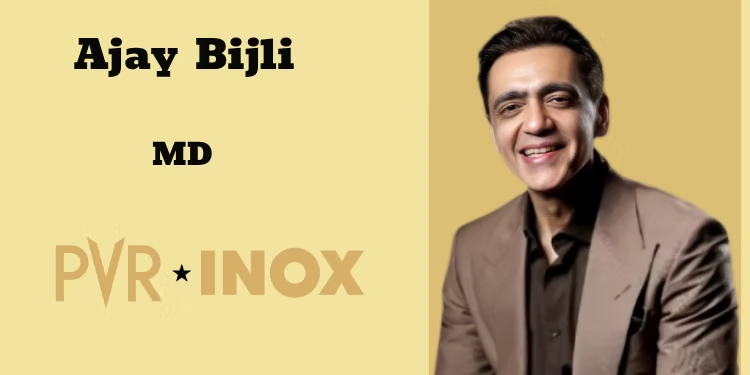
Ajay Bijli has been serving as Managing Director at PVR INOX. Bijli has transformed the way millions of Indians watch movies for over two and a half decades exposing Indian viewers to world-class movie viewing experience. This led to the beginning of the growth of the out-of-home entertainment sector with movie going in multiplexes playing an integral role. Bijli is spearheading the multiplex industry growth in an under-screened market for the world’s largest film producing nation.
It is fair to say that the multiplex operator had a much better 2025 compared with 2024. In 2025 it continued its calibrated expansion strategy with a strong focus on capital-light growth and deeper penetration into smaller towns and cities.
It opened 55 screens across nine new cinemas, including in emerging markets such as Raipur, Jabalpur, Siliguri, and Gangtok with Gangtok marking the first multiplex in Sikkim. In the coming months, it will further expand into underserved regions with upcoming launches in Leh, Hubli, and Agra.
As 2025 comes to a close, Medianews4u.com caught up with Ajay Bijli, MD, PVR INOX
Q. Which key markets did PVR INOX focus on for growth in 2025? What potential do Tier Two and Tier Three towns hold?
In 2025, PVR INOX continued its calibrated expansion strategy with a strong focus on capital-light growth and deeper penetration into smaller towns and cities. During the current fiscal year, we opened 55 screens across 9 new cinemas, including in emerging markets such as Raipur, Jabalpur, Siliguri, and Gangtok with Gangtok marking the first multiplex in Sikkim. In the coming months, we will further expand into underserved regions with upcoming launches in Leh, Hubli, and Agra.
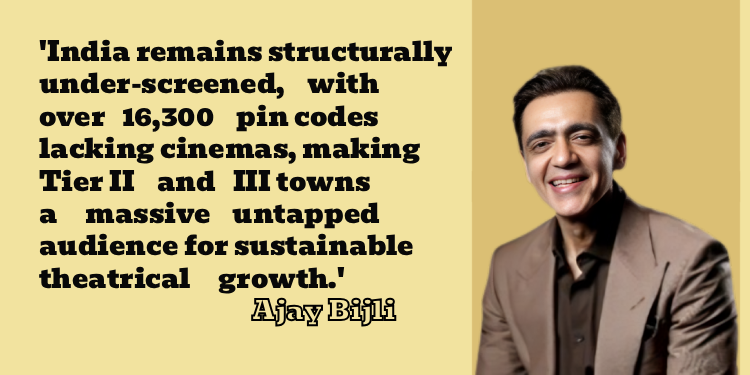
Tier Two and Tier Three markets represent a significant long-term opportunity. India remains structurally under-screened, with only 7 screens per million people, and over 16,300 of the country’s 19,000+ pin codes still lacking access to a cinema. Today, only an estimated 150 million Indians of the country’s 1.4 billion population visit movie theatres annually highlighting a vast untapped audience.
To address this opportunity, we are piloting a new capital-efficient “value” cinema format internally called Smart Cinemas specifically designed for these markets. This model offers lower capex per screen and a value-centric proposition tailored to local preferences. Based on pilot performance, we will take a considered approach toward scaling this format further.
Q. What is the progress toward becoming debt-free?
PVR INOX has made substantial progress toward its debt-free goal through disciplined capital allocation, strong free cash flow generation, and a strategic pivot to capital-light expansion. Over the past 2.5 years, net debt has reduced from Rs. 14,304 million (March 31, 2023) to ₹6,188 million (September 30, 2025) a reduction of Rs. 8,116 million (57%).
This deleveraging has been supported by a sharp reduction in annual capex (from Rs. 6,269 million in FY’24 to Rs. 3,249 million in FY’25), improved operating efficiency, and strong free cash flow Rs. 3,320 million in H1 FY’26 alone. Our move toward Asset-Light and FOCO models is structurally lowering capex per screen, enabling expansion without additional leverage.
While future deleveraging will depend on box office performance, our focus remains on sustaining strong cash flows, maintaining financial discipline, and progressing toward a debt-free balance sheet in a calibrated manner.
Q. Does the success of diverse films over a few blockbusters make 2025 a standout year for PVR INOX?
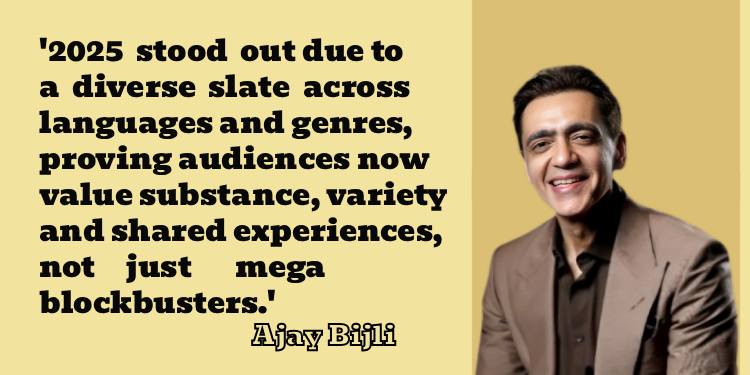
Yes. 2025 has been a standout year for both PVR INOX and the broader theatrical industry. Unlike earlier years dominated by a handful of mega-blockbusters, this year witnessed the success of a diverse and dynamic slate across languages, genres, and scales.
Mass entertainers such as ‘Dhurandhar’, ‘Chhaava’, ‘War 2’, ‘Raid 2’, ‘Jolly LLB 3’, ‘Housefull 5A & 5B’, along with emotional narratives like ‘Sitaare Zameen Par’ and ‘Saiyaara’, resonated strongly with audiences. Hollywood titles like ‘Mission: Impossible – The Final Reckoning’, ‘F1: The Movie’, ‘Jurassic World: Rebirth’ and ‘The Conjuring: Last Rites’ drew large crowds, proving that tentpole experiences continue to thrive.
Regional and cultural blockbusters including ‘Kantara: A Legend Chapter 1’, ‘Lokah: Chapter 1 Chandra’, ‘Mahavatar Narsimha’, ‘Su from So’, ‘Laalo Krishna Sada Sahayaate’ and ‘Dude’ expanded the definition of mainstream success. Even niche content such as anime performed exceptionally well with ‘Demon Slayer: Infinity Castle’ achieving remarkable traction.
This month will see major releases like ‘Avatar: Fire and Ash’ (19 December) and ‘Tu Meri Main Tera’ (25 December) along with several regional titles.
The year’s trends underline a major shift: audiences now visit cinemas not just for scale, but for substance, variety and shared emotional experiences.
Q. Has improved storytelling contributed to the turnaround in Hindi films this year?
Yes. Enhanced storytelling has been a key driver of the resurgence in Hindi cinema. Audiences are responding to well-written narratives, engaging characters, and content that reflects contemporary sensibilities. Quality content is performing well irrespective of cast or scale.
Q. Does the success of ‘F1: The Movie’ indicate that Hollywood’s appeal now extends beyond MCU films?
Yes. The success of ‘F1: The Movie’, which became the 19th Hollywood film to cross Rs. 100 crore in India, demonstrates that Indian audiences are increasingly open to Hollywood content beyond Marvel/MCU franchises.
While its success showcases wider acceptance, quality storytelling and relevance to Indian audiences remain critical drivers.
Q. Occupancies improved—what role premium formats play? What enhancements are being made to Director’s Cut?
Premium formats have meaningfully contributed to improved occupancies, reflecting a shift toward experience-led cinema consumption.
Year-to-date (till November 2025), our Director’s Cut cinemas are operating at mid-30% occupancy while delivering nearly 4x the ATP of mainstream formats. Demand for luxury formats continues to rise we have opened four new Director’s Cut locations in the last four years.
Director’s Cut continues to evolve with the best-in-class screen experience, superior sound, luxurious seating and elevated F&B, ensuring a clearly differentiated premium offering.
Q. How impactful has the GST reduction (12% to 5% on tickets priced at Rs. 100 and below) been?
The reduction from 12% to 5% has been a positive development for consumers, and we passed the full benefit through immediate price reductions. While the benefit is modest in absolute terms, it has improved affordability and strengthened sentiment among value-focused audiences.
For example, our popular Blockbuster Tuesday’s pricing dropped from Rs. 99 to Rs. 92, fully reflecting the GST relief.
While not a major financial level, the GST cut supports our broader strategy of manufacturing footfalls through value and strengthening weekday cinema-going.
Q. Has there been any change in the revenue share arrangement with film producers?
No. There has been no change in the revenue-sharing arrangement with film producers.
Q. After Blockbuster Tuesdays, what more can we expect in innovative ticket pricing in 2026?
Blockbuster Tuesdays launched in April 2025 with ticket prices starting at ₹99 across 300+ cinemas has significantly boosted weekday footfalls.
In 2026, audiences can expect:
- Bundled ticket + F&B packages
- Premium format discounts on off-peak days
- Subscription-based or loyalty-tier pricing models
All aimed at improving accessibility and driving consistent weekday footfalls.
Q. What has been the impact of featuring media leaders like Anita Kotwani on in-cinema advertising?
Featuring industry leaders like Anita Kotwani through our Thought Leadership Initiative significantly strengthened the credibility of in-cinema advertising. By engaging CXOs rather than only media buyers, the campaign generated strong word-of-mouth and widespread industry visibility.
This has led to measurable business impact. In H1 FY’26, advertising revenue rose to Rs. 235.2 crore, a 16% YoY increase. Advertiser confidence is improving, with stronger repeat partnerships and growing interest from national and regional brands.
Q. Are there better tools now to measure the impact of in-cinema advertising? Are FMCG, BFSI, and auto still the dominant categories?
Yes. Our measurement capabilities have improved significantly. With internationally renowned cloud-based partners, we can now deliver campaign-specific post-evaluation reports to clients. (FMCG, BFSI and auto remain among the core advertising categories.)
Q. Are advertisers using cinema lobbies for experiential activations?
Yes. We are actively deploying experiential marketing activations across our cinemas.
Examples include:
- Happydent at PVR INOX Ambience Gurugram: an AI-powered smile-detection photo booth with instant Polaroids.
- Goibibo: interactive games, trivia, contests and giveaways tied to a film release.
Such activities demonstrate how advertisers are leveraging our lobby spaces for immersive consumer engagement beyond traditional screen advertising.
Q. Is predictive analytics playing a larger role in decisions around new screens, closures, or F&B?
Yes. Predictive analytics is increasingly central to network and operational decisions.
Our in-house data-led tool evaluates catchment potential, demographics, competitive intensity, and mall viability before signing any new screen. It enables highly accurate forecasting of footfalls, pricing potential, and long-term profitability.
Predictive analytics also informs rationalisation decisions for underperforming cinemas, enabling timely exits based on structural insights.
On F&B, predictive tools analyse purchase patterns, daypart trends, product affinity, and price elasticity helping optimize menus, localize offerings, design bundles and minimize wastage.
Q. How is the content pipeline shaping up for 2026? Will it be as diverse as 2025?
The outlook for 2026 is extremely strong. It is poised to be another landmark year for the industry, with a diverse lineup across Hindi, Hollywood and regional cinema.
Some of the key titles include: ‘Ramayana Part 1’, ‘Border 2’, ‘Dhurandhar Part 2’, ‘Toxic’, ‘Dhamaal 4’, ‘Love and War’, ‘O’ Romeo’, ‘The Raja Saab’, ‘Alpha’, ‘Bhoot Bangla’, ‘Naagzilla’, ‘Mardaani 3’, ‘Spider-Man: Brand New Day’, ‘Jumanji 3’, ‘The Odyssey’, ‘Dune: Part Three’, ‘Avengers: Doomsday’, ‘Mana Shankara Varaprasad Garu’, ‘Jana Nayagan’, ‘Peddi’, ‘Jailer 2’ and many more.
Alongside 100+ new screens planned for 2026, the strong film slate gives us confidence in continued growth, diversity and innovation.
Q. Should US President Donald Trump’s proposed tariffs on films made outside the US apply only to movies set in the US but shot abroad?
While these proposed tariffs do not directly impact PVR INOX as an exhibitor, such measures may have broader implications for global film collaboration.
Film production is inherently global. Creative development, financing, shooting, post-production, and distribution often span multiple countries. Classifying films based on narrative or shooting geography could create ambiguity, compliance challenges and operational complexity for studios.
Selective tariffs may also distort production incentives, impacting both US and international filmmaking ecosystems without significantly aiding domestic employment.