The Banyan is a pre-school and corporate day care brand launched in 2003, it was born from a deep understanding of the challenges faced by working parents, especially mothers, in balancing the demands of their careers and caregiving responsibilities. In response, The Banyan set out to build a supportive, high-quality childcare ecosystem that enables parents to pursue their professional goals with confidence and peace of mind.
The Banyan currently operates in centres across Delhi NCR, Rajasthan, Maharashtra,Gujarat and Karnataka, and now offer PAN-India childcare solutions through on-site and near-site day-care models. It caters to children aged 6 months to 12 years, through One vision : To make quality childcare accessible at every workplace so no parent has to choose between career and family. The Banyan plans to expand PAN India with 200+ centres and partnerships in the next 5 years.
With 22+ years of experience, 20,000+ children served, and 100+ corporate partnerships in Government, Hospitality, Aviation, Power, University sectors. The Banyan combines care, systems, and innovation to help parents and help companies retain talent. They’re not just raising children, they’re empowering women and shaping a stronger future for families and workplaces in India.
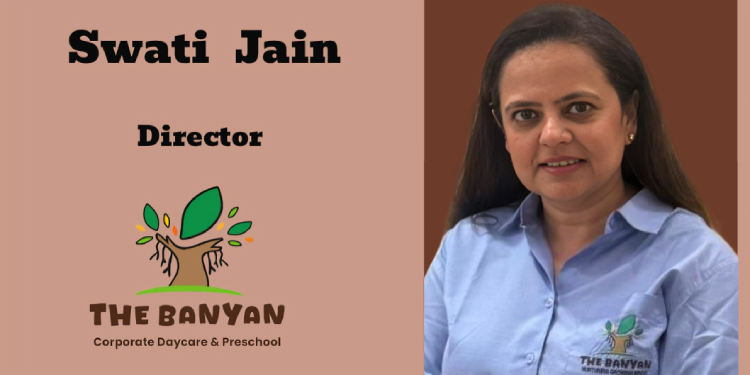
Medianews4u.com caught up with Swati Jain Director The Banyan
Q. The Banyan launched in 2003 was born from an understanding of the challenges faced by working parents, especially mothers, in balancing the demands of their careers and caregiving responsibilities. What progress has been made over the past two decades?
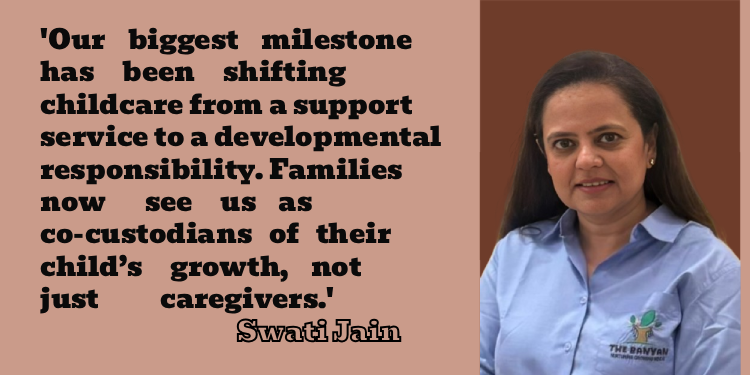
When The Banyan began in 2003, the idea of structured, high-quality childcare itself was still nascent in India. Over the past two decades, we’ve witnessed and contributed to a significant shift in how childcare is perceived. It has moved from being seen as a necessity of convenience to an essential pillar of early childhood development and women’s workforce participation.
What makes me most proud is that we have evolved from a single solution for working mothers into a comprehensive ecosystem for early learning, care, and family support. We’ve professionalised caregiving, invested deeply in curriculum design, safety standards, and caregiver training, and built long-term trust with parents and corporate partners alike. Today, parents don’t just leave their children with us, they choose us as partners in their child’s formative years. That trust is the true marker of progress.
Q. How do you tackle the challenge of ensuring that every teacher and caregiver is aligned with the company’s philosophy in order to build a supportive, high-quality childcare ecosystem?
Alignment begins with clarity. At The Banyan, our philosophy is crystal clear, early childhood care must be nurturing, respectful, developmentally appropriate, and emotionally safe. We embed this philosophy right from the recruitment stage.
Every teacher and caregiver goes through a structured induction, continuous training, and mentoring, not just on pedagogy but also on empathy, observation, and child psychology. We invest heavily in upskilling because we believe quality childcare is delivered by people, not infrastructure alone.
We give equal importance to our culture as well. We foster an environment where caregivers feel valued, heard, and supported because only emotionally secure adults can create emotionally secure spaces for children. Alignment, for us, is not enforced; it is cultivated through shared purpose and constant dialogue.
Q. The Banyan plans to expand PAN India with 200+ centres and partnerships in the next five years. What does this entail?
Our expansion vision is ambitious, but it is also deeply intentional. Scaling to 200+ centres PAN India reflects our belief in rapid replication, without compromising on our quality.
This expansion will be driven through a mix of company-owned centres and strategic partnerships, especially with corporates, institutions, and communities that share our commitment to quality early childhood care. It entails strengthening backend systems, standardising training frameworks, investing in technology, and building leadership pipelines so that each centre reflects The Banyan’s ethos, regardless of geography.
Ultimately, this expansion is about access, ensuring that high-quality childcare is not limited to a few urban pockets but becomes available to working families across India.
Q. What marketing activities and innovations can one expect in the coming months?
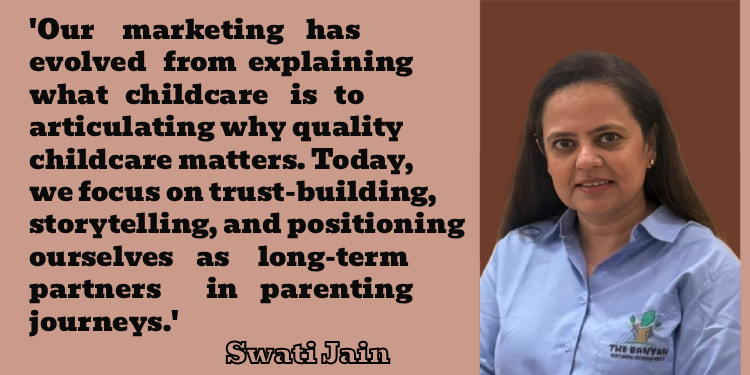
Our marketing focus is shifting from visibility to meaningful engagement. You will see us invest more in content-led storytelling, such as sharing real parent journeys, caregiver voices, and everyday moments that define early childhood.
We are also exploring community-centric initiatives, digital experiences, and collaborations that spark conversations around parenting, work, and wellbeing. Innovation for us doesn’t mean noise; it means relevance. Every campaign we plan is designed to resonate emotionally while clearly communicating the value we bring to families.
Q. Is word of mouth going to be crucial in growing the business?
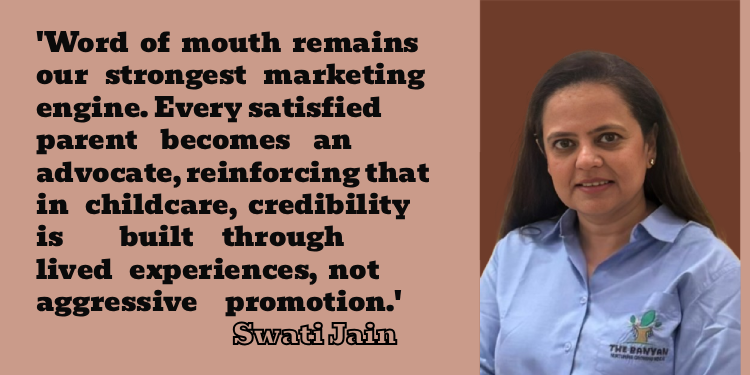
Absolutely. In our industry, we cannot have new parents trust us unless we have proven our mettle. And so, our existing clientele (parents) becomes our strongest growth driver.
When a parent recommends The Banyan to another parent, it’s not just a referral; it’s an endorsement of safety, care, and values. Our focus has always been to deliver experiences that parents want to talk about, both organically and confidently.
Q. Will The Banyan also use celebrity mothers to get the message across? Kindly elaborate.
We are open to working with celebrity mothers, but very selectively and authentically. For us, influence is meaningful only when it aligns with lived experience and shared values.
If a celebrity parent genuinely resonates with our philosophy and has experienced The Banyan firsthand, their voice can help normalise conversations around childcare, career continuity, and maternal guilt, topics that many women silently struggle with. However, authenticity will always take precedence over reach.
Q. Could you shed light on The Banyan’s social media strategy to participate in the conversation around being a working mother?
Our social media strategy is not about perfection; it’s about honesty. We aim to create a space where working mothers feel seen, validated, and supported.
We focus on real stories, expert insights, and everyday challenges from separation anxiety to career pauses and returns. Rather than prescribing solutions, we encourage dialogue. Social media, for us, is a listening tool as much as it is a communication channel.
Q. WhatsApp has introduced new tools for businesses. Has it become a more useful platform as a result?
Yes, a significant portion of them actually. WhatsApp has become an extension of our parent engagement strategy. The newer tools allow for faster, more personalised, and more transparent communication, which is critical in childcare.
From daily updates to quick clarifications and emergency communication, WhatsApp helps us stay connected with parents in real time, in a way that feels natural and reassuring.
Q. Will The Banyan be doing a lot of on-ground marketing activities like workshops, seminars for parents?
Very much so. Parenting is experiential, and so is trust. We plan to expand our on-ground engagement through parenting workshops, expert-led sessions, and community meet-ups.
These forums allow us to move beyond service delivery and actively contribute to parental learning and wellbeing. They also strengthen community bonds, which is clearly an important element among modern urban families.
Q. What is the strategy going to be to strengthen the 100+ corporate partnerships in Government, Hospitality, Aviation, Power, University sectors?
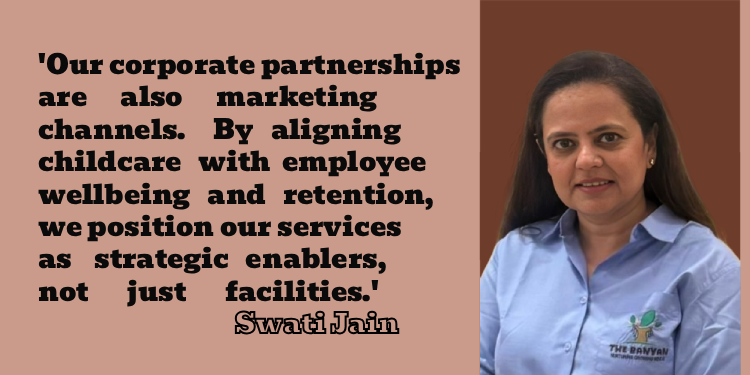
Our corporate partnerships are built on long-term value creation, not transactional arrangements. Going forward, we plan to deepen these relationships by offering customised childcare solutions, data-driven insights, and enhanced employee engagement support.
As organisations increasingly recognise childcare as a strategic enabler of diversity, retention, and productivity, we see ourselves playing a consultative role, not just a service provider.
Q. Are parents who work in media and entertainment companies an important client base?
Yes, they are a very important segment for us. Media and entertainment professionals often work irregular hours, high-pressure schedules, and project-based roles, which makes dependable childcare ever so critical.
Our flexible models, extended care options, and emphasis on emotional security make The Banyan particularly relevant for such families.
Q. What trends do you expect to see when it comes to AI-Powered Personalised Learning in Preschools in the coming five years?
Over the next five years, AI-powered personalised learning in preschools will become far more thoughtful and purpose-driven. In early childhood education, AI will not be about pushing academics earlier, but about understanding each child better such as their pace, interests, emotional needs, and developmental milestones.
One key trend will be AI being used as an insight and observation tool for educators. By analysing patterns in engagement, learning behaviour, and developmental progress, AI can support teachers in tailoring activities to suit individual children, making classrooms more inclusive and responsive. This will be particularly valuable for identifying early developmental needs and ensuring timely, appropriate support.
AI will also strengthen parent-school collaboration. Personalised insights can help parents understand their child’s growth beyond grades, creating greater transparency and trust between families and schools.
Human connection, play, creativity, and emotional security will always remain at the heart of early learning. AI should work quietly in the background, enhancing sensitivity and personalisation, while preserving the joy and warmth that define childhood.
Q. How important will gamification and interactive learning be in shaping the future of the preschool curriculum?
Gamification and interactive learning will play a critical role in shaping the future of preschool education because young children learn best through play, exploration, and engagement. When learning is interactive, children are more curious, confident, and motivated to participate.
It helps in developing essential skills such as problem-solving, collaboration, creativity, and emotional regulation, without the pressure of formal instruction. Importantly, interactive learning also allows educators to observe how children think, respond, and adapt, enabling more personalised support. When designed thoughtfully, gamification does not distract from learning it enhances it, making early education joyful, meaningful, and developmentally appropriate while laying strong foundation.
Q. What role can EdTech play in bridging the gap in Preschool Education?
EdTech can play a meaningful role in bridging gaps in preschool education by improving access, consistency, and quality across diverse settings. It can support teachers through structured training modules, curriculum resources, and assessment tools, especially in regions where skilled educators are limited. For parents, it enables better engagement through regular updates, learning insights, and guidance on reinforcing development at home. Most importantly, when used thoughtfully, EdTech can help personalise learning and identify early developmental needs.
But its also important to acknowledge that its role is more or supportive than substitutive. Technology together with human interaction, play, and emotional connection, can create a lasting impact on early childhood education.
Q. How can technology and innovation enhance the early childhood education sector?
Technology and innovation have the potential to significantly strengthen the early childhood education sector by improving quality, consistency, and reach. When applied thoughtfully, technology can streamline administrative processes, support educator training, and offer valuable insights into children’s developmental progress.
Innovation also enables stronger parent–school partnerships through transparent communication and shared understanding of a child’s growth journey. At the same time, technology can help scale best practices and maintain high standards as the sector expands.
However, it is important to recognise that early learning is deeply human. Technology has the potential to enhance empathy, play, and creativity. At The Banyan, we believe the true impact of innovation lies in striking the right balance: using technology as a quiet enabler while keeping relationships, care, and childhood joy at the centre of everything we do.