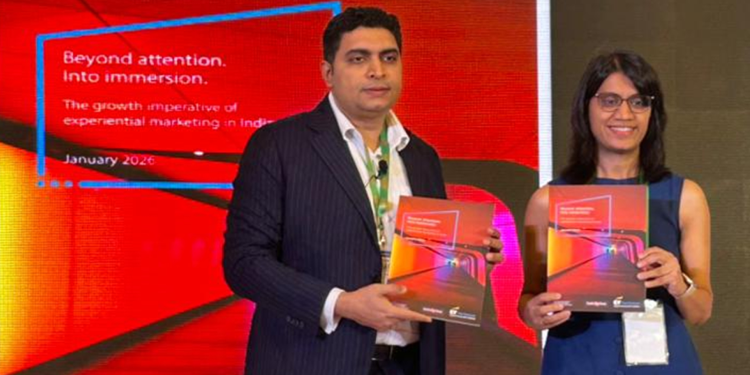
Mumbai: EY-Parthenon and BookMyShow have released a report titled ‘Beyond Attention. Into Immersion’, highlighting the rapid rise of experiential marketing as a strategic growth engine for brands in India. The report underscores how the country’s ₹13,000 crore live events market is reshaping brand engagement, with consumers increasingly favouring immersive experiences over traditional advertising.
According to the report, 59% of live event attendees recall brands they interact with on-ground, while 55% report a higher purchase intent after engaging with brands at events. The findings are based on post-event surveys conducted across 7,450 attendees and indicate that live experiences are emerging as powerful environments for brand engagement, delivering measurable improvements in recall, purchase intent and brand perception.
The study also reveals a broader behavioural shift among consumers, with 78% of Indian consumers stating they prefer spending on experiences over products. This trend is contributing to the growing importance of concerts, festivals, comedy tours and cultural showcases as platforms for brands to connect with audiences through immersive and participation-driven engagement.
Further insights show that 63% of attendees felt brands enhanced their overall event experience, while 29% reported an improvement in brand imagery, suggesting that experiential marketing can strengthen consumer perception and emotional connection with brands.
Commenting on the report, Raghav Anand, Partner and Leader, Media & Entertainment at EY-Parthenon India, said, “As interruption-based advertising loses traction, audience participation is becoming the new currency of relevance. The rising spend, the proven lifts in recall and intent, and the cultural gravitation toward experiences all point to the same conclusion: experiential marketing is now a full-funnel growth engine, not a tactical add-on.”
Samradha Tibrewala, Head – Partnerships and Revenue at BookMyShow, added, “Experiential marketing in India has moved well beyond being a tactical add-on. What we are seeing today is brands investing with far greater intent – looking to build memory, meaning and measurable business outcomes through experiences. Live entertainment offers a uniquely powerful canvas for this, where emotion, attention and participation converge at scale. This report is our attempt to put structure and data behind what the industry is already witnessing on the ground.”
Globally, experiential marketing spending is projected to reach $130 billion by 2025, growing at 10.5%, with 74% of Fortune 1000 marketers planning to increase their experiential budgets. In India, the report notes that more than half of brands have executed experiential activations in the past year, and 88% of those that invested in the category plan to continue doing so in a more structured manner.
Over the past three years, 44% of active brands that increased experiential marketing spend reported up to 30% growth. Brand leaders are increasingly leveraging experiential initiatives to drive brand awareness (67%), product sampling and trial (56%), sales growth (56%) and brand storytelling (44%). However, barriers such as lack of expertise (71%), budget constraints (57%) and measurement challenges (43%) still limit wider adoption.
The report also introduces the Experiential Impact Pyramid, a framework designed to help brands move from audience insights to narrative building, participation and long-term cultural ownership. It encourages marketers to shift focus from impressions to deeper emotional engagement, loyalty and sustained cultural relevance.
The report highlights how brands across sectors such as BFSI, FMCG, beauty, fashion, beverages, mobility and technology are increasingly embedding themselves into live cultural environments. Brands including RuPay, Kotak Mahindra Bank, H&M, Budweiser 0.0, Nivea, Vicks and Nykaa are using experiential platforms to drive brand discovery, community engagement and trial through festivals, curated environments and proprietary IPs such as Nykaaland.
As India’s experiential ecosystem continues to evolve, the report suggests that brands investing consistently in immersive experiences can move beyond visibility to build stronger cultural relevance and long-term consumer loyalty.