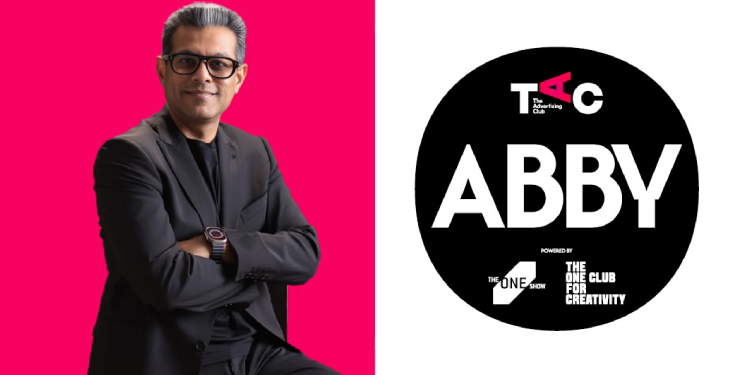
Mumbai: Ahead of Goafest 2026, Dheeraj Sinha shared his vision for the evolution of the ABBY Awards and The Advertising Club, outlining how the 57-year-old awards platform is adapting itself to the rapidly changing advertising and marketing ecosystem.
Speaking during a virtual media interaction, Sinha positioned the ABBY Awards 2026 as a platform balancing “legacy with agility,” while embracing AI, global standards, client inclusion, and emerging marketing disciplines.
According to Sinha, the broader objective is to ensure that The Advertising Club, a 70-year-old institution, remains relevant amid structural shifts reshaping the industry.
“In times of change, when agency structures are changing, when AI is coming in, the Ad Club has to become the beacon for navigating this change,” he said.
A 70-year institution built for the moment
Dheeraj Sinha began by grounding his vision for the ABBY Awards 2026 in the wider mandate he has set for The Advertising Club — one of the longest-standing institutions in Indian advertising, now in its 70th year. That legacy, he said, carries both weight and responsibility.
One of his first moves as President was to reconstitute the Ad Club committee with deliberate diversity. “We’ve got clients on board along with professionals from media platforms, while also retaining all the veterans who got the Ad Club to where it is today,” he said. The intent was to bring a wider, more contemporary set of voices to decisions that shape the industry’s most celebrated awards platform.
From that more diverse foundation, a clear new positioning emerged for the Ad Club: in a period of profound change — agency structures shifting, AI entering every workflow, and the lines between creative, media, content, and technology continuing to blur — the institution’s role is to be a beacon that navigates this change, sparks conversation around it, and builds platforms that help the industry make sense of it. The ABBY Awards, now in their 57th year, are central to that ambition. What Sinha describes as “change with agility” — preserving what makes the ABBYs credible while updating everything that needs updating — underpins every choice made for the 2026 edition.
The five pillars of change at ABBY 2026
AI as a platform partner, not just a subject
For the first time, AI has been embedded into the ABBY Awards infrastructure itself — not merely as a category of work to be recognised, but as a functional participant across submission, judging, tallying, and the awards process. “For me, any award show is only worth as much as its integrity. That is the mark,” Sinha said. “AI is now integrated right from the beginning — part of judging, part of the conversation, part of the award tally and so on.”
New categories built for modern marketing
Following a deep brainstorm with creative leaders across the industry — who were invited to help shape what the ABBYs should look like — the 2026 edition introduces a substantial rearchitecting of the category framework across both Creative and Media ABBYs. On the Creative side, two new digital-led categories have been added: Social Content & Influencer Marketing, which gives dedicated recognition to creator-led and platform-native work for the first time; and Creative Commerce, Use of Data & B2B, which covers commerce-driven creativity, data-informed campaigns, and business-to-business communication. In addition, the former Green ABBY, Red ABBY, and Diversity, Equality & Inclusivity categories have been amalgamated into a single Sustainable Development Goals Abby — a more holistic framework aligned with the UN SDGs that replaces three separate sub-categories with a unified lens on socially purposeful work.
The Media ABBY has seen an equally significant expansion, with four new categories introduced to reflect how media planning and buying has evolved. Innovative Use of Sponsorship and Innovation in Media Buying recognise strategic and structural creativity in how media is purchased and deployed. Two further categories — Innovative Use of AI in Media Planning, and Innovative Use of AI in Media Operations & Content — make the ABBYs among the first major Indian awards to formally recognise AI as a media discipline in its own right. “Some of these categories may be ahead of the curve,” Sinha acknowledged, “but the ABBYs have to be ahead of the curve — and everything else will follow through.”
Client participation made central
Among the clearest signals from the industry brainstorm was a desire to bring clients more meaningfully into the recognition framework. Every award entry this year carries a client credit alongside the agency. More significantly, a Client of the Year award has been introduced for the first time — covering both the Creative and Media ABBYs — recognising the brand whose body of submitted work earns the highest cumulative recognition across the awards. “Any work this industry does is only as good as the needle it moves for the client,” Sinha said. “The intent was to make client participation more inclusive.”
New recognition tiers for the full industry
Alongside Client of the Year, ABBY 2026 introduces a set of network-level and agency-level awards designed to widen the frame of recognition beyond individual campaigns. Creative Network of the Year and Media Network of the Year reward the holding company networks that collectively perform best across their respective award pools. And for agencies that operate outside the network system entirely, an Independent Agency of the Year award has been introduced — ensuring that the growing independent creative and media community has its own podium. “When you introduce network-level awards, smaller agencies ask: what about us?” Sinha said. “So we’ve introduced Independent Agency of the Year as well.”
A genuinely global jury standard
This year’s Creative ABBY jury consists of 243 judges across 22 categories, with 22 jury chairs spanning both Creative and Media. Four international jury chairs join the panel — a record for the ABBYs. All Indian jury chairs have also served on global award juries, and the four international chairs bring that same exposure directly into the ABBY judging room. “My assertion is that what wins at ABBYs also wins globally,” Sinha said. “Indian ideas are now travelling everywhere — and we want our work to be subject to a global benchmark.”
On participation, new categories, and the democratic reach of the ABBYs
When asked about the industry’s response to the newly introduced categories — which together drew 92 shortlists from the creative side and 13 from the media side — Sinha was characteristically clear-eyed. The participation numbers were welcome, but not the primary measure of success. “My idea was to introduce categories which are changing the dynamics of our industry. I’m just happy that we’ve seen participation — but even if we couldn’t, I would still do it. My view is that the Ad Club and the ABBYs have to be ahead of the curve. Sometimes the work will be there, and sometimes it will fall short. But we have to show the light.”
On the question of underserved categories — areas where Indian agencies may be producing strong work but not submitting it for recognition — Sinha pointed to a proactive exercise the Ad Club undertook. Creative leaders from across the top agencies were convened and asked specifically to help identify categories that had lost participation or relevance. The result was a rationalisation rather than an expansion: categories were removed or merged where data showed declining engagement, so that what remains on the table is genuinely well-served by entries.
The participation numbers tell a compelling story of their own. With approximately 300 organisations entering this year — agencies, clients, production houses, data companies, and content studios combined — the ABBYs are reaching well beyond the traditional axis of network creative and media agencies. “Between you and me, we can’t even count so many organisations in our sector,” Sinha said. “To know that around 300 organisations are now part of this — that excites me. That tells you the ABBYs are now genuinely an industry platform, not just an advertising-media-credit platform.” The total entries for the year stand at around 4,000, a figure Sinha noted is broadly consistent with the previous cycle — a sign that participation has held firm despite consolidation across the industry reducing the overall number of operating agencies.
On whether the shortlist is dominated by network agencies or whether independent and homegrown agencies are finding meaningful ground, Sinha was deliberate about the limits of his role. The Ad Club functions as the facilitator of the awards platform — not a participant in its creative judgements. The jury and secretariat handle that process entirely. “The jury chairs would be better placed to comment on patterns in the work and how it is being recognised,” he said.
On global jury chairs and the idea that Indian work travels
One of the more pointed questions put to Sinha concerned the four international jury chairs — and whether bringing in global perspectives risks sidelining Indian cultural nuance in the judging process. His response was a direct statement of creative philosophy. The ABBYs do not brief international jury chairs specifically on Indian context, and Sinha is firm that this is the right call. “My personal belief is that ideas have no boundaries. Ideas are global in nature. If you look at the last few years — the work we’ve done at FCB, at other agencies — those were ideas created for the Indian market, and they went on to win everything globally. Indian ideas are now travelling everywhere. And therefore, we want our ideas to be subjected to a global benchmark.” The jury architecture reflects that belief: 22 Jury Chairs all with global awards experience, and four international chairs who bring that exposure directly into the room.
Sinha was equally clear about the boundaries of his role when the conversation turned to the jury process itself. The Ad Club committee and the ABBYs committee have no access to or involvement in jury deliberations — handled entirely by the secretariat and EY teams. “What I can say is that we’ve received great feedback from the international jury on the level of judging, the quality of entries, and the entire ABBYs platform,” he said. “The fact that they’ve given their time to the ABBYs tells you something about how the platform is valued on a global stage.”
What Goafest 2026 will settle
Across the interaction, a consistent picture takes shape: an institution determined to modernise without surrendering the credibility that 57 years of the ABBYs have built. AI integration, a restructured category architecture, mandatory client credits, new recognition tiers for networks and independents alike, and a 243-strong jury set deliberately to a global standard — these are not cosmetic updates. They reflect a considered attempt to make the ABBYs relevant to the full breadth of what the Indian marketing and communications industry has become in 2026.