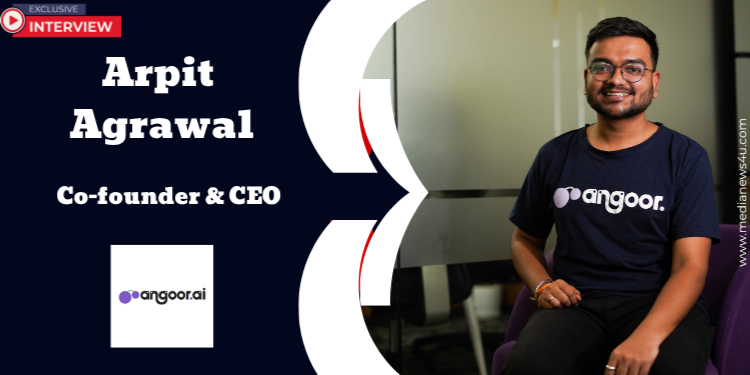
Angoor AI is an Agentic AI-native Customer Interaction Platform that helps businesses automate their customer engagement across different platforms like WhatsApp, Calls, Shopify, Web, Instagram, Email, Messenger, among others. Businesses across verticals such as e-commerce, real estate, consumer electronics, fashion, wellness, and F&B, among others, will benefit from the platform. Some of its clients include Sanfe, InstaAstro, Apps For Bharat, Student Tenant, Rupyz, etc.
It recently raised Rs. 2 Crore in a pre-seed funding round.
The Bengaluru-based startup was founded in Oct 2023 by three IIT Bombay graduates Arpit Agrawal, (Co-Founder and CEO), Anuj Agrawal, (Co-Founder and CTO), and Rishabh Kumar, (Co-Founder and CPO). The recent funding was led by Venturizer and prominent angel investors, including Uday Sodhi, (ex Business Head, SonyLIV, and Co-Founder of Founders Room Capital), Tarun Billa (Tech Lead at JP Morgan, Singapore), and Mayank Singh Tomar.
Medianews4u.com caught up with Angoor AI Co-founder, CEO Arpit Agrawal
Q. Agentic AI Trends in 2026 — How will it help brands communicate more effectively with consumers?
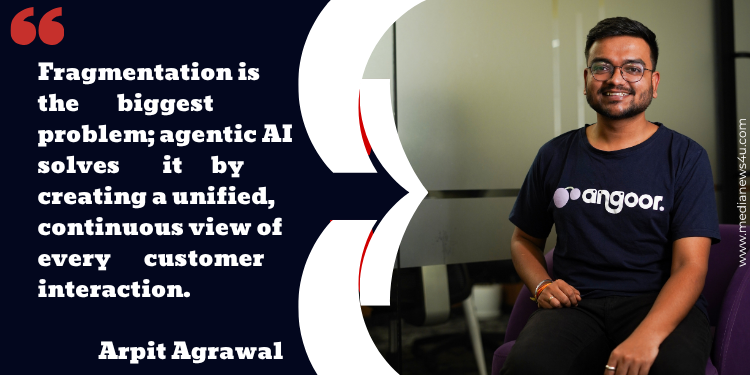
The fundamental problem brands face today isn’t a lack of AI, it’s fragmentation. A customer interacts with a brand on WhatsApp, calls their support line, sends an email, and DMs them on Instagram. Each of these is a disconnected experience. Nobody has a full picture of that customer.
And stitching these channels together with engineering hacks costs money, breaks constantly, and still doesn’t solve the core problem.
2026 is the year centralisation stops being aspirational and becomes table stakes.
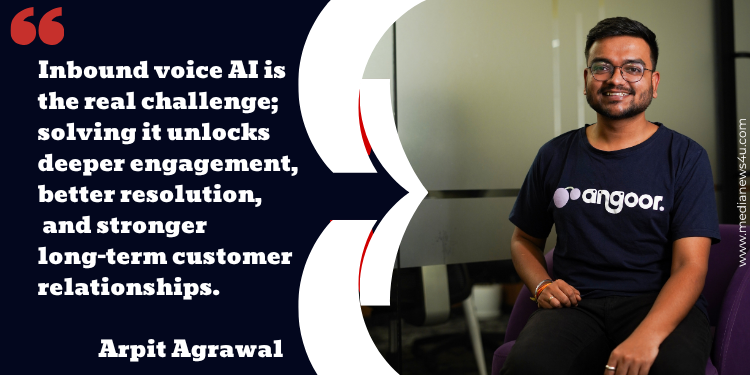
On voice specifically, this is where I see the biggest unsolved gap in the market. Most voice AI built today is designed for outbound: scripted calls, reminders, follow-ups. But inbound is a fundamentally harder problem. A customer calls with an unpredictable query, expects the system to handle context-switches mid-conversation, and wants their issue resolved, not just acknowledged. Very few platforms can actually do this well. And almost none of them are natively integrated with CRM and lead management systems, which means teams are still moving data around in spreadsheets.
The brands that get this right will have a significant competitive advantage. Not just in efficiency, but in trust. Because customers notice when they’re heard. They also notice when they are not.
What’s shifted in our conversations with brands is the expectation. It’s no longer can AI handle this query? It’s can AI handle this query and then trigger the right action, update the order, route to a human, send a follow-up?; That’s the leap from automation to agentic AI, and it’s a meaningful one.
Q. What role will Angoor AI play in this?
We’ve built Angoor around exactly the gaps I just described, not because it was the obvious thing to do, but because we felt the pain ourselves when we tried to find something that already existed.
Our thesis is simple: any consumer-facing interaction you can imagine, voice, WhatsApp, Instagram, email, you should be able to build as a powerful, AI-orchestrated flow without writing integration code or stitching together five different tools. That’s what we are building.
The closest analogy I can give is Gumloop for B2B internal automations. They proved that non-engineers can build sophisticated automation workflows. We want to prove the same for consumer-facing automations, and the complexity there is an order of magnitude higher, because you are dealing with real customers, real emotions, and real brand reputation on the line.
What we are not building is a chatbot company. We’re building the interaction infrastructure that enterprise B2C brands will run their customer operations on. The difference matters.
Q. The company has raised Rs. 2 crores in a pre-seed round led by Venturizer. What are the investors expectations?
The expectation, shared by us and our investors, is to become the infrastructure layer for customer interaction at enterprise B2C brands. Not in one vertical, not in one channel. The whole stack. To be clear, we are not chasing that vision in one leap.
The plan for the next two quarters is very focussed: double down on what is working, ship products fast, and go deep on the customer segments where we have already seen strong early traction. Large enterprises are already trusting us to run sub-verticals for them. That’s a meaningful signal, and we intend to earn more of it.
The Rs. 2 crore is the beginning of a much larger story. But we are building it the right way, proving the product, proving the unit economics, proving the team can execute, before we talk about scale.
Q. The fresh capital will be deployed towards building an enterprise sales function, expanding the product and engineering team. What would all of this entail?
Until now, I have been running sales myself. That is the right thing to do as a founder, you need to understand every objection, every buying signal, every moment where a prospect hesitates. I am glad I did it. But there is a ceiling to what a founder-led sales function can accomplish, especially in a space dominated by seasoned sales professionals who’ve spent decades building relationships in enterprise accounts.
So we are now building a dedicated sales function, people who bring both domain credibility and the hunger to build. We are not just hiring a sales team; we are building a sales machine with clear vertical playbooks across ecommerce, D2C, real estate, student housing, and beyond.
And critically, this frees up Rishabh and Anuj, my co-founders, to do what they do best. We are working at the edge of voice AI and agentic orchestration. That requires deep, uninterrupted focus. The best product decisions come from people who have the space to think, not people who are context-switching between a prospect call and a system design conversation. This capital lets us make that separation properly.
Q. What goals have been set for 2026, and is lack of talent going to be the big challenge in accelerating the company’s path to product-led growth?
Three things define 2026 for us: meaningful expansion of our active client base across India and the UK, building voice AI into a genuinely differentiated product offering, and laying the groundwork for US market entry, properly, not prematurely.
On talent, honestly, I don’t lose sleep over this. We need maybe two more exceptional product owners or engineers to hit our PLG goals. Two. If you are building the right culture and the right community around your company, smart people find you.
We have a rule internally: if five minutes of your time saves someone else thirty minutes, you give those five minutes. No exceptions. It sounds small, but it signals something important, that we are here to build together, not to protect our time or territory. That kind of culture is a talent magnet. It attracts people who want to build, not people who want to manage.
The hiring challenge is always in filtering, finding the right person takes time and discipline. But I have never believed that talent scarcity is a structural problem. It’s an execution problem.
Q. The aim is enabling brands to operate 24×7 without dependence on human availability. How will this deepen customer relationship management by enabling brands to respond to challenges and queries in real time, anytime?
There is a simple truth at the heart of this: it feels good to be heard. And it feels terrible to be ignored.
Brands already know this. The problem is scale. You can’t hire enough people to give every customer a timely, contextual, helpful response across every channel at every hour. So brands end up making a trade-off between speed and quality. AI lets you stop making that trade-off.
But here is what I think people miss about the 24/7 AI narrative, its not just about availability. Its about continuity. A customer’s first WhatsApp message, their support call two weeks later, their product review, their re-purchase, all of that should be connected. Every interaction should be informed by the full history of the relationship. That’s what turns a transaction into a relationship.
What we are building at Angoor is that continuity layer, bringing all of a customers data and interactions under one roof, so that every touchpoint is smarter than the last. That’s where the real value is.
Q. As Angoor AI increasingly helps brands with automation, will the function of the marketer undergo a structural shift, as what will be optimised is also going to be a part of what was called strategy?
I want to be direct about something: performance marketing is complementary to what we do. Our product kicks in after the marketing has done its job, we are at the interaction layer, not the acquisition layer. So I will be careful not to overstate our view here; some of our fellow founders working in performance marketing, like the team at getCrux, are far closer to that structural shift and would have sharper insights than me.
What I do believe, more broadly, is this: the winners in an AI-enabled world are not the ones with the best tools. They are the ones who understand their brand and their customers most deeply. I often think of it this way, Verstappen in a Wagon R would still beat me in an F1 car. The car amplifies the driver’s skill; it doesn’t create it.
Agentic AI in marketing works the same way. It amplifies your thinking, your nuance, your customer understanding, it doesn’t replace it. The marketers who treat AI as a lever for their own strategic judgment will outperform the ones who outsource their thinking to it.
Q. Does Angoor AI work closely with product development teams at companies like WhatsApp, Instagram, Messenger to understand how they are advancing features for businesses, so that it can stay prepared well in advance?
We stay very close to platform roadmaps, through official business solution provider channels, developer documentation, beta access where we can get it, and active participation in developer communities. Meta’s Business Messaging platform, for instance, has moved rapidly: interactive templates, flows, payments, increasingly sophisticated automation APIs.
We track all of it. To be transparent, a formal, direct relationship with platform product teams at that level is something we are still building toward as we grow. We are not there yet. But what we have invested in heavily is architectural agility. Our platform is built to be provider-agnostic, which means when
WhatsApp introduces a new interactive component or Instagram opens a new API surface, we can integrate it quickly without rebuilding our core infrastructure.
We also watch what developer communities are building on top of these platforms. That typically signals where the platforms themselves are heading six to twelve months out.
Q. Could you talk about work done with B2C and D2C brands across India and the UK that stands out?
A few cases represent the breadth of what the platform can do.
Sanfe, a leading D2C wellness brand in India, deployed Angoor for customer support across email, Messenger, and Instagram. The agent handles everything from order queries and returns to sensitive, nuanced product-related questions.
First-response times have dropped significantly, and a meaningful share of tickets are now fully resolved without any human involvement. We’re now extending into voice flows and order updates with them.
StudentTenant and FitProperty, two student accommodation platforms in the UK, use our AI agent Sage for lead qualification. Prospective tenants are engaged, qualified, and moved through the funnel around the clock. In the UK student housing market, with its time-zone complexity and high inquiry volumes, always-on AI isn’t a nice-to-have. It’s the only way to operate at scale.
Insta Astro is a different kind of use case. We are handling a multimillion-strong customer base discovering services on WhatsApp and Instagram, orchestrating demos and connecting users with astrologers directly on their devices. It shows the versatility of the platform. Agentic AI doesn’t just work for returns and support tickets; it works anywhere a meaningful interaction needs to happen.
Q. Consumers increasingly use AI tools for product discovery in categories like travel. What opportunities does this unlock for Angoor AI?
We are genuinely excited about this space, but I want to be honest about an inherent limitation that doesn’t get talked about enough: a brands AI agent will never recommend a competitor’s product, even if that competitor’s product is better suited to the customer. That is the structural constraint of
brand-owned AI. Customers sense it. It limits trust.
So the real opportunity isn’t to make brand agents more exploratory. It’s to make them more precise. Recommended carts based on a users specific purchase history. A real estate platform that finds apartments matching hyper-specific requirements, a building with a pool table, a pet-friendly policy, proximity to a specific university. These are contexts where an AI agent that genuinely knows the customer’s preferences adds real value, not just noise.
Our view is that AI agents shine at two extremes: genuine discovery, helping a customer find something they didn’t know they wanted, and high-precision execution, completing complex tasks with accuracy and speed. The middle ground, passive browsing and soft recommendations, feels transactional and customers can tell the difference.
Looking further ahead, providing MCP layers that allow external consumer AI agents to access brand catalogues and inventory, enabling discovery through tools the customer already trusts, is a significant strategic frontier for us. That’s where brand presence in the next generation of customer journeys will be built.
Q. Is email still relevant as a communications tool?
Absolutely. The reports of email’s death have been greatly exaggerated.
Email works best for what it was always good at: formal communications, important notifications, follow-ups that require a record. It’s cost-effective, the interface is entirely within the brand’s control, and it’s still the highest-fidelity channel for personalised campaigns.
The challenge is that most brands, particularly outside the US, have lost the discipline around email. Deliverability has eroded. Open rates have declined. That’s not an email problem; that’s a misuse problem.
What we want to help brands do is reclaim email for the right use cases, solving customer queries, delivering updates that matter, not blasting promotions nobody asked for. There is also a structural role email plays that gets undervalued: it’s the final leg of a multi-channel flow. You send an AI-driven voice call. You follow up on WhatsApp. When all of that goes unanswered, email holds the context and ensures the customer still has a record of the interaction. It’s the safety net of the communication stack. You don’t want to be without it.
Q. In an increasingly competitive market, are the brands that will win the ones who offer customers a seamless experience?
Yes, and this isn’t just a philosophy, it’s a business outcome. Customer experience drives customer loyalty. Customer loyalty is what determines whether a B2C brand has a sustainable business or a leaky bucket. Every point of friction in the customer experience is a churn event waiting to happen.
The brands that take this seriously, and invest in removing that friction consistently, will compound their advantage over time. The ones that treat customer experience as a cost centre will keep losing customers to the ones that don’t.
Q. How will Voice transform search marketing in 2026? Is people using two languages in queries (like English and Hindi) an issue?
Outbound voice AI and search marketing share very little in their underlying mechanics, in my view. Search is exploratory and intent-driven, the customer comes with a query. Outbound voice is direct and outcome-driven, you are initiating a conversation with a specific purpose.
The skills that make a great search marketer don’t automatically translate here.
What they share, though, is this: if you don’t know your customer, you are wasting everyone’s time.
Exploratory AI cold calls have low success rates. The brands that win with voice AI are the ones that have done the segmentation work, they know exactly which customer to call, why, and when. That customer intent intelligence is what separates high-performing voice programmes from expensive experiments.
On the language question, Hindi-English code-switching is largely solved at this point. The frontier models we use handle it well, and we maintain direct feedback loops with our model providers to flag performance gaps in real-world conversations. Regional languages are still catching up, and that’s an honest limitation of the ecosystem right now, not just our platform.
What I’d point to as our competitive advantage is the orchestration layer we’ve built on top of these models. Using the same underlying models, you can build meaningfully smarter agents on our platform than the industry standard. That’s not the model doing the work, that’s the infrastructure and process we’ve built around it.
Q. Could you shed light on expansion plans in the US?
The US is on our roadmap, and we’re approaching it deliberately. The B2C market there, particularly in ecommerce, D2C, and services, is mature and competitive. Entering it prematurely, without the right product maturity, compliance infrastructure, and channel integrations, is a fast way to waste capital and damage the brand.
We’ve seen enough startups make that mistake. Our approach is vertical-focussed entry. We’ll go into the US in the categories where we’ve already built strong, proven outcomes in India and the UK, not trying to be everything to everyone from day one. We are currently in conversations with potential US partners and using 2026 to build the right foundations: data residency, regulatory compliance, and US-specific integrations.
The goal is a credible US presence by late Q3 2026. Credible being the key word, we would rather enter once, properly, than rush in and retreat.