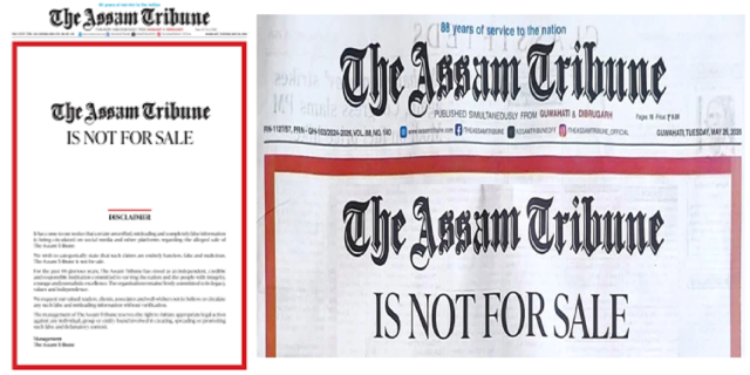
Guwahati: One of Northeast India’s most respected newspaper institutions, The Assam Tribune, has found itself at the centre of intense public discussion after publishing an unusual front-page advertisement declaring that the newspaper is “not for sale.”
The full-page advertisement, carried on May 26, 2026, sought to counter widespread social media speculation that the 88-year-old media house was being acquired by billionaire industrialist Gautam Adani-led Adani Group for an estimated ₹421 crore. While the management described the move as a necessary clarification, media observers questioned the decision to devote the newspaper’s most valuable editorial space to address what it termed “baseless rumours.”
The advertisement emphatically stated, “THE ASSAM TRIBUNE IS NOT FOR SALE,” while reaffirming the publication’s commitment to independent journalism and warning of legal action against individuals or groups allegedly involved in spreading defamatory content.
Earlier, through its verified social media channels, the newspaper had criticised the rapid spread of unverified reports, noting that the speculation had been amplified by prominent personalities and even some media outlets without credible sourcing or official confirmation.
“For nearly nine decades, The Assam Tribune has remained committed to preserving the trust of its readers,” the publication said, adding that unverified speculation was increasingly being repackaged as news in the age of social media.
Rumours Amid Financial Distress
The sale rumours emerged against the backdrop of growing concerns about the financial health of the Guwahati-based media group. Several social media users linked the alleged sale discussions to reports of delayed salary payments and pending retirement benefits owed to former employees.
The Assam Tribune Employees’ Union has, over the past year, publicly highlighted delays in salary disbursements and post-retirement settlements. The union organised demonstrations and press conferences, alleging that substantial government advertising dues remained unpaid by Assam’s Information and Public Relations Department.
The management has also acknowledged the existence of pending government dues and expressed hope for their early release.
Legacy Institution Faces Industry Headwinds
Founded in 1939 by noted Assamese entrepreneur Radha Govinda Baruah, The Assam Tribune remains the oldest and most influential English-language newspaper in Northeast India. Initially launched as a weekly from Dibrugarh, it shifted to Guwahati and became a daily publication in 1946.
Over nearly nine decades, the newspaper has chronicled many of Assam’s defining political and social developments, including the language movement, anti-illegal immigration agitations, insurgency-related conflicts, and the rise of regional political forces.
The newspaper’s stature was reflected in visits by two Prime Ministers during milestone celebrations. Former Prime Minister Atal Bihari Vajpayee attended its diamond jubilee event in 1999, while Prime Minister Narendra Modi participated in its platinum jubilee celebrations in 2014.
Restructuring and Labour Disputes
The group’s challenges became more visible in September 2025 when the management transferred the operations of its Assamese-language daily Dainik Asom to another media entrepreneur. The new operator reportedly declined responsibility for more than 75 employees associated with the publication, leaving the existing management responsible for settling their dues.
With payments remaining unresolved, affected employees approached the courts. Recent legal proceedings reportedly directed the management to clear the outstanding dues.
The Tribune Group had earlier discontinued its long-running Assamese weekly Asom Bani, effectively merging it into Dainik Asom as a Sunday supplement before the publication ceased operations. The closure occurred without any formal public announcement from the management, drawing criticism from sections of the media community.
A Changing Media Landscape
Like many regional newspaper organisations across India, The Assam Tribune has faced significant commercial pressures since the Covid-19 pandemic. Falling circulation numbers, migration of advertising spending to digital platforms, and rising operational costs have reshaped the economics of the newspaper business.
Industry observers note that while the publication continues to command considerable goodwill and brand equity across Northeast India, sustaining traditional newspaper operations has become increasingly challenging in a rapidly evolving media environment.
The recent front-page declaration may have successfully dispelled immediate sale rumours, but it has also drawn attention to larger questions about the future sustainability of legacy newspaper institutions. For many readers and industry stakeholders, the focus now shifts from ownership speculation to whether one of India’s most respected regional media brands can navigate its financial and operational challenges while preserving its long-standing editorial credibility.
(MediaNews4U News Desk with inputs from NJ Thakuria)