With consumer behaviour becoming increasingly fluid across search, social, commerce, content and AI-powered interfaces, businesses are being compelled to rethink not only their marketing strategies but also the way they organise data, technology, creativity and customer experiences.
As LS Digital completes 20 years in the industry, the company is marking its own transformation—from a performance marketing-focused agency into an integrated, AI-native digital business transformation group. Over the years, LS Digital has expanded across media, creative, customer experience, UI/UX, data and technology, mirroring the industry’s evolution from siloed service models to interconnected intelligence ecosystems designed to solve complex business challenges.
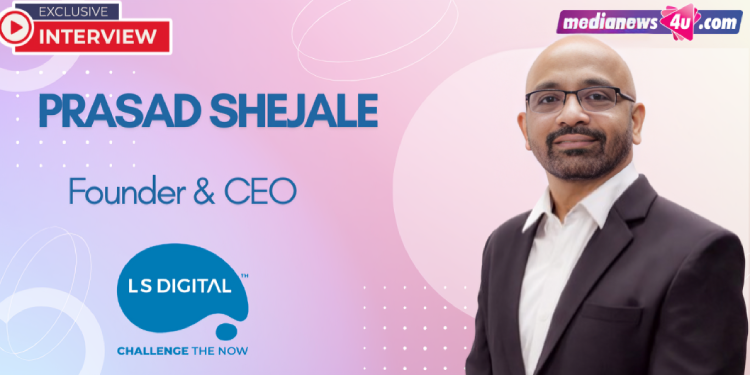
In an exclusive interaction with MediaNews4U, Prasad Shejale, Founder & CEO, LS Digital, reflects on the strategic decisions that shaped the company’s journey, the growing convergence of media, creative, data and technology, and why he believes AI must evolve from a productivity tool into a foundational operating layer for organisations. He also shares his perspectives on changing consumer behaviour, the future of performance marketing, global expansion, leadership, and LS Digital’s ambition to build a globally competitive company from India.
1. Looking back, what were the most important strategic decisions that enabled LS Digital to evolve from a performance marketing specialist into a full-stack digital business transformation group?
Prasad: The journey was shaped by a series of strategic pivots over two decades. One of the earliest and most important decisions came around 2011–12, when we consciously moved away from a cost-arbitrage model that served small and medium-sized UK clients. While that model was working, we believed India’s digital economy would become a far bigger opportunity. We chose to focus on larger Indian enterprises, which fundamentally changed the type of talent, services, systems, and processes we built.
Another major turning point came when nearly 90% of our revenue was coming from affiliate marketing. While profitable, I realised affiliate relationships were largely transactional and would not earn us a strategic seat at the table with business leaders. We therefore made the difficult decision to exit affiliate marketing and focus on performance-led digital transformation. It was a risky move, but it opened doors to larger enterprise accounts, particularly in BFSI.
As consumer behaviour evolved, we recognised that solving only the bottom-of-the-funnel challenge was insufficient. Brands needed full-funnel solutions. That led us to build capabilities across media, creative, UI/UX, data, customer experience, and technology. Where we lacked expertise, we acquired companies such as F1Studioz for UI/UX, Social Panga for creative, and Langoor for technology and customer experience, while building DataQuark as our data and insights business.
At every stage, our evolution was driven by understanding customer pain points, anticipating future trends, and building the capabilities necessary to remain relevant. Today, that same philosophy is guiding our AI-native transformation.
2. How do you see the convergence of Media, Creative, Data and Technology changing organisational structures inside both agencies and client organisations?
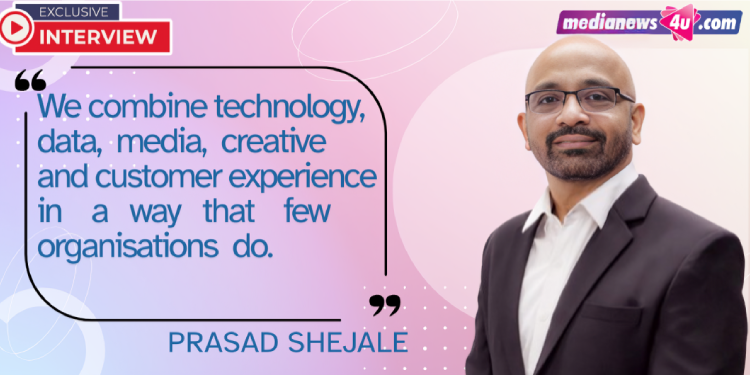
Prasad: This convergence presents one of the biggest organisational challenges because each discipline requires very different skills, mindsets, and training. Media, creative, data, and technology specialists are fundamentally different professionals. Expecting one person to master all four disciplines is unrealistic.
Our approach has been to maintain deep vertical expertise while introducing a horizontal consulting layer. Specialists continue to excel within their domains, but we have built a layer of consultants and client leaders who understand business problems across multiple disciplines and can orchestrate integrated solutions.
We have embedded this philosophy into our organisational structure, training programs, and KPIs. These teams are encouraged to identify customer problems that require multiple services working together rather than operating in silos.
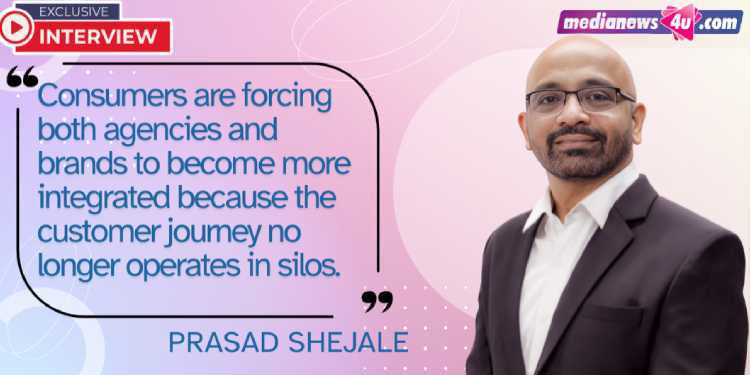
On the client side, many organisations still have separate decision-makers for branding, media, digital, technology, and data. However, post-pandemic, boards and CXOs increasingly recognise that consumer journeys no longer fit into siloed structures. This has accelerated collaboration between agencies and clients.
Ultimately, the convergence of these disciplines is being driven by changing consumer behaviour. Customers move rapidly from awareness to action, and brands no longer have the luxury of managing disconnected functions. Agencies and brands alike are being compelled to adopt more integrated operating models.
3. Many organisations still view AI as a tool or productivity layer. You have spoken about becoming an AI-native organisation. What does that distinction mean in practical business terms?
Prasad: The fundamental difference lies in whether AI is being added to existing workflows
or whether workflows are being redesigned with AI at the centre.
Many organisations view AI as an additional productivity layer. They provide employees with AI tools but continue operating with the same processes and structures. In contrast, becoming AI-native means rebuilding workflows around AI as the core intelligence layer. This requires a significant cultural and organisational shift. It is not about sprinkling AI across existing operations; it is about reimagining how work gets done when AI becomes an integral part of decision-making, execution, and optimisation.
The transition is challenging, particularly for larger organisations, because it requires changes
in mindset, structure, and ways of working. However, the distinction between AI-assisted and
AI-native organisations will become increasingly important as businesses seek sustainable
competitive advantages.
4. Consumer journeys today span search, social, commerce, content, AI assistants and owned channels. How should marketers rethink consumer engagement in this fragmented environment?
Prasad: Consumers do not think in terms of channels. They experience a single journey while moving through what is often called the “messy middle”—a phase where they continually evaluate options, compare alternatives, and seek reassurance before making a decision.
The key to managing this fragmentation lies in data infrastructure. Brands need the ability to capture, unify, and analyse consumer signals across touchpoints. The more effectively a brand can identify and connect these interactions, the better it can understand consumer intent.
For example, we worked with a leading life insurance company where we identified 39 different behavioural parameters across the customer journey. By integrating data from multiple systems and applying advanced analytics, we were able to create highly specific consumer cohorts and develop tailored engagement strategies.
At the same time, AI is beginning to reshape the messy middle itself. Increasingly, consumers are using AI assistants to answer questions, evaluate products, and narrow choices. This means brands must optimise not only for search engines but also for AI-driven discovery environments. Understanding consumer queries and ensuring AI systems can accurately surface relevant information about a brand will become a critical marketing capability.
5. Are brands adequately prepared for a future where AI agents may become the primary interface between consumers and businesses?
Prasad: Readiness varies significantly. Some organisations are moving quickly and experimenting aggressively, while others remain cautious due to uncertainty, costs, and the rapid pace of technological change.
The challenge is that AI is evolving faster than many organisations can adapt. There is considerable confusion around technologies, investment requirements, implementation models, and long-term implications.
At the same time, consumers are adopting AI tools much faster than enterprises. Whether in developed or emerging markets, consumers are increasingly using AI to simplify decision-making and access information more efficiently.
As a result, organisations must build lean, agile teams that can experiment quickly, learn continuously, and adapt their strategies. Becoming AI-ready is not a one-time initiative but an ongoing transformation journey. Agencies have an important role to play in helping brands navigate this transition.
6. As AI increasingly mediates consumer discovery and decision-making, what happens to traditional performance marketing models?
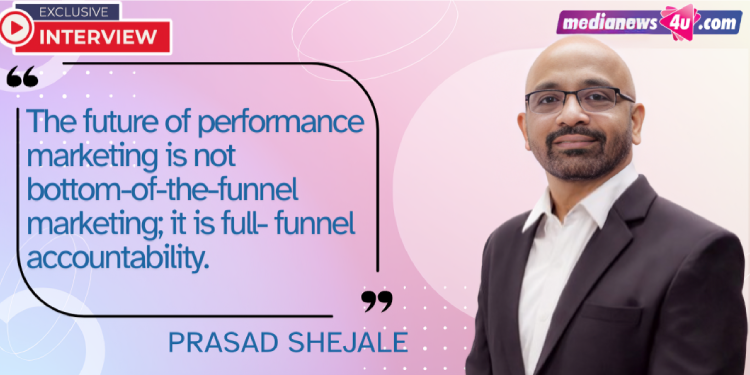
Prasad: The concept of performance marketing itself needs to evolve. Historically, performance marketing has often been associated with bottom-of-the-funnel activities where consumers have already expressed intent. However, every marketing activity should ultimately be measurable and accountable for outcomes.
As AI transforms discovery and decision-making, performance marketing will become a full-funnel discipline. Every marketing investment—whether at the awareness, consideration, or conversion stage—will need to demonstrate measurable impact.
The future lies in integrating brand-building and performance metrics rather than treating them as separate disciplines. AI will enable marketers to connect actions across the entire consumer journey, making full-funnel measurement both possible and necessary.
7. LS Digital has expanded significantly across multiple business verticals. Which areas are currently driving the strongest growth and why?
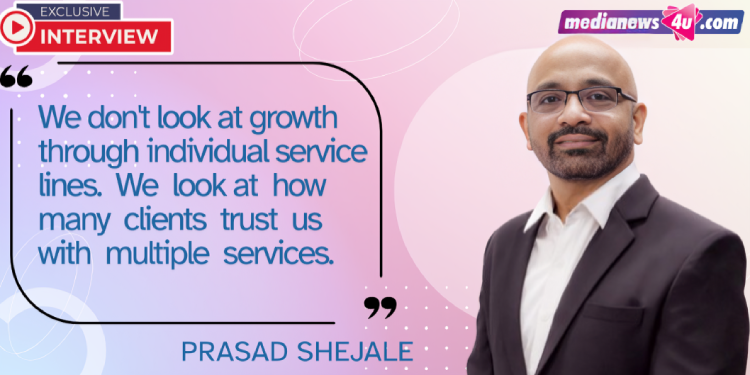
Prasad: Rather than measuring growth by individual service lines, we focus on integrated client relationships.
Today, nearly 70% of our 300-plus active clients use more than two services from LS Digital. More importantly, over 90% of new client acquisitions during the past year engaged us across multiple service areas.
Our strategy is increasingly centred around integrated problem-solving. Marketing challenges today require a combination of media, creative, data, technology, and customer experience capabilities working together. As a result, the strongest growth is coming from integrated engagements rather than standalone services.
Our KPI is not simply revenue by vertical but the number of clients adopting multiple services. Last year, our benchmark was two or more services; this year, we are aiming for three or more. This integrated model is growing significantly faster than individual business lines.
8. How do you position LS Digital relative to global advertising networks such as WPP, Publicis, and Omnicom?
Prasad: Rather than comparing ourselves directly with traditional holding companies, we see ourselves occupying a unique position between global consulting firms and advertising networks.
At one end of the spectrum are systems integrators and technology consulting companies such as Infosys and Accenture. At the other end are media and creative-led advertising holding companies. LS Digital operates in the middle, combining expertise across technology, data, media, creative, and customer experience.
Our positioning reflects the belief that modern business problems require a blend of consulting, technology, data, and marketing capabilities. If I were to identify a global comparable, it would be closer to Accenture than a traditional advertising network.
9. Having successfully balanced organic growth with strategic acquisitions, what will be the key drivers of LS Digital’s next phase of expansion, and how do you view capital deployment, potential funding options, and M&A as part of that growth strategy?
Prasad: Our future growth strategy rests on three pillars.
First, we want to accelerate both new business acquisition and expansion within existing accounts by offering integrated solutions to increasingly complex business problems.
Second, international expansion remains a significant growth opportunity. We have successfully integrated our six divisions, and now the focus is on scaling those capabilities across global markets.
Third, we will continue pursuing strategic acquisitions. We actively seek founders who share our vision of building a globally respected company originating from India. Cultural alignment and long-term commitment are far more important to us than transactional acquisitions.
From a capital perspective, we remain a zero-debt company with strong cash reserves. We have sufficient resources to pursue selected acquisitions independently. For larger opportunities, options such as debt financing or private equity remain available.
As for an IPO, it is certainly part of the long-term vision. For us, an IPO is not an exit strategy; it is an entry point into becoming a truly global company. It represents an opportunity to bring retail investors into our growth story and support our ambitions of competing on the global stage.
10. LS Digital has steadily expanded its international footprint over the years. What have been the most important learnings from operating across multiple markets with different levels of digital maturity?
Prasad: Every market is different, and success depends on identifying the right product-market fit.
Our approach is to enter a market with a small number of carefully selected services, test demand, gather feedback, and then scale the offerings that resonate most strongly.
For example, our Middle East business has been growing rapidly, while in the United States we are seeing strong traction for data-driven solutions. In Europe, geo-targeting and UI/UX services have performed particularly well.
The lesson is that no two markets are identical. Rather than attempting to sell every service everywhere, we focus on identifying the capabilities most relevant to each region and using those as entry points before expanding into broader engagements.
11. If LS Digital’s first 20 years were about helping businesses navigate digital transformation, what will its next 20 years be about?
Prasad: The next phase is about becoming a truly global organisation.
The first 20 years were spent building capabilities and assembling the right combination of services. The next 20 years will be focused on competing globally, winning larger enterprise accounts, and operating at a scale comparable to leading international consulting and technology firms.
This requires a significant evolution in culture, talent, operating models, and ambition. We need to think exponentially bigger, attract world-class talent, and develop consulting and technology capabilities that can compete at the highest levels globally.
It is a very different challenge, but one we are excited to pursue.
12. How has your own leadership philosophy evolved over the last 20 years?
Prasad: The biggest change has been moving from personally solving problems to enabling others to solve them.
Twenty years ago, my instinct was to jump into every challenge and work alongside the team to find solutions. Today, leadership is more about defining a clear vision, creating alignment, inspiring people, and empowering them to execute.
As organisations grow, it becomes impossible for a founder to personally solve every problem. The challenge is learning to trust others, navigate uncertainty, and build teams capable of achieving ambitious goals.
I often reflect on the saying: “If you want to go fast, go alone. If you want to go far, go together.” In today’s rapidly changing environment, success depends on bringing people along, helping them see the opportunity, and enabling them to contribute meaningfully to the journey.