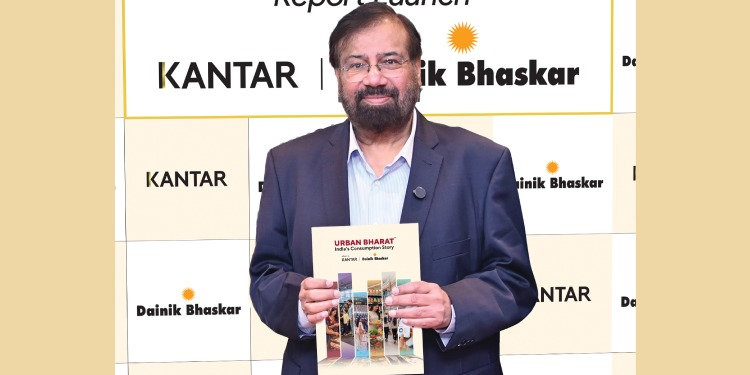
Mumbai: Harsh Goenka, Chairman of RPG Enterprises, on Tuesday unveiled the Urban Bharat – India’s Consumption Story Report, a joint study by Dainik Bhaskar Group and Kantar that highlights the growing role of Tier-2 and Tier-3 cities in driving India’s next phase of consumption-led growth.
The report presents an in-depth analysis of changing consumer behaviour across Urban Bharat, highlighting how rising aspirations, increasing affluence, evolving lifestyles and digital adoption are reshaping consumption patterns beyond the country’s metropolitan centres. It is designed to help brands, marketers, media planners, agencies, investors and policymakers make more informed, data-driven decisions.
The study tracks consumption trends across 11 high-growth sectors—automobile, personal finance, e-commerce, education, FMCG, healthcare, jewellery, real estate, retail, telecom, and travel & tourism—and points to a transition from need-based purchases to aspiration-led, branded and premium consumption.
A key feature of the report is the Urban Bharat City Opportunity Index, which ranks the top 50 cities best positioned to drive India’s next wave of consumption growth. The index aims to provide businesses with credible market intelligence to support investment and marketing decisions.
Speaking at the launch, Harsh Goenka, Chairman, RPG Enterprises, said, “Our attention is often confined to metro cities like Bengaluru, Delhi and Mumbai, but the real aspirational India lies beyond these metros—in Tier-2 and Tier-3 cities. The market has long suffered from a lack of authentic data, making it difficult for businesses to formulate effective strategies. This research report will be a significant asset for the entire marketing community. Instead of relying on assumptions, marketers will now be able to make decisions based on credible data points, enabling them to better understand and unlock the immense potential of Tier-2 and Tier-3 markets.”

Girish Agarwal, Director, Dainik Bhaskar Group, said, “For years, marketers have looked at Bharat through the lens of metro India, often relying on assumptions due to the absence of credible market intelligence. That reality has changed. Today, cities like Jaipur, Lucknow, Surat and Indore are emerging as powerful consumption hubs. Consumers across Tier-2 and Tier-3 India are highly aspirational, digitally connected and increasingly willing to spend across categories. Through this joint initiative with Kantar, our objective is to equip marketers, media planners and businesses with robust insights that help them identify where India’s next phase of growth will come from.”

Biswapriya Bhattacharya, Director – B2B & Technology, Kantar, said, “In recent years, 76% of the growth in India’s affluent population has come from Urban Bharat. More importantly, 60% of this affluent population is below the age of 35. This young demographic is in its peak earning and spending years and is actively driving India’s new consumption economy. These insights reaffirm why brands must increasingly look beyond the metros to unlock future growth.”
Among the report’s key findings, nearly one in three urban Indians now lives in Urban Bharat, making it one of the country’s largest and fastest-growing consumption markets. The affluent population in these cities has grown by 76% over the past six years, with nearly 60% of residents below the age of 35.
The report also notes that premiumisation is accelerating outside metro markets, with affluent (NCCS A) households increasing from 26% to 41% over six years. Digital payments, online banking, investments and e-commerce have become mainstream, with one in three consumers now shopping online. Additionally, more than 27% of households spend over 10% of their income on education, reflecting growing aspirations and increased willingness to invest in quality.
According to the report, Urban Bharat has evolved from being a peripheral market to becoming a parallel—and in several sectors, faster-growing—engine of India’s consumption economy. It concludes that businesses seeking long-term growth will increasingly need to focus on emerging urban centres, supported by data-driven market insights rather than conventional assumptions.