In a medium long dominated by impressions and reach, Out-of-Home (OOH) advertising is undergoing a paradigm shift. OSMO, one of India’s fastest-growing OOH agencies, is pioneering this transition with LOC8 — an AI + Human Vision Cognition platform that measures real attention in real time.
In conversation with MediaNews4U, Mangesh Shinde, Co-Founder of OSMO, discusses how LOC8 aims to redefine accountability and performance measurement in OOH.
Q) For decades, OOH has been measured in impressions and reach. From your perspective, why have these metrics fallen short in truly capturing impact?
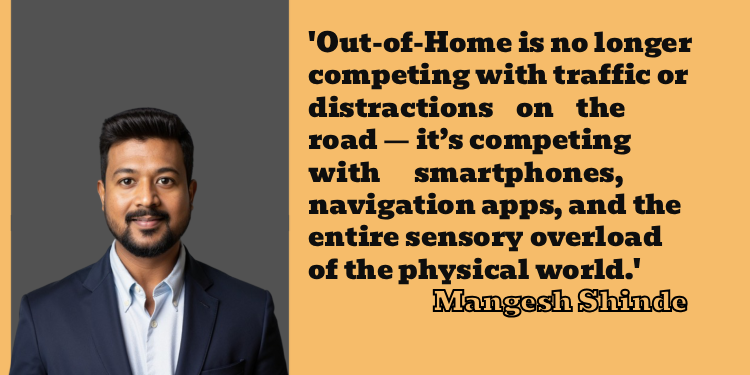
Mangesh Shinde: In the past few years, consumer attention has become increasingly fragmented across multiple platforms and channels — from television and print to digital publishers. Out-of-Home is not merely competing with traffic or environmental distractions anymore; it’s competing with smartphones, navigation apps, and the entire sensory overload of the physical world.
While impressions and location data are important, they no longer tell the complete story. The most fundamental metric that has emerged globally is attention. Brands are shifting from an impression-based economy to an attention-based one — because higher attention directly correlates with higher brand recall and stronger business outcomes.
However, until now, there hasn’t been a way to measure attention in the OOH space. That’s precisely where LOC8 comes in. Our platform analyses roadside and ambient videos using a machine learning engine to not only detect OOH sites but also generate detailed attention metrics such as dwell time, perceptual size, distance from the road centre, and even visibility for front or rear passengers.
By integrating this with live traffic data, LOC8 doesn’t just answer “how many people saw it” — it answers “will this campaign be noticed, and by how much?”
 Q) LOC8 positions itself as moving the narrative from “reach” to “attention.” How exactly does the tool quantify real human attention?
Mangesh Shinde: We have built LOC8 by combining AI with human vision cognition — the science of how people perceive and notice visual stimuli in the real world. We capture and upload video footage of road segments, then analyze these using models trained on how the human eye and brain interact with outdoor visuals while driving or commuting.
Several proven factors contribute to visibility: contrast ratios, size of the display, and whether the asset falls within the natural field of vision. We’ve integrated all these parameters into our system so that the platform can predict whether a given OOH asset will be noticed, and to what degree.
It’s important to note that LOC8 does not seek to replace existing OOH metrics like impressions or reach. Rather, it introduces a new dimension of measurement — attention metrics that complement the industry’s current data ecosystem, enriching planning and performance evaluation with a far more accurate indicator of campaign effectiveness.
Q) You are talking about OOH. Does that mean the tool also covers DOOH and ambient media?
Mangesh Shinde: Absolutely. The training dataset used to build our machine learning model includes ambient environments, digital OOH screens, and all traditional outdoor formats. Whether it’s an airport lounge, a shopping mall, or a roadside hoarding — static or digital — LOC8 can process the video data and deliver consistent, actionable metrics across all environments.
Our vision is to create a unified framework for attention measurement that spans every form of outdoor advertising, providing brands with true accountability for every rupee spent.
Q) Can you walk us through the science behind LOC8’s AI + Human Vision Cognition engine? What makes it different from traditional traffic or footfall-based measurement systems?
Mangesh Shinde: Let me illustrate this with a few examples — say CyberHub in Gurgaon, or Bandra Kurla Complex and Worli in Mumbai. Each of these locations has both static and digital OOH formats. While traffic volumes may vary across these locations, the positioning of each site — how close or far it is from the road, whether it sits at the foot of a bridge, its angle, size, and the presence of obstructions such as trees or other hoardings — plays a decisive role in determining impact.
Our system factors in all of these real-world physical parameters. It even analyses vehicle speed, because at 4 km/h in dense traffic you spend far more time within a site’s visual zone than when driving at 100 km/h on a highway. LOC8’s algorithm processes this environmental data to calculate the likelihood of an OOH asset being noticed.
We combine human vision cognition — how people naturally perceive objects in motion and contrast — with computer vision models trained through extensive datasets. This hybrid of cognitive science and machine learning allows LOC8 to measure true visibility, not just theoretical exposure. In short, it’s an intelligent blend of data science and perception modelling, calibrated through continuous hyperparameter tuning.
 Q) Many agencies claim to use AI for targeting or optimization. How does LOC8 stand apart in terms of proprietary technology and real-time insights?
Mangesh Shinde: The key differentiator lies in the type of data and the objective we focus on. Most platforms still operate within a traditional framework of impressions, reach, and frequency — essentially, number-based planning. For example, you might be told that a particular stretch of road delivers 50 million impressions in a month. But if there are 20 billboards on that stretch, do all of them truly deliver the same visibility?
LOC8 answers that second, far more critical question: which specific asset truly captures attention. Our platform evaluates visibility and attention likelihood for each site individually, helping brands identify the most impactful locations.
We approach OOH campaigns from an objective-based lens — driving awareness, building familiarity, and achieving a higher share of mind. Those outcomes are only possible when your creative is actually noticed. That’s why we focus on attention-led metrics rather than purely exposure-led ones. This is what makes LOC8 stand apart in a marketplace still dominated by volume-based metrics.
Q) With marketing budgets under pressure, how do you see LOC8 giving brands tangible proof of ROI on their OOH spends?
Mangesh Shinde: I’d divide that into two parts.
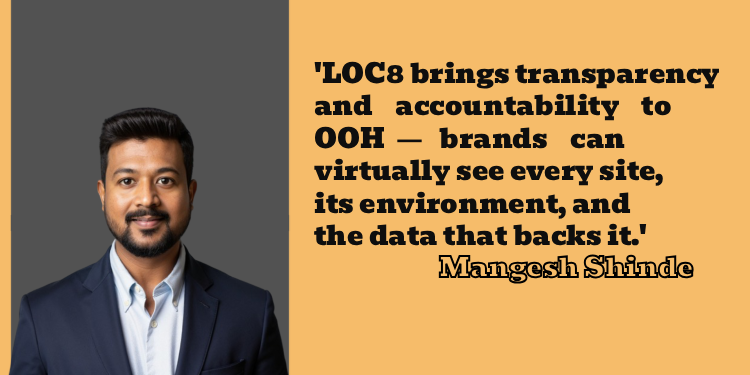
First, LOC8 provides transparency and accountability. The platform allows brands to virtually experience the entire roadside environment — not just static images — while accessing data points on each site’s visibility, dwell time, and obstructions. This enables informed decision-making and helps advertisers optimize their spends more efficiently.
Second, technology builds trust. Traditionally, OOH plans have been presented as static images or PDFs, which makes it difficult for marketers to visualize real-world impact. LOC8 replaces guesswork with verifiable data and visuals, helping brands see exactly what their money is doing in the field.
If we were to draw a parallel, television has TRPs or TVRs as its performance currency. In the case of OOH, we define our metric as Effective Impressions and Attention Scores — a refined measure that adjusts traditional reach figures based on actual visibility and likelihood of being noticed.
This combination of transparency, technology, and measurable attention is how LOC8 delivers true ROI accountability for outdoor media.
Q) What kind of attention metrics — visibility, dwell time, attention depth — matter most for brands, and how do these influence media planning and buying decisions?
Mangesh Shinde: Let me give you a practical example. Consider an automobile brand targeting self-driven consumers, typically in the ₹5–8 lakh price segment. This audience is usually behind the wheel or seated in the front passenger seat. Using our planning platform, we can identify outdoor sites that offer maximum visibility to front-seat passengers, optimizing for that specific line of sight.
Now, contrast this with a real estate brand we work with that sells premium properties priced above ₹8 crore. Their audience consists largely of luxury car owners who are chauffeur-driven, meaning they are seated in the rear of the vehicle. Using the same data, LOC8 helps us determine which OOH assets are more visible to rear-seat passengers, allowing us to plan placements that align with the brand’s actual audience behaviour.
And that’s just one example of how granular attention metrics can reshape planning. We can integrate several other parameters — from dwell time and perceptual size to visibility zones — to fine-tune campaigns based on the brand category, audience type, and desired outcomes. It’s a far more data-driven, precision-led approach to OOH planning than what the industry has seen before.
 Q) You compared LOC8’s impact on OOH to what BARC did for TV. Do you believe this could become the new industry currency for outdoor advertising?
Mangesh Shinde: That is certainly our vision. We want LOC8 to become the most accepted and credible form of attention-based measurement in the OOH ecosystem. But this is just the beginning — there’s a lot more innovation we plan to integrate.
One of the next steps is to embed Natural Language Processing (NLP) capabilities into the platform. This will allow planners and marketers to interact with LOC8 using simple prompts — just like you would with a conversational AI tool. For instance, you could ask:
“Show me OOH sites that reach luxury travellers and high-end shoppers across top metros, with at least 80 percentile visibility and 100 percentile size.”
The platform will automatically generate a plan based on those parameters, drawing from its database of visibility, dwell time, attention depth, and placement metrics.
As we continue enhancing these capabilities, we genuinely see LOC8 evolving into the next defining standard for OOH advertising, much like BARC did for television.
Q) How have advertisers like Renault, HP, or Daikin responded to LOC8’s insights? Can you share an example of how attention measurement changed a campaign’s outcome?
Mangesh Shinde: One of the first brands we onboarded on the LOC8 platform was Max Estates, from the real estate sector. Real estate as a category is geographically fixed and highly micro-targeted — it depends heavily on precise audience mapping. When Max Estates planned to launch a property in Vaidyanagar, Jammu, their objective was to establish visibility and generate buzz in a new market.
Using LOC8, we identified the high-performing sites that would deliver maximum visibility and attention for their target audience. These insights helped them finalize placements that not only enhanced brand visibility but also ensured long-term impact. In fact, they’ve retained those sites for over 18 months now, a clear indicator of sustained effectiveness.
In the automobile category, we’ve worked with brands such as Renault, where we provided detailed attention metrics and video-based visibility snapshots as part of the planning process. This gave their teams greater confidence and agility in decision-making — enabling them to identify high-performance assets faster. The campaign is still ongoing, but the early feedback has been positive in terms of transparency and decision speed.
Overall, the response from advertisers has been very encouraging — brands are seeing how attention measurement translates into smarter planning, stronger impact, and long-term efficiency.
Q) Global advertisers are increasingly focused on attention metrics across media. How do you see India’s OOH ecosystem aligning with this trend, and can LOC8 become an exportable model?
Mangesh Shinde: Absolutely — since LOC8 is technology-driven, it’s inherently scalable across geographies. The core principles of attention measurement don’t change whether you’re in India, Europe, or the U.S. What we do have to be mindful of is data privacy, ensuring that no personally identifiable information is exposed in the process of capturing or analyzing video data.
We’re already integrating robust privacy safeguards within the platform, and once that is fully operational — hopefully in the next two quarters — LOC8 can easily scale into global markets.
At present, we’re operational across 22 markets in India, covering over 15,000 km of road networks and 5,000+ outdoor assets. By the end of the next quarter, our goal is to expand to 50 markets, creating one of the most comprehensive OOH attention datasets in the country.
 Q) What’s next for OSMO and LOC8—do you plan to integrate with other data ecosystems like mobile location, programmatic DOOH, or even cross-media measurement?
Mangesh Shinde: Our immediate focus remains on deepening attention-based insights, but we’re also exploring integrations with programmatic Digital Out-of-Home (DOOH).
DOOH presents a unique challenge — it’s a shared medium, with six to eight advertisers often rotating across a single screen. Let’s say a digital billboard has a 15-second ad slot, shared among four advertisers. That means each brand effectively reaches only one-fourth of the total audience within that timeframe.
By combining LOC8’s attention and dwell-time data, we can identify DOOH sites that deliver higher audience retention and create a real-time bidding (RTB) model around these insights. The long-term goal is to build a programmatic ecosystem powered by attention metrics, where brands buy not just impressions but verified attention.
That’s the future we’re working towards — where OOH becomes as measurable, accountable, and performance-driven as any digital medium.