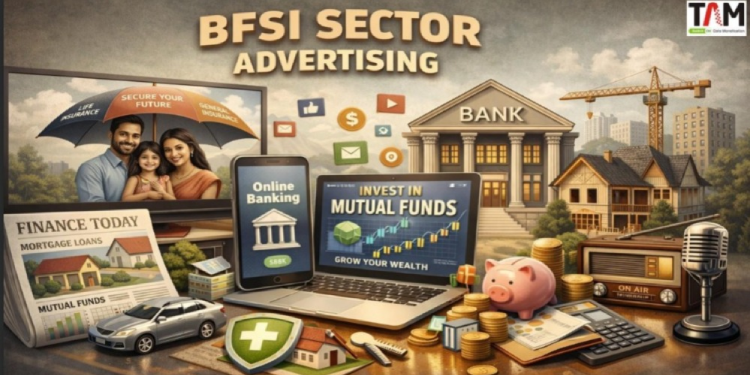
Mumbai:India’s banking, financial services and insurance (BFSI) sector is witnessing a sharp realignment in advertising strategy, with digital scaling rapidly even as television records a slowdown. The TAM AdEx Cross Media Report 2025 reveals that while overall BFSI ad volumes declined by 16% in 2025 compared to 2024, the sector remains on a strong long-term growth trajectory, with advertising activity up 64% versus 2021 levels.
This divergence highlights a market transitioning from mass-led visibility to performance-driven, multi-platform engagement.
Television: Decline in Volumes Despite Strong Category Concentration
Television advertising for BFSI showed signs of moderation in 2025, with indexed ad volumes dropping back to 100 in 2025 from a peak of 116 in 2024, effectively erasing the previous year’s gains.
The slowdown was particularly visible within the year. After a strong first quarter, ad volumes fell sharply, with Q2 and Q3 declining by 35% each and Q4 by 13% compared to Q1 levels.
Despite this contraction, category concentration remained high. Life Insurance accounted for 19% of ad volumes, followed by Mortgage Loans at 16% and Corporate Financial Institutions at 13%, together contributing significantly to TV spends.
The Life Insurance Corporation of India (LIC) alone commanded 11% of total TV ad volumes, while the top 10 advertisers together contributed 51% of the overall share, reflecting a highly concentrated advertiser base.
Content strategy continues to be heavily skewed towards news programming. News channels captured a dominant 68% share of ad volumes, with news bulletins alone accounting for 48%, reinforcing BFSI’s reliance on high-trust environments.
Prime time remained the most preferred slot with a 34% share, followed by afternoon (22%) and morning (20%), together contributing 76% of total TV ad volumes.
Print: Sustained Growth with 64% Expansion Since 2021
Print emerged as one of the most stable and steadily growing mediums for BFSI advertising. Ad space grew consistently from an index of 100 in 2021 to 164 in 2025, marking a 64% increase over the period.
Within 2025, the momentum strengthened in the latter half, with Q3 ad space rising 46% and Q4 increasing 33% compared to Q1, indicating heightened campaign activity around financial cycles.
Life Insurance led print advertising with a 21% share, followed by Mutual Funds and Banking Services at 13% each.
However, unlike television, advertiser concentration in print remains low. The top 10 advertisers contributed only 19% of total ad space, while the top 10 brands accounted for just 9%, indicating a fragmented and diverse advertiser base.
Language preferences were clearly skewed, with English publications commanding 62% share, followed by Hindi at 20%. Business and finance publications dominated with 59% of ad space, underscoring the medium’s relevance for high-involvement financial communication.
Regionally, the South zone led with a 33% share, ahead of North (28%) and West (26%), highlighting strong BFSI demand in southern markets.
Radio: Strong Growth of 45% Since 2021 Led by Regional Markets
Radio has emerged as a strong complementary medium, with BFSI ad volumes increasing to an index of 145 in 2025 from 100 in 2021, translating to a 45% growth over the period.
That said, the medium also saw intra-year fluctuations, with Q2 and Q3 declining by 43% and 42% respectively compared to Q1, before a modest 2% growth in Q4.
Life Insurance remained the leading category with a 22% share, followed by Banking Services at 14% and Corporate NBFCs at 11%.
LIC dominated radio advertising with a 20% share of ad volumes, while the top 10 advertisers together contributed a significant 69% share, indicating high concentration.
Geographically, Maharashtra led with 18% share, followed by Gujarat at 16% and Uttar Pradesh at 9%, with the top three states accounting for 43% of total radio ad volumes.
Time-band preferences were sharply defined, with evening slots accounting for 44% and morning slots 40%, together contributing 84% of total ad volumes.
Digital: Ad Impressions Surge 5X, Programmatic Dominates at 91%
Digital continues to be the standout medium for BFSI advertising, with ad impressions rising dramatically from an index of 100 in 2021 to 545 in 2025, marking a more than fivefold increase.
Even within 2025, despite short-term corrections of 19% and 12% declines in Q2 and Q3, impressions rebounded with an 8% increase in Q4 compared to Q1, indicating sustained momentum.
Banking Services dominated digital with a 27% share of ad impressions, followed by Life Insurance and Credit Cards at 19% each.
Axis Bank emerged as the top advertiser with a 12% share, while the top 10 advertisers together accounted for 59% of impressions, reflecting a competitive yet moderately concentrated landscape.
A defining feature of digital advertising in BFSI is the dominance of automation. Programmatic buying accounted for an overwhelming 91% of ad transactions, with programmatic and ad network methods together capturing 96% of total impressions.
A Structural Shift Toward Performance-Led Media
The TAM AdEx report makes it clear that BFSI advertising is no longer uniform across media but is evolving into a layered ecosystem. Television, despite a 16% year-on-year decline, continues to offer scale and credibility, particularly through news-led environments. Print has emerged as a steady growth medium with a 64% rise since 2021, reinforcing its role in trust-driven communication.
Radio, with 45% growth, is strengthening its position as a regional amplifier, while digital—with its 5X surge in impressions and 91% programmatic adoption—is rapidly becoming the core engine for customer acquisition and engagement.
As BFSI brands navigate this transformation, the emphasis is shifting from pure reach to a more balanced strategy that integrates trust, targeting and transaction—marking a decisive evolution in how financial services are marketed in India.