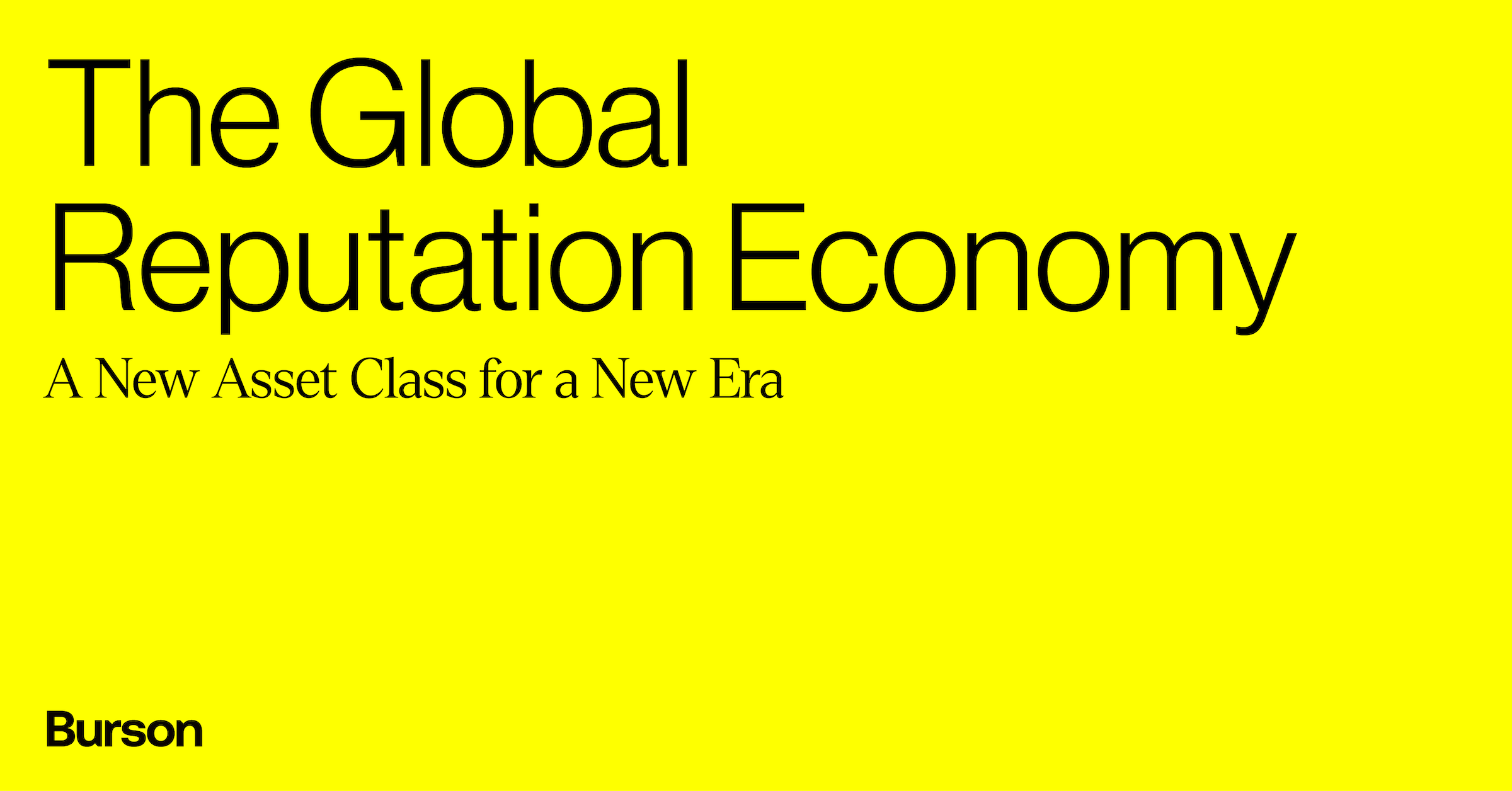
Mumbai: Corporate reputation has moved from being an intangible brand virtue to a measurable financial asset capable of delivering billions of dollars in shareholder value, according to a landmark new global study by Burson.
The research, titled “The Global Reputation Economy: A New Asset Class for a New Era,” finds that companies with strong reputations generate an average 4.78% in additional unexpected annual shareholder returns, over and above what traditional financial performance would predict. Aggregated globally, this translates into a $7.07-trillion “Reputation Economy.”
Burson’s analysis shows that reputation-driven returns for individual companies range from $2 million to as much as $202 billion, making reputation one of the most powerful — and previously unmeasured — drivers of enterprise value.
“For decades, leaders have known intuitively that reputation matters, but they’ve never been able to quantify it as a financial asset; now, we can,” said Corey duBrowa, Global CEO of Burson. “Our research shows that reputation is an interconnected system that, when rigorously managed, can yield billions in measurable returns, build resilience against shocks, and give leaders the confidence to make bold moves.”
Reputation moves from ‘soft’ to ‘hard’ asset
The study introduces what Burson calls a Reputation Capital model, which breaks reputation into eight measurable drivers including Leadership, Innovation, Governance, Product, Workplace and Citizenship. Companies that performed strongly across these levers consistently delivered superior shareholder returns, independent of their underlying financials.
Top-tier reputation leaders outperformed weaker peers by 11 to 15 points across every reputation driver, with the widest gaps seen in Innovation (15.5 points), Product (15.2 points) and Governance (14.4 points) — reinforcing the idea that reputation is built through operational excellence, not just communications.
AI and the workplace emerge as the new fault line
One of the most striking findings relates to the workplace, which was ranked the least important reputation driver (11%) by external audiences, yet showed one of the largest performance gaps between leading and lagging companies — 11.8 percentage points.
Burson warns this gap is likely to widen as companies roll out artificial intelligence across their operations.
“Businesses must go beyond having an ‘AI strategy’ and create an ‘AI people strategy,’” said Matt Reid, Global Corporate and Public Affairs Lead, Burson, and U.S. CEO of Burson Buchanan. “Organizations that invest in reskilling and co-creating the future with their people will earn a reputation dividend. Those that treat AI purely as a cost-cutting tool will face a reputation tax.”
Inside-out recovery in high-risk industries
In industries where trust is fragile or failure is catastrophic — particularly aerospace and energy — the study found reputation is being rebuilt from the inside out.
Two aerospace companies recorded their biggest reputation gains not through product storytelling but through Governance (+7.9%) and Workplace (+6.2%), signalling that operational integrity and internal culture are now central to public trust.
Similarly, in the energy sector, reputation improvements were driven by Workplace and Citizenship, rather than sustainability messaging alone.
Finance faces reputational erosion
The research highlights a sharp deterioration in the financial services sector, which has seen declines across Leadership (-24%), Governance (-11%) and Citizenship (-15%). For the firms studied, this erosion puts $4.3 billion — or 38% — of their total reputational value at risk.
Asia-Pacific implications
For companies in Asia, reputation management is now a strategic growth lever rather than a communications afterthought, according to HS Chung, Asia-Pacific CEO of Burson.
“Reputation is no longer an abstract idea, but a measurable asset with a direct impact on enterprise value,” Chung said. “Through our Reputation Capital model, we can now give clients near real-time insight into how external events and internal actions are shaping their reputation — and their financial outcomes.”
As investor scrutiny, AI disruption and stakeholder activism intensify, Burson’s findings suggest that reputation has become one of the most valuable — and volatile — assets on a company’s balance sheet, reshaping how corporate performance itself is measured.