S Chand and Company Limited, an education publishing company, with over 86 years of legacy and a sharp focus on modern learning innovations. Under Saurabh’s financial and strategic leadership, S Chand has evolved beyond textbooks into a diversified knowledge powerhouse shaping how India learns today.
With a network spanning over 40,000 schools and institutions nationwide, S Chand has been at the forefront of combining traditional excellence with cutting-edge solutions. Notably, the company’s recent partnership with Google to integrate Google Lens into school textbooks has transformed how students interact with printed materials. Its digital-first offerings, including platforms like Mylestone, Smartivity, and OnlineTyari, are reshaping hybrid classrooms by offering e-books, interactive tools, and personalized learning journeys.
Adding to its momentum, the company is also entering a new revenue stream with AI content licensing. It is also well-prepared for the upcoming NCERT syllabus rollout, which will drive significant demand in the K–8 segment from FY26 onward.
Growth is not solely dependent on the NCERT opportunity. The company is simultaneously advancing new verticals and strategic initiatives including:
· CUET coaching to tap into India’s fast-growing test-prep market through TESTCOACH
· Entered multiple partnerships for content and Licensing including Allied (ICSE Books), Discovery, Amar Chitra Katha, Money Prep (Financial Literacy), Speedlabs (JEE and NEET Foundation).
· GST hike on paper and its impact on the publishing industry and the company.
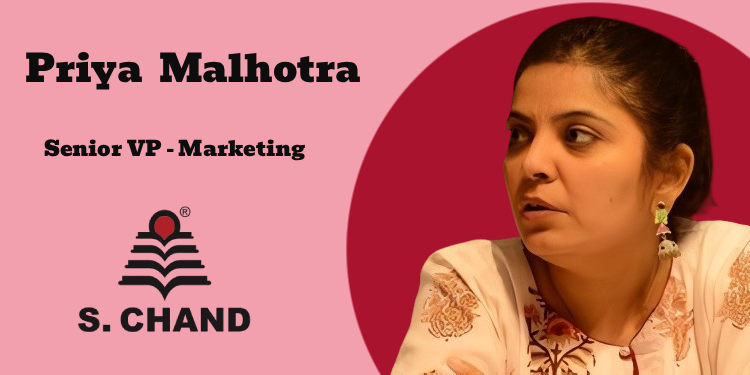
Medianews4u.com caught up with Priya Malhotra, Senior VP Marketing S Chand Group
Q. The ed-tech sector has seen a major correction. Is there a trust deficit? What needs to be done?
I believe there has been a trust reset rather than a trust deficit. This correction lay bare business models that prioritised aggressive growth over learning outcomes.
To rebuild credibility, the sector will have to focus on measurable impact, transparent pricing, curriculum alignment, and long-term partnerships with schools rather than purely transactional, consumer led models. Confidence will eventually develop by demonstrating learning efficacy and institutional trust.
Q. The company is focusing on K-12 publishing, AI data licensing, and acquisitions. Plans for 2026?
In K-12, our focus is on strengthening curriculum-aligned, NEP ready content with strong digital companions. In AI data licensing, the group is leveraging its vast, structured, and pedagogically sound content corpus to support responsible AI training use cases.
On acquisitions, the approach remains selective by adding capabilities, platforms, or niche IP that complement our core education ecosystem.
Q. The goal is to be the go-to content provider. Are institutional requirements evolving rapidly?
Institutions today want partners who can evolve with them, not just dealers, distributors or vendors.
They expect modular, outcome driven content that integrates print, digital, assessment, and analytics. There is a clear shift from static textbooks to adaptive learning resources, teacher support tools, and data-backed performance insights.
Q. S Chand’s evolution beyond textbooks, big challenges including piracy?
Managing the transition from a print first mindset to a hybrid knowledge ecosystem while protecting intellectual property has been one of the biggest challenges in the past few years. As far as piracy is concerned, it remains an industry wide concern, across print & digital but primarily in digital formats.
Addressing it requires a combination of technology safeguards, legal enforcement, awareness, and offering affordable, high-quality alternatives that reduce the incentive to pirate.
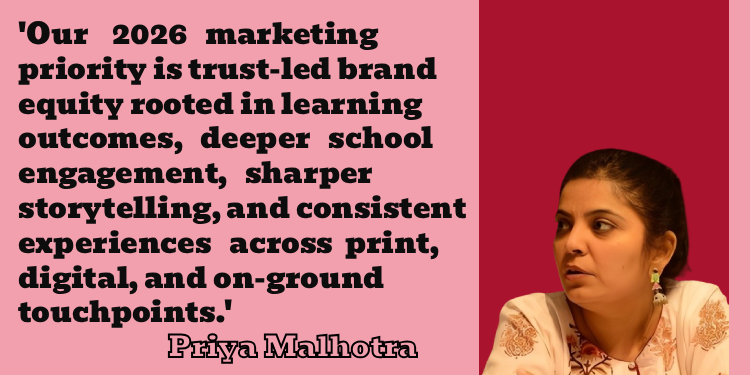
Q. What are the marketing priorities and focus areas in 2026?
The priority is building trust led brand equity anchored in learning outcomes. Focus areas include deeper school engagement, sharper storytelling, and consistent brand experiences across print, digital, and on-ground touchpoints.
Marketing will also play a stronger role in supporting product adoption, not just awareness.
Q. Marketing campaigns and innovations expected in 2026?
You can expect more integrated campaigns that blend on ground school engagement with digital storytelling.
There will be use of educator led advocacy, and technology led demonstrations. Innovation will more about relevance, personalization, and measurable impact.
Q. Are short form video platforms like Reels becoming important?
Yes, they are becoming important, especially for awareness and recall. Short form video is effective for simplifying complex ideas, showcasing classroom use cases, and engaging younger audience and parents, increasing brand engagement and sharing.
However, it complements and supplements rather than replacing long-form content and conventional formats like workshops, demos in education marketing.
Q. With an 86-year legacy, has S Chand rebranded for Gen Z and Gen Alpha?
Rather than being rebranding, our focus has been on modernising the brand through product experience, design language, tone of communication, and digital engagement.
The intent is to remain contemporary and relevant while retaining the trust and credibility built over decades. Brand evolution is an ongoing rather than a onetime exercise.
Q. How does S Chand approach B2B marketing through seminars and workshops?
B2B marketing is relationship driven and integral to our marketing plans and strategies. Seminars, workshops, and teacher training programs are central to our approach, as they create value led engagement instead of pure promotion.
These platforms allow us to listen, co-create, and demonstrate practical classroom impact, which is far more effective than conventional advertising in this segment.
Q. What is the impact of the Google Lens partnership on printed textbooks?
The integration of Google Lens transforms textbooks into interactive learning tools.
Students can instantly access explanations, visuals, and supplementary content by scanning pages, bridging the gap between print and digital. It enhances curiosity, self-learning, and contextual understanding without replacing the textbook’s core role.
Q. Digital first offerings and hybrid classrooms: Is hybrid education the future?
Hybrid education is a structural shift. The future lies in flexible models where print, digital, and teacher-led instruction coexist.
Digital and hybrid education support personalised learning paths, making education more inclusive, scalable, and outcome oriented.
Q. Could you shed light on the role of AI and predictive analytics across a 40,000+ institution network?
AI and analytics help us understand adoption patterns, content usage, learning gaps, and regional needs.
This enables better forecasting, targetted interventions, and more relevant offerings for schools and institutions, strengthening relationships while improving operational efficiency.
Q. Finally, should there be a course on AI in schools?
Yes, but age appropriate and concept driven. AI education should focus on fundamentals like logic, ethics, data literacy, and responsible use.
The goal should be to build informed users and critical thinkers, not doctors and engineers.