Founded in 2023 by Rajakumaran and Anbarasan, Indian Snack House was born out of their personal longing for authentic South Indian flavours after relocating to metro cities. While snacks from various parts of India were widely available, the duo realized there was no trusted, branded platform for beloved South Indian treats — and that gap inspired them to create Indian Snack House.
Celebrating the culinary richness of South India, the brand offers classics such as Tirunelveli Halwa, Srivilliputhur Palkova, Atreyapuram Pootharekulu, Dharwad Peda, and Kozhikode Halwa. What sets them apart is their commitment to “Aspirational Quality” — with no palm oil, preservatives, or artificial colours — making it a conscious yet indulgent choice for modern consumers.
The brand has already gained strong traction, shipping over 1,00,000 packets monthly and receiving thousands of positive ratings on platforms like Swiggy and Zomato. Backed by Kunal Bahl, Rohit Bansal, and Titan Capital, Indian Snack House is now expanding across more cities, online marketplaces, and new product ranges covering popular snacks from Kerala, Karnataka, Andhra Pradesh, and Telangana.
As it enters its next growth chapter, Indian Snack House is poised to take the authentic taste of South India not only to Indian households but also to global diaspora communities.
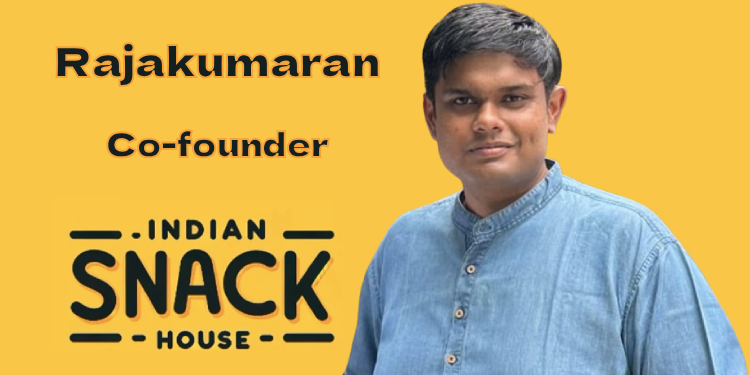
MediaNews4U caught up with Rajakumaran, Co-founder of Indian Snack House, to share his journey, the inspiration behind the brand, and the exciting road ahead.
Excerpts:
Q: What was the turning point that made you both decide to move from just missing South Indian snacks to actually building a brand around them?
Rajakumaran: It really started from a very personal pain point. Both Anbarasan and I grew up in small towns — I come from Tirunelveli, and these native snacks were part of our daily life. After moving to metro cities like Bangalore, Chennai, and Mumbai, we realized how difficult it was to find these authentic South Indian snacks. We often ended up calling our uncles back home to send parcels of halwa or palkova, and this became a recurring practice not just for us but for many of our friends as well. That made us ask: Why is there no trusted brand making these iconic South Indian flavors available everywhere?
The real inflection point came when we were in Chennai, a city with one of the largest South Indian populations. We walked into supermarkets and saw multiple aisles filled with branded potato chips and North Indian snacks — but when it came to South Indian snacks, all we found were transparent, unbranded packets with no standardization, trust, or quality assurance. That question kept haunting us: Why don’t we have a Tirunelveli Halwa available like we have a Kolkata Rasgulla across India and beyond?
We also recognized the size of the opportunity. The South Indian snack market is estimated at around ₹25,000 crore, yet there are very few organized players in the space. When you contrast this with the North Indian snack market, you see giants like Haldiram, and Bikaji. South India, despite its iconic snacks, has no equivalent brand. For example, Tirunelveli Halwa is so culturally significant that we have songs and proverbs around it — yet no standardized, trusted brand owned that space.
That became our vision: to build the Haldiram equivalent for South Indian snacks, one that preserves authenticity while offering aspirational quality. Fortunately, we had the right co-founding team — people like Ibrahim, Dhanesh, and Anbodhi, who each brought unique expertise. Having ideas is one thing, but execution requires the right team, and we were at the right stage in our careers to take the plunge, invest our own money, and experiment.
That’s how Indian Snack House was born — out of a personal longing, a clear market gap, and the dream of creating a trusted brand that brings iconic South Indian snacks to every household in India and eventually to the world.
Q: You talk about “aspirational quality” — what does that mean to you, and how does it influence decisions around sourcing, packaging, and branding?
Rajakumaran: When we talk about aspirational quality, what we really mean is food that matches the quality of what you’d cook in your own home. For us, that begins with ingredients. In a typical household kitchen, you’ll find groundnut oil, sunflower oil, or coconut oil — but you won’t find palm oil or chemical-sounding additives. We apply that same principle to our products. Every ingredient we use is something you can recognize from your own kitchen. That’s why our snacks feel as safe as homemade food, especially for mothers buying for their children.
This approach does bring challenges. Many of the native snacks we work with come from tier-2 and tier-3 towns where pricing is very sensitive, and manufacturers are used to using shortcuts like palm oil or preservatives. For example, it’s difficult even in Nagercoil to find banana chips without palm oil, or in Tirunelveli to find halwa without vanaspati. We had to work hard with our manufacturing partners to create special batches that meet our standards. Sometimes we even decide not to launch certain products if we can’t find the right manufacturer who aligns with our clean-label philosophy. But the promise we make is simple: every Indian Snack House product meets our quality benchmark, or it doesn’t make it to market.
On the branding front, this becomes our strongest differentiator. Parents today want to give their kids better food than what they themselves grew up with — and that aligns perfectly with our positioning. By offering authentic South Indian flavors made with clean, home-style ingredients, we stand apart from mass-market brands.
Finally, our communication is built around two pillars: authenticity and clean-label quality. We promise customers the authentic taste of South Indian snacks, delivered in the cleanest, most trustworthy format. For many families, especially young mothers with limited time and traditional cooking skills, we’re bridging the gap: providing snacks with the effort, patience, and authenticity of home recipes — like halwa that traditionally takes 24 hours of fermentation — but in a ready-to-enjoy, trusted branded format.
That’s what aspirational quality means to us — food that is authentic, clean, and as close to home as possible, yet convenient for modern lifestyles.
Q: Many of the snacks you offer are steeped in regional traditions. How do you strike a balance between authenticity and shelf-stable modern packaging?
Rajakumaran: Authenticity is at the core of everything we do, which is why we work directly with native makers in the towns these snacks originate from. That ensures the taste remains true to tradition. But at the same time, we also want these products to travel far beyond their native towns — to metros across India and eventually overseas. That requires world-class packaging standards.
To achieve this, we use nitrogen-flush packaging across all our savouries. This is the same high-standard packaging used by leading FMCG players, but we are among the first to bring it into the native South Indian snacking space. In fact, we’ve invested in packaging infrastructure ourselves. We have set up a centralized packaging unit in Kanyakumari and installed nitrogen-flush and baking machines at our partner vendors’ facilities in places like Srivilliputhur, Nagercoil, and Tiruttukudi. We not only provide the machines and high-quality packaging material but also create detailed SOPs so that local makers can preserve authenticity while meeting shelf-life and hygiene standards.
We also collaborate with equipment manufacturers in Chennai and beyond to ensure we’re using the best available technology. While the technology itself is not new, no one in the traditional South Indian snack space had applied it in a branded format before. Most native products were simply sold in transparent packets or couriered within towns, without consideration for long shelf life. We’ve changed that by enabling our products to stay fresh for over 100 days, which allows us to scale distribution across multiple cities.
Today, we have distribution centers in Chennai, Mumbai, Bangalore, and Hyderabad, and we are expanding to Delhi this month. By combining authentic recipes from native towns with world-class packaging, we’re ensuring that South India’s most beloved snacks are no longer limited to local availability — they can now reach households across India and, soon, across the globe.
Q: You’re already shipping over 1,00,000 packets a month — what have been some key levers that helped you scale so quickly?
Rajakumaran: A few core levers have driven this rapid scale. First, our team’s expertise across marketing and operations enabled us to efficiently build and meet demand. Second, customer love has been a huge factor. Many of our products like Srivalliputhur Palkova, Tirunelveli Halwa, or Nagarkoil Banana Chips already had deep-rooted fan bases. We simply made them accessible in a branded, consistent format, and customers flocked in.
Our marketing is entirely internal — we don’t outsource to agencies. Instead, we rely on our in-house team to drive e-commerce growth. So, in short, it’s a combination of the right product, strong execution, and tapping into existing demand that helped us scale fast.
Around 20% of our online customer base comes from people outside the traditional South Indian audience — foodies and experimenters trying these products for the first time.
It’s similar to how North Indian snacks like Haldiram’s Bhujia or Rasgulla gained mass acceptance nationwide. We believe South Indian classics like Tirunelveli Halwa or Nagarkoil Banana Chips will follow the same path and become mainstream across India and globally.
Q: How would you describe your core marketing strategy, and who are the primary customer segments you are targeting through it?
Rajakumaran: At the core, our strategy is about connecting authenticity with accessibility. We focus primarily on people who love South Indian food and authentic regional flavors. Within this, mothers make up a very large segment — they purchase for their families and children. More broadly, anyone who values authenticity and a homemade-quality snacking experience falls into our target group.
Our marketing is digital-first. We rely heavily on Facebook, Instagram, Google, YouTube, and WhatsApp to tell transparent stories — showing how we source, pack, and deliver. Recently, we’ve also extended to platforms like Swiggy. Essentially, we position ourselves where our customers are already present.
Q: Since your strategy is primarily digital, how do you target and engage your consumers through these channels?
Rajakumaran: Our approach is simple — transparency and storytelling. We create videos showing how products are made, how we pack them, and how we maintain authenticity and hygiene. We then communicate this consistently through Meta platforms (Facebook, Instagram, WhatsApp) and Google (Search, YouTube).
We also ensure open communication with customers. If there’s ever a delay or issue, we address it directly. Over time, we are also exploring mass channels like modern trade and physical retail to expand reach. But digital-first storytelling has been our foundation.
Q: What sets Indian Snack House apart from other ethnic or regional snack brands in the market?
Rajakumaran: Two things. First, authenticity — none of our products are mass-produced in a single central kitchen. Each item is sourced directly from native makers in its region of origin. This means when a customer buys Srivalliputhur Palkova from us, they get the exact same taste as from the town itself. Almost 80% of our products aren’t available in typical snack shops across metros.
Second, we deliver on a clean-label promise. All our products are free from palm oil, preservatives, and artificial additives. For example, even in Nagarkoil, it’s hard to find banana chips without palm oil. But at Indian Snack House, that’s the standard. Together, authenticity and clean-label quality make us stand apart.
Q: Your early customers seem incredibly loyal. What do you think resonates most with them?
Rajakumaran: It’s about comfort food. These snacks connect customers with their roots and their homes. A Nagarkoil Banana Chips or Tirunelveli Halwa isn’t just a product — it’s an emotion, a familiar taste they’ve missed for long.
Unlike trendy snacks with artificial flavors, our products are simple, authentic, and easy on the stomach. Customers return for that consistency — knowing they’ll get the same taste and quality every single time. That’s why these products have endured in their regions for 70–80 years, and why our customers keep coming back.
Repeat customers form a very strong base for us. Around 40–45% of our orders each month are repeat orders. So, if we ship 1,00,000 packets, nearly 40,000–45,000 come from loyal customers.
Typically, they reorder their comfort snacks — like Tirunelveli Halwa or Chettinad Murukku — while also trying one or two new items. So the same customer base is both loyal and experimental. This dual behavior helps us grow while keeping a solid foundation of repeat demand.
Q: Do you see Indian Snack House as a purely D2C brand, or are you aiming for offline presence as well?
Rajakumaran: We want to be a consumer brand — not just D2C. D2C is our starting point, but not the endgame. Four months back, we were only available through our website. Today, we’re also present on Swiggy and Zomato. In the next phase, we’ll be on BigBasket, modern trade, and multiple offline channels.
The idea is to be omnipresent — available wherever our customers are. Scaling comes with challenges, of course, but our goal is to build a pan-India consumer brand rooted in authenticity.
Q: Titan Capital has backed several breakout consumer brands — how do their insights and network help shape your growth roadmap?
Rajakumaran: When it comes to Titan Capital, I believe they are an exceptional investment firm for any early-stage company, especially for first-time founders like us. We did not come from a deep business background, nor did we have experience in operating at a large scale or raising significant capital. Titan has been instrumental in bridging those gaps for us.
What sets them apart is that they are not just investors; they are also seasoned operators. Leaders like Kunal Bahl and Rohit Bansal bring in immense operator-level expertise. Their way of evaluating businesses, identifying priorities, and guiding founders is very different from traditional investors. They are deeply committed and extremely sharp in their business understanding.
One of the most valuable aspects of working with Titan is that, unlike many VCs, they do not pressure us into rapid scaling. Instead, they encourage us to do the right things at the right time. For example, very early on, we were putting considerable energy into international orders. Titan stepped in and advised us to refocus, reminding us that India’s domestic market itself is massive and should be our priority before we looked overseas. That clarity helped us streamline our roadmap and conserve resources.
Their network and connects have also been a major accelerant. They consistently open doors for us, whether in terms of partnerships, vendor connects, or strategic advisors. They spend time with us, guiding us not just with insights but also with hands-on directions. I would say their experience as operators gives them the ability to empathize with founder challenges. In fact, in our early conversations, they directly addressed our insecurities and operational hurdles, which gave us a lot of confidence.
Another reason we are fortunate to have Titan as our anchor investor is their track record. They have been with multiple companies from day zero all the way to IPO. They know the full journey and the different inflection points. That long-term experience provides us with a sense of security and aspiration — we see that value transcending in our own story too.
Q: With the funding you have raised so far, what are the immediate focus areas for Indian Snack House?
Rajakumaran: The first and foremost priority for us has been distribution expansion. At the time of our fundraise, we were present only in two cities. Today, we have already scaled to four cities — Chennai, Bangalore, Mumbai, and Hyderabad — and we are expanding further into Delhi soon.
Another milestone is our entry into Swiggy and Zomato. Back then, we weren’t even on these platforms. We started with just one outlet, which was Muftia Barrows. Today, we are available across 20 different touchpoints, making our products far more accessible to customers.
Alongside distribution, the second big focus is on scaling production while maintaining authenticity. We are investing heavily in our manufacturers, providing them with machines, packaging solutions, and standard operating procedures to ensure that even as volumes grow, we do not lose the native authenticity and our clean-label promise. For us, this is critical — scaling must never come at the cost of quality or tradition.
So to summarize, we are channeling the capital into two very focused areas:
- Expanding distribution aggressively to ensure our products are available in more cities and through more channels.
- Supporting and enabling our manufacturing partners to scale production with the right technology and processes, without compromising on the authenticity of native snacks.
These two focus areas are the foundation on which we are building our next phase of growth.
Q: How do you serve a customer in Mumbai versus a customer in Chennai? It’s easy for you to source and distribute locally, but how do you assure the same authenticity and timely service for someone in Mumbai?
Rajakumaran: We have already established our fulfilment centers, which we call barrows, in four cities—Chennai, Bangalore, Mumbai, and Hyderabad. Stocks are readily available in these barrows. So, if a customer in Mumbai places an order on our website at 9 a.m., in most cases we deliver the same day.
For customers beyond the city limits, we use courier partners. Within city peripheries, the delivery window is usually three days, and for further geographies, it can take up to five days. Across these four cities, we currently deliver same-day across nearly 400 pin codes, and we are expanding aggressively. By this month-end, we will also launch in Delhi to increase our same-day delivery presence.
Q: Why did you choose Hyderabad as an expansion market so early, instead of focusing fully on Mumbai or scaling into Delhi directly, which are larger markets in terms of population and purchasing power?
Rajakumaran: That’s a valid question. Our market expansion has been both strategic and data-driven. We started with Chennai, as it was our natural home market. Bangalore came next because it’s close by, logistically efficient, and has a significant Tamil Nadu-origin population, giving us an initial trust base.
Our third city was Mumbai, and Hyderabad was the fourth. While it may seem unconventional, Hyderabad made sense for a few reasons:
- From Chennai, shipments reach Hyderabad overnight, making logistics very efficient compared to Delhi, which takes longer.
- We noticed significant organic demand from Hyderabad early on. Customers were ordering directly from our website, and many reached out with appreciation for the authentic Tamil Nadu snacks.
In fact, Hyderabad now contributes almost 30% of our website sales, nearly on par with Mumbai. Our data confirmed that Hyderabad wasn’t just an experiment—it is a high-demand, loyal market.
For perspective, in our D2C website sales, Bangalore is the largest market with 25% share, and Chennai, Mumbai, and Hyderabad each contribute around 20%. Additionally, on Swiggy and Zomato (currently active in Chennai and Bangalore), Chennai leads. So, while geography played a role, our expansion decisions were ultimately guided by customer data and demand.
Q: Looking ahead, do you see Indian Snack House remaining a pure-play snack brand, or could it evolve into a broader South Indian food platform?
Rajakumaran: At least for the foreseeable future, our focus will remain on snacks and sweets only. We believe there’s still so much opportunity in this space. Today, we have just about 25 products in our catalogue, but even within that, there are many authentic flavors that people have been missing for years.
Our mission is to bring back those much-loved South Indian snacks and sweets to people everywhere. Before diversifying into any other categories, we want to get this range absolutely right and build deep customer love around it. So, for now, the goal is to remain focused, but grow very strong in snacks and sweets, and take them across India and the world.
We are following a phased, channel-driven approach. The first priority is to establish ourselves strongly in the metro cities. After Delhi, we are evaluating Pune, Vizag, Mysore, and Coimbatore as the next set of markets. Ultimately, the idea is to cover the top 100 cities of India, starting with the metros.
We typically launch first with B2C through our website, study the demand and customer behavior, and then extend into Swiggy/Zomato and other channels like modern trade. So, it’s always demand-led and customer-driven expansion.
Currently, we have 25 products in our steady catalogue. Alongside, we keep 5–6 experimental products running at any given time. We launch them in limited numbers, gather customer feedback, refine, and only then move them into the permanent catalogue.
We don’t want to become a brand with hundreds of SKUs. Instead, our philosophy is “limited but most loved.” Every product in our range should be something customers truly cherish and associate with authenticity. So, customer love—not numbers—is the parameter for expanding our product line.