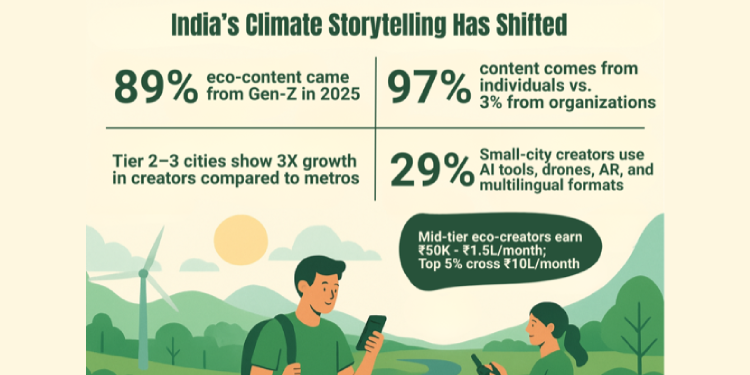
Mumbai: India’s digital climate movement is being reshaped by its youngest citizens. According to a new report from WeNaturalists, a global platform for nature professionals and enthusiasts with over 500,000 members, Gen Z creators (ages ~13–27) were responsible for 89% of all eco-content shared in 2024, with the platform recording a 34% surge in nature-related posts since 2021. The growth is largely driven by creators from Tier 2 and Tier 3 cities, marking a purpose-led shift in how and where climate conversations are emerging.
From 2021 to 2024, nature-related content creation on WeNaturalists increased by 34%. In 2025, the platform has already recorded 80% of last year’s total posts by August, signaling another record-breaking year. Individual creators dominate this trend: 97% of posts came from individuals compared to just 3% from organizations in 2024—a ratio that holds steady in 2025. This highlights a movement that is grassroots, youth-driven, and decentralized.
Maharashtra, Delhi-NCR, Karnataka, Tamil Nadu, West Bengal, and Kerala remain the top eco-content regions. However, the fastest growth is seen in Tier 2–3 hubs like Indore, Jaipur, Kochi, Bhubaneswar, and Chandigarh, which now produce 3x more creators than metros. These creators are amplifying local environmental issues such as Delhi’s air pollution, Rajasthan’s water crises, deforestation in the Northeast, and coastal resilience in Tamil Nadu and Kerala—making climate conversations increasingly hyperlocal and action-oriented.
“The consistency of growth in climate content and the fact that nearly 90% is being driven by individual voices tells us one thing clearly: young creators, especially from India’s non-metro cities, are not just speaking up, they’re stepping up,” said Amit Banka, Founder & CEO of WeNaturalists. “This isn’t about volume alone, it’s a shift toward deeper, more participative, and purpose-driven storytelling. Our priority now is to strengthen this movement by supporting creators with digitally transformative tools and sustainable solutions. Enabling them to, network, build community, manage and document projects and a revolutionary way to monetize content. Our goal is to help anyone and everyone to amplify their Climate Action & SDGs initiatives.”
Beyond WeNaturalists, India’s wider digital ecosystem for climate and sustainability continues to expand. Platforms like Instagram, LinkedIn, X, and YouTube drive the highest engagement, with short-form videos and educational explainers seeing the widest reach. Facebook remains strong for community mobilization. Across this space, user-generated content delivers up to 4x the engagement of branded content, underscoring its impact.
Content spikes are strongly linked to global environmental days. On World Nature Conservation Day (July 28), creators posted 78 times in 2025 (up from 73 in 2024). Earth Day (April 22) surged from 4 posts in 2024 to 42 in 2025, while World Environment Day (June 5) saw fewer posts this year, with recap content still anticipated.
Technology is shaping creator behavior too. In 2025, about 29% of Tier 2–3 city creators used AI tools for editing, scripting, or optimization, while drones, AR filters, and multilingual formats boosted reach.
The eco-creator economy is also maturing rapidly. Mid-tier creators now earn between ₹50,000–₹1,50,000 per month, while the top 5% cross ₹10 lakh monthly through brand partnerships, NGO campaigns, and platform monetization. Even micro-influencers with under 10K followers are seeing traction thanks to high-engagement storytelling.
With India poised to play a defining role in global climate discourse, WeNaturalists predicts record participation in the green creator economy in 2025–26. The movement is increasingly digital, local, measurable, and youth-powered.