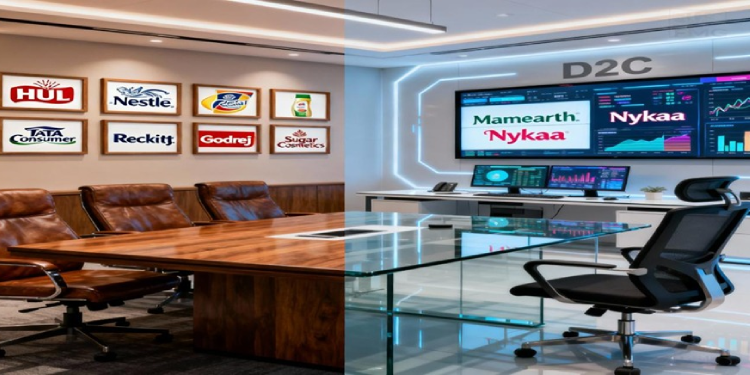
The writing is on the wall. India’s FMCG sector, long dominated by legacy giants such as HUL, Nestle, ITC, Reckitt, Godrej, Tata Consumer and some of the world’s largest consumer goods conglomerates, is experiencing a seismic shift that’s fundamentally altering the competitive landscape. Challenger brands are not just nibbling at the edges anymore; they are systematically dismantling the traditional playbook that made these giants seemingly invincible.
The numbers tell a compelling story: smaller FMCG players are now growing faster than their larger competitors, with D2C companies clocking a staggering 40% compound annual growth rate between 2021-2024, while established players managed only 9%. More tellingly, two-thirds of all FMCG acquisitions in the past five years have been legacy companies buying D2C brands, a clear admission that the old ways no longer work.
As someone who’s spent three decades in the trenches of TV sales, content creation, and digital transformation, I have witnessed this evolution firsthand. The question is not whether giants will stumble, they already are. The question is: will they adapt fast enough, or will they become cautionary tales in business schools?
Why Legacy Giants Are Losing Their Edge
The Innovation Paralysis
Legacy FMCG companies are trapped in their own success. Take HUL’s recent legal tussle with Mamaearth over sunscreen claims, a battle that perfectly illustrates how established players are reacting defensively instead of innovating proactively. While HUL controls 25% of India’s ₹2,000 crore sunscreen market, focused beauty brands including Mamaearth, L’Oreal, and Nykaa have captured 33% share and are projected to reach 42% by 2027.
The bureaucratic layers that once ensured quality control now stifle rapid response. Where challenger brands can pivot product formulations, messaging, and distribution strategies within weeks, legacy players require quarters or even years for similar changes.
Distribution Complacency
Traditional FMCG success was built on deep distribution networks and retailer relationships. But as Nestle’s outgoing MD Suresh Narayanan aptly noted: “Legacy companies can no more think the small guy does not matter.” These small players are not trying to sell millions of tonnes; they are targeting specific localities and pin codes with surgical precision.
Quick commerce and e-commerce now account for 20% of the FMCG sector, giving new brands equal access to consumers and neutralising the traditional distribution advantage. A D2C brand can now reach customers directly through Blinkit, Zepto, or Instagram, bypassing the complex distributor networks that took legacy players decades to build.
The Margin Trap
Cost pressures have forced many legacy brands into a dangerous cycle: cut costs to maintain margins, compromise on quality or innovation, lose consumer trust, and then cut costs further. This race to the bottom is exactly what challenger brands exploit by positioning themselves as premium alternatives that actually deliver on their promises.
Tradition Meets Disruption: Why Both Media Matter
As much as digital acceleration shapes the future, it’s important to underline: traditional media, especially television, print, and radio, is still essential for FMCG brands building mass market presence, driving recall, and connecting with millions of households nationwide. Genres like family staples, packaged foods, and personal care depend on scale and frequency that only TV and print provide. The greatest campaigns today don’t pick sides; they integrate traditional impact and digital precision, leveraging both mass reach and targeted engagement.
I have always advocated for brands to orchestrate integrated campaigns, where traditional media’s emotional resonance and credibility complements digital’s targeting, measurement, and real-time optimisation. The best executions are those that win household hearts and data battles. Categories focused on habit, rural penetration, or national launches remain heavily advertising on traditional channels because digital alone cannot replace cultural connection. The message: don’t abandon traditional, but combine it smartly with digital for true disruption.
The Creative Advantage: Internal Innovation vs Agency Dependency
Here is where the fundamental difference becomes most telling. Legacy FMCG brands have become over-dependent on external agencies for their creative ideas, promotional strategies, marketing campaigns, and advertising concepts. This dependency has created a dangerous disconnect between brand vision and execution.
D2C Brands: Ideas Born from Within
For startups and D2C brands, ideas for creative campaigns, promotional strategies, marketing initiatives, and advertising concepts come directly from the brand owners themselves. This internal origination of ideas is why their success rates are significantly higher than legacy brands that depend on external agencies for creative direction.
When Mamaearth’s founders conceptualise a campaign around toxin-free parenting, it comes from their personal journey as parents. When Nykaa creates content around beauty democratisation, it stems from founder Falguni Nayar’s genuine understanding of Indian women’s beauty struggles. This authenticity cannot be replicated by external agencies, no matter how talented they are.
The Agency Filter Problem
Legacy brands lose critical nuances when their ideas pass through agency filters. What starts as a genuine brand insight gets processed through multiple layers, account managers, creative directors, client servicing teams, each adding their interpretation and diluting the original vision.
The result? Campaigns that feel manufactured rather than authentic. Generic messaging that could work for any brand rather than specific, resonant communication that speaks directly to target consumers.
Speed and Agility Lost in Translation
D2C brands can go from idea to execution in days because the decision-makers are also the idea generators. There is no complex briefing process, no multiple rounds of presentations, no elaborate approval hierarchies. The founder who understands the consumer pain point is also the one greenlighting the creative solution.
Legacy brands, constrained by elaborate agency processes, take weeks just to brief an idea, followed by weeks of creative development, multiple rounds of feedback, and endless refinements. By the time their campaign launches, D2C competitors have already tested, optimised, and moved to their next iteration.
The Media Revolution: How D2C Brands Are Winning the Attention War
Performance Marketing vs. Mass Media Spray
However, for high-frequency FMCG categories like soaps, detergents, and packaged foods, traditional media’s mass reach remains irreplaceable for building household penetration and habit formation across diverse demographic segments.
Programmatic Precision vs. Traditional TV Bulk Buying
That said, TV’s emotional storytelling and cultural impact cannot be replicated digitally, especially for brands targeting multi-generational households or rural markets where traditional media trust runs deep and digital penetration remains limited.
Social Media Mastery vs. Celebrity Endorsement Dependency
Yet celebrity endorsements on television still drive massive brand recall for mass-market products, particularly in categories where family decision-making and trusted faces matter more than authentic micro-conversations. The key is knowing when each approach works best.
Data-Driven Creative vs. Intuition-Based Campaigns
D2C brands leverage first-party data to create hyper-personalised creative content. They know exactly which product images, messaging angles, and call-to-actions drive conversions for specific audience segments. Their creative development cycles are measured in days, not months.
Legacy brands, operating with limited consumer data and lengthy approval processes, often rely on broad creative concepts that aim to please everyone but resonate with no one specifically. By the time they test and iterate, challenger brands have already moved to their next campaign.
How Challenger Brands Win
AI-Driven Insights at Scale
New-age D2C brands harness real-time data and predictive analytics, slicing niche segments, personalising storytelling, and optimising spend far faster than legacy rivals. They use AI to determine optimal ad spend allocation across channels, predict customer lifetime value, and identify the exact moment when a prospect is ready to purchase.
Influencer Credibility Over Celebrity Endorsements
While legacy brands pay celebrities millions for mass appeal, challenger brands invest in authentic influencer partnerships that cost a fraction but deliver superior engagement and conversion rates. A beauty D2C brand working with 50 micro-influencers often achieves better ROI than a legacy brand’s single celebrity campaign.
Real-Time Optimisation vs. Quarterly Reviews
Challenger brands live in a world of continuous optimisation. If a Facebook ad is not performing within 24 hours, it is paused and replaced. If a particular product message resonates on Instagram, it is immediately scaled across all channels. Legacy brands, constrained by quarterly review cycles and hierarchical approval processes, can’t match this speed of iteration.
Community-First Marketing Over Broadcast Messaging
D2C brands build narratives rooted in real consumer problems and back them up with authentic community engagement. They create spaces where customers become brand advocates, generating organic word-of-mouth marketing that no paid campaign can replicate.
What Legacy Players Must Do: The Internal Entrepreneurship Imperative
Launch Separate D2C Divisions with Independent Creative Teams
Instead of just acquiring challenger brands, legacy companies need to create completely separate divisions that operate like startups. These divisions should have their own creative teams, their own performance marketing budgets, and the autonomy to generate ideas internally without being constrained by parent company protocols or external agency dependencies.
Think of it as creating internal competitors. Give these divisions the freedom to compete directly with external challengers using the same weapons: agile decision-making, internal creative development, performance-focused budgets, and digital-native marketing approaches.
Build In-House Creative Capabilities
Legacy brands must reduce their dependency on external agencies for core creative ideation. While agencies can provide specialised execution support, the fundamental creative vision, brand messaging, and campaign concepts should originate from teams that live and breathe the brand daily.
This means hiring creative professionals who understand both the brand’s heritage and the new-age consumer’s mindset. These internal teams should be incentivised for innovation and risk-taking, not just brand safety and consistency.
Autonomous Innovation with Performance Marketing DNA
Foster startup DNA internally by creating teams incentivised for speed and performance, not just brand safety. Allow these teams to allocate 70% of their budgets to performance marketing, programmatic advertising, and social media campaigns, reversing the traditional media mix.
Data-First Storytelling with Real-Time Creative
Combine first-party data with creative, purpose-driven narratives. Invest in social listening, micro-segmentation, and adaptive content that can be modified based on real-time performance data. Move from quarterly creative campaigns to weekly creative iterations.
Programmatic Advertising Mastery
Legacy players must build programmatic advertising capabilities that match challenger brands. This means investing in technology platforms that enable real-time bidding, audience segmentation, and cross-device targeting. The future belongs to brands that can combine traditional TV’s emotional impact with programmatic advertising’s precision targeting.
Influencer Network Development
Build authentic influencer networks instead of relying solely on celebrity endorsements. Develop long-term partnerships with micro and nano-influencers who align with brand values and can create ongoing, authentic content.
The Acquisition Strategy: Beyond Just Buying Success
The recent spate of acquisitions tells a revealing story. HUL’s ₹2,955 crore purchase of Minimalist, Marico’s acquisition of Plix for ₹380 crore, and ITC’s buyout of Yoga Bar for ₹225 crore – these are not just strategic investments. They’re admissions that organic innovation within legacy structures is not keeping pace with market demands.
But here is the crucial insight: buying a D2C brand and then operating it with legacy media strategies and external agency dependencies is a recipe for failure. The very agility, consumer intimacy, and internal creative capabilities that made these brands successful often gets diluted when absorbed into larger organisational structures.
The Integration Challenge
About 60% of D2C acquisitions have been in personal care, with the remainder in food and beverages. While these deals provide legacy players access to niche categories and digital marketing expertise, the real test lies in maintaining the acquired brand’s internal creative capabilities and performance marketing agility while leveraging the parent company’s scale.
Early indicators suggest mixed results. Some acquired brands benefit from larger media budgets and better R&D support, but others lose their nimbleness, internal creative spark, and direct consumer connection, the very attributes that made them attractive acquisition targets.
The Road Ahead: Coexistence or Conquest?
The FMCG landscape of 2030 will look dramatically different from today. Legacy giants won’t disappear, but their dominance will be permanently altered. Some will successfully reinvent themselves by creating autonomous D2C divisions with internal creative capabilities that can compete with challenger brands on equal terms. Others will become increasingly niche players, relegated to categories where traditional distribution still matters more than digital agility.
The winners – whether legacy or challenger, will be those that master the new ecosystem: internal creative development, programmatic advertising precision, influencer authenticity, social media engagement, performance marketing optimisation, and data-driven creative iteration.
For challenger brands, the window of opportunity remains wide open, but competition is intensifying as more legacy players adapt. The key is building sustainable competitive advantages in internal creative capabilities and customer acquisition before legacy players complete their digital transformation.
For legacy giants, the choice is stark: create internal startup divisions with digital-first creative capabilities and performance marketing strategies, or prepare to cede market leadership to a new generation of brands that understand today’s consumers and media landscape better than you do.
The great FMCG disruption is not coming, it is already here. The only question is which side of the creative and media revolution your brand will be on.
Adapt before this disruption becomes a textbook case in university classrooms. #FMCGDisruption
(Views are personal)