IPREX is a global network of independent communications and marketing agencies with more than 1,100 professionals in over 100 markets. Its partners are led by senior practitioners who combine deep local insight with global reach to support clients across geographies and sectors. The network strengthens independent agencies through shared expertise, leadership development and collaboration that supports new business, empowers agency leaders and he
The network recently welcomed Aurai Consulting in Milan, Bear Icebox Communications in Chicago, and Magnitude of Change in Las Vegas as new partners, strengthening its presence in Italy and the United States. In Asia Pacific, IPREX has also onboarded Talking Point Communications in India as the inaugural participant in its Cohort Programme—a structured pathway designed for prospective agencies entering the network.
Medianews4u.com caught up with Alexandra Mayhew, Executive Director, IPREX
Q. In 2026 IPREX aims to expand its global communications network. What is the gameplan in this regard? How important is India in this regard?
Growth for IPREX is not about scale for scale’s sake. The focus is on relevance, depth, and usefulness for partners.
We have invested heavily in a more disciplined content strategy. We are not producing content to fill space. We are producing tools, research, and insight that partners can actively use in their agencies. A recent example is our retention toolkit, which found that work-life balance has overtaken financial compensation as the top priority for agency talent for the first time. That kind of insight shapes how agencies recruit, lead, and retain people.
India is important to our growth strategy. It is a large, dynamic market with increasing geopolitical influence and a rapidly growing economy. From a communications perspective, Indian agencies are among the most globally connected in Asia. They are working across borders, industries, and cultures every day. That makes India both a priority market and a critical source of insight for the network.
Q. When you look at adding partners is their ability to add depth the priority?
Value alignment comes first, always.
We look for agencies that show up, contribute, and actively engage with their peers. That willingness to push in and add value is non-negotiable.
After that, depth matters. We share business in two main ways. The first is geographic, supporting clients as they move into new markets. The second, which is growing in importance, is service sharing. Agencies increasingly rely on specialist partners for areas such as digital, public affairs, data, or paid media. Depth of expertise strengthens the entire network.
Q. What trends does IPREX expect to see in 2026 when it comes to the PR and communications industry? Will there be more cross-border collaboration?
We expect to see two clear trends continue.
First, deeper integration of AI across agency operations and client work. Second, continued service integration, with fewer siloed offerings and more coordinated solutions.
Cross-border collaborationwill not always be straightforward. Working across borders brings clear benefits. Diversity of thought and experience improves strategy and outcomes. At the same time, agencies are operating amid real geopolitical and economic uncertainty. That makes trust, strong relationships, and clear communication even more important.
Q. How will AI reshape the PR and communications industry in 2026? How important will it be for content to be structured for AI models?
AI is already reshaping the industry.
Our research shows that in just two years, AI usage has moved from limited experimentation to deep integration across agencies. It is now embedded in everything from administration and research to ideation, analysis, and content development. AI agents are becoming more common, both internally and in client work.
One shift is particularly significant. Communicators are no longer speaking only to human audiences. AI models are now a gatekeeper for visibility. If content is not structured in a way AI can understand and surface, a significant portion of a brand’s digital presence may never be seen.
Agencies that understand how to design content for both human decision-making and machine discovery are positioning their clients well for what comes next.
Q. In the media and creative agency business we are seeing consolidation. Will the PR and communications industry also see consolidation in the coming three years?
Consolidation has been part of the industry for many years and it will continue.
What is changing is the nature of the work. Siloed communications are being replaced by integrated approaches that bring together earned, owned, shared, and paid channels. That shift favours agencies that can collaborate effectively, whether inside a group or across independent partners.
Q. Is the job of the PR and communications industry far more complex in a diverse country like India, the US as opposed to smaller nations?
Yes. In large markets, communicators must operate with greater cultural sophistication. Listening becomes even more critical. Campaigns need to be more targeted, more localised, and more responsive to regional nuance. A one-size approach simply does not work. This is a primary reason IPREX even exists.
Q. When you talk to various agencies are declining consumer attention spans their biggest concern?
They are not the primary concern. The bigger issues agencies are grappling with are the pace of AI change and ongoing geopolitical and economic volatility. Attention is not disappearing. It is shifting.
The task for communicators is to adapt format and delivery. That may mean short-form video instead of long reports, or different channels entirely. Success still comes down to understanding audiences and meeting them where they are.
Q. Is authenticity in PR and communications going to be of paramount importance in 2026? Gen Alpha has Zero tolerance for mediocrity?
Authenticity is not new, and it is not optional.
The foundation of good communication remains unchanged. Understand your audience. Communicate transparently. Deliver value. Any credible communications professional already knows this.
Generational shifts change tone, platforms, and expectations, but they do not replace the fundamentals.
Q. Has diversity, equity and inclusion (DEI) become less of a priority in the industry?
In some markets, particularly the US, data suggests a pullback in visible commitment. That is not what we see across IPREX. Our partners remain committed to DEI.
We continue to see regional differences. The APAC region ranks highly in our research, both in prioritising DEI and in meeting staff expectations.
Q. Is handling PR and communications for startups a separate skillset?
The fundamentals of communication do not change, but there are nuances.
Startups often operate with different commercial models, including equity arrangements or upside-based compensation rather than traditional retainers or project-based agreements. Generally speaking, timelines are tighter, resources are leaner, there is significant senior-leadership involvement (client-side), and risk-tolerance is higher.
There are agencies that specialise in this space and do it exceptionally well, just as there are specialists in any sector.
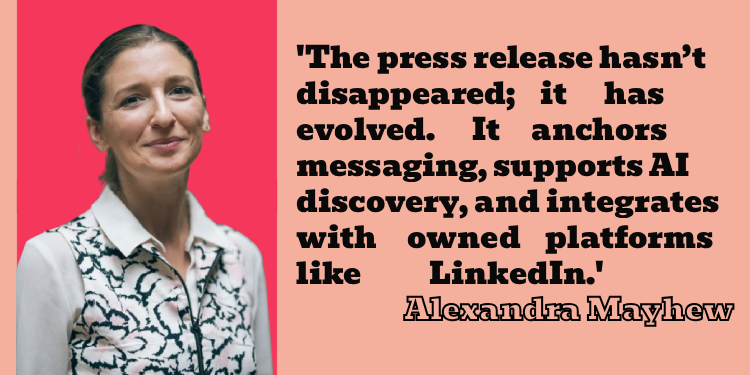
Q. Corporate leaders make important announcements on LinkedIn. Has this platform become an alternative to the press release? As a result has the role of the press release evolved?
The role has evolved, not disappeared.
Organisations increasingly use owned and shared platforms such as LinkedIn to control their message. That does not make the press release obsolete, it’s just playing a different role.
If you’re a good communicator you know that a strong media release aligns leadership, supports internal communication, anchors website content, informs media outreach, and provides a base for amplification. It also matters in an AI-driven environment, where credible, authoritative sources influence how information is surfaced and prioritised (data suggests it’s even more important in AI-search than SEO).
Integration, not replacement, is the real shift.