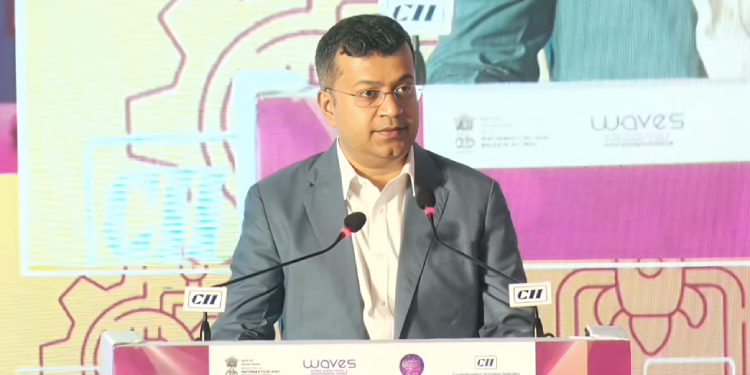
At the CII Big Picture Summit 2025, Gaurav Banerjee, Chair, CII National Council on Media & Entertainment, and MD & CEO, Sony Pictures Networks India, set an assertive tone for the industry’s next decade—urging India’s media and entertainment sector to embrace global ambition and build the institutional backbone required to lead the world’s creative economy.
Delivering the keynote address at the inaugural session, Banerjee said the sector stands at an “inflection point where talent, technology, culture and confidence have aligned,” creating a once-in-a-generation window for accelerated growth. Citing CII’s latest whitepaper, he noted that while the global M&E industry is poised to touch USD 3.5 trillion by 2030, India is projected to outpace global growth by 2.5 times, even though it currently contributes just 2% of global value. “That gap is not a limitation—it is phenomenal headroom,” he said, setting a bold target of a USD 100-billion Indian M&E economy.
“Why should our market be only India?”
Banerjee calls for export-driven creative strategy
The keynote underscored the need to shift India’s traditional definition of success—centered on domestic performance—to a global outlook. Banerjee referenced the South Korean playbook, where the government and industry jointly reimagined content as a strategic export, giving rise to the Hallyu wave.
“They didn’t just export content—they exported belief,” he said, emphasising that India must internalise similar confidence in its cultural storytelling. With Indian music topping North American charts, creators gaining global traction from small towns, and films finding resonance beyond borders, he said global appetite for Indian stories has never been stronger.
Citing the recent box-office success of the animated film Mahavatar Narsimha, Banerjee argued that audiences are rewarding bold, original and boundary-breaking creativity. “The constraint is not the market—it is the ambition we place on ourselves,” he warned.
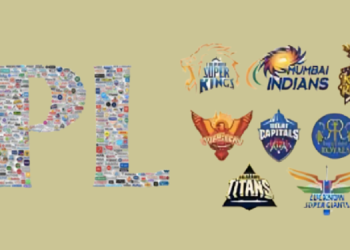
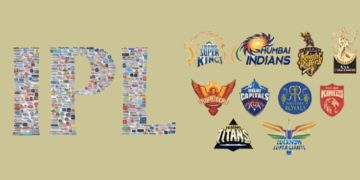
Building the IPL of Creativity:
A call for institutions, clusters and talent density.
Banerjee stressed that scaling global influence requires a structural leap—modeled on high-performance ecosystems like Silicon Valley and India’s own IPL. Both, he said, were built on talent density, institutional support, risk-friendly culture and public-private participation.
To unlock India’s next chapter, he outlined four critical pillars:
1. Next-gen specialised creative institutions
Dedicated schools for writing, animation, gaming, VFX, design and emerging media—at a scale comparable to the world’s leading creative economies.
2. Deep industry–academia linkages
Training that is contemporary, practical and aligned to real industry needs.
3. Regional creative clusters
Talent and technology hubs that represent India’s full linguistic and cultural diversity—not only Hindi-speaking markets.
4. Urgent public–private partnerships
A coordinated approach to scaling capacity and enabling global competitiveness.
“These aren’t gaps—they are opportunities,” Banerjee said, urging the industry to dramatically expand the number of world-class creators India produces every year.
On AI: “Tools cannot define creativity—humans must”
Addressing one of the Summit’s central themes—AI—Banerjee acknowledged the technology’s promise in enhancing efficiency, scale and speed. But he offered a clear caution:
“AI should not define creativity. Human imagination alone should do that.”
He encouraged the industry to explore AI responsibly and ethically, leveraging it as an enabler while preserving the primacy of human storytelling.
Defining success by global influence
Closing his keynote, Banerjee urged the sector to look beyond India’s domestic scale.
“India cannot define success by domestic scale alone—we must define success by our global influence,” he said. If India sets bold ambition, invests in institutions seriously, nurtures creators across all languages, and expands its creative aperture, “India will not just grow—India will lead.”
The CII Big Picture Summit 2025 continues through the day with industry leaders exploring AI, content creation, distribution, regulation and the future of media economics.