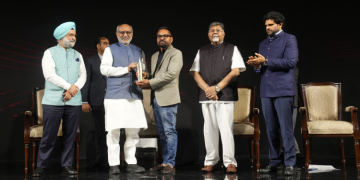
Mumbai: India’s retail market is projected to more than double from approximately ₹90–95 trillion in 2025 to ₹210–215 trillion by 2035, according to a joint report released by Boston Consulting Group (BCG) and RAI.
Titled Winning Codes for Retail 2035: Capturing the ₹200 Trillion Prize, the report examines the key structural shifts reshaping Indian retail, evolving consumer behavior, and the strategic choices retailers must make to stay competitive over the next decade.
India continues to be among the fastest-growing major economies globally, registering GDP growth of 8% in 2025 and remaining on track to become the world’s third-largest economy by 2030. Private consumption, particularly discretionary and services spending, remains a central growth engine, underpinning the projected expansion of the retail market to over ₹200 trillion by 2035.
The report highlights that consumer choice is becoming increasingly complex and context-driven, with rising demand for convenience, personalization and differentiated value propositions. Organized retail, which has historically outpaced category growth, is now witnessing a narrowing growth gap, especially in offline channels — signaling the need for sharper positioning and operating model evolution.
Technology, particularly artificial intelligence (AI), is emerging as a structural disruptor across the retail value chain. Globally, nearly 42% of urban U.S. consumers have already used generative AI tools in their purchase journeys. With India’s internet adoption having grown more than threefold since 2016 and high elasticity for digital adoption, AI-led commerce is poised to scale rapidly, especially in urban centers and among Gen Z consumers.
Beyond front-end customer engagement, AI is transforming core retail functions. According to the report, an end-to-end functional AI transformation can unlock efficiency gains of 40–60%, compared with 10–15% typically achieved through isolated use-case deployments. Notably, nearly 70% of value generated from AI initiatives stems from internal capability building, process redesign and effective change management rather than technology alone.
The report outlines three strategic imperatives for retailers: defining clear focus segments with deliberate trade-offs to deliver a strong customer value proposition; embedding AI across the shopper journey to enhance personalization and conversion; and driving a comprehensive, function-led AI transformation to unlock sustained value creation.
“India’s retail story is an inspiring story – the sector is poised to expand into a nearly ₹200 trillion opportunity over the next decade. More importantly – both the offline and online operating cash flows are showing clear and sharp improvement. The winners of the future will have sharp differentiated value proposition, at scale use of AI and technology and excellent execution”, said Abheek Singhi, Managing Director & Senior Partner, BCG.
“Retail is entering a decisive new phase where AI is no longer a peripheral experiment but a core driver of competitive advantage. Agentic commerce is already influencing how consumers discover, evaluate, and purchase products globally. Given India’s strong digital adoption curve, we expect AI-led shopping journeys to accelerate rapidly in urban India, particularly among Gen Z consumers. The bigger opportunity, however, lies beyond front-end experiences. Retailers that adopt an end-to-end AI-led functional transformation approach—across merchandising, supply chain, marketing, and service can unlock 40–60% performance gains, far exceeding the incremental impact of isolated use cases. To win in India’s complex retail landscape, companies must make deliberate strategic choices: define clear focus segments, align decisions around a distinctive core value proposition, and embed AI across the shopper journey to drive personalization, improve conversion, and reimagine the overall shopping experience”, added Bharat Mimani, Managing Director & Partner, BCG.
“India’s retail industry enters 2026 with three parallel realities: demand remains resilient, consumers are becoming more discerning, and retailers are innovating. The next decade’s ₹200 trillion opportunity will not be captured by sales growth alone. It will be captured by retailers that make explicit business model choices, embed AI across the shopper journey, leverage AI to power agent-led functions, and rebuild talent and operating models with sustained operational excellence. The winners of the next decade will be those who treat transformation as a discipline rather than a project, and who build trust by delivering consistently across formats, channels, and price points,” said Kumar Rajagopalan, CEO, Retailers Association of India (RAI).
As India’s retail sector enters its next phase of structural growth, the report concludes that retailers combining clarity of focus, disciplined execution and AI-led transformation will be best positioned to capture disproportionate value in the journey toward a ₹200 trillion-plus retail economy.