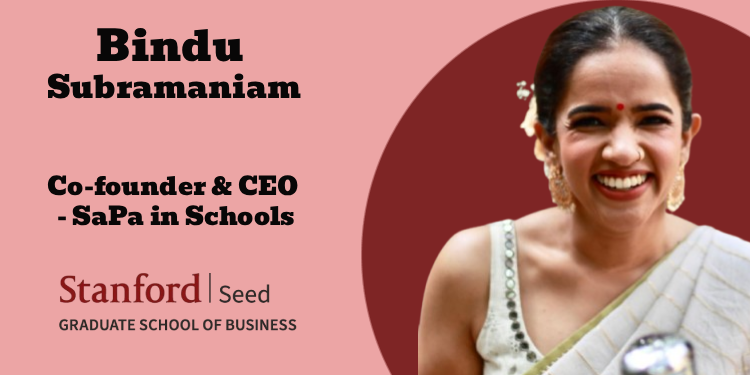
Bindu Subramaniam has been serving as Co-founder and CEO at SaPa in Schools (Past President STN South Asia). Her journey is an example of how purpose-driven entrepreneurship can evolve into institution-building at scale. What began as a personal mission to introduce her daughter to global music transformed into SaPa — now impacting over 30,000 students annually across 100 schools and building one of India’s most structured in-school music education ecosystems.
Beyond her entrepreneurial work, she plays a key role in strengthening founder ecosystems through her leadership within the Stanford Seed Transformation Network (STN) South Asia — a curated community of high-growth entrepreneurs focused on scale, governance, and global competitiveness.
Through STN, she actively contributes to building collaborative founder communities that accelerate growth, enable cross-border learning, and promote ecosystem thinking over isolated success.
Medianews4u.com caught up with Bindu Subramaniam, Co-founder, CEO SaPa in Schools (Past President STN South Asia) for an insightful interaction around leadership, entrepreneurship, and the evolving creative economy in India.
Q. What was the gap seen in the market that led to formation of SaPa?
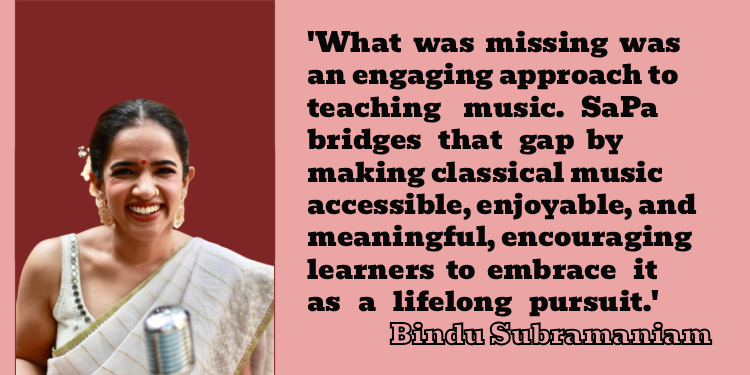
Often, when people found out that I was a musician, they would come up to me and share stories about how, as children they were sent to learn classical music, and they hadn’t really enjoyed it, but they still wished they had stuck with it, so that they could still sing or play as adults.
Hearing these stories and this feedback made me realise that there was nothing wrong with the music itself — what needed improvement was the methodology. I wanted to create a space where learning classical music could be joyful and engaging, even for babies. That became the fundamental premise of the SaPa Baby programme.
When we started SaPa in Schools, it was driven by the belief that every child should have access to high-quality music education as part of their schooling. The benefits are tremendous — not just arts for art’s sake, but in terms of how music helps develop 21st-century skills like creativity, critical thinking, teamwork, and so much more.
These were two very significant gaps that existed at the time, even though we weren’t thinking of them explicitly in terms of market forces or market gaps back then.
 Q. What goals have been set for 2026 in terms of giving the creator economy a boost by giving musicians visibility and education?
At SaPa, my brother Ambi and I been really fortunate to nurture a group of young musicians who are now in their teens and early adulthood, and who have already been performing for the better part of a decade. These young artists have made us incredibly proud — releasing music, winning awards, and contributing to social causes.
As we see them coming into their own, both as individual creators and as ensembles, our role as mentors has also evolved into that of a launchpad. A big part of our focus now is on how we help launch their careers — equipping them with the skills every young artist needs today. This goes beyond performance skills to include recording and production, songwriting and creation, social media content, video editing, and, importantly, helping them understand how streaming, the music business, publishing, and the broader ecosystem actually work.
Q. The aim is to make great music fun. What are the various legs going to be in this goal?
As an educator, my main aim is to always help young people learn to love what they do. If you love it, you can make it fun, and then tremendous amounts of hard work no longer feel like a struggle.
Q. Will SaPa be doing a lot of outreach programmes in schools, colleges to catch children as young as possible? What shape would these activities take in 2026?
2026 has already started off as a pretty exciting year for us. We work with children as young as one and a half years old, and continue all the way through to adulthood. Working across a variety of formats, at our centres, with partner schools, universities, and performing groups, gives us valuable insight into the many different ways young people learn and create.
Our work spans long-term courses, short-term programmes, and a growing number of international collaborations. One initiative we’re particularly excited about is the launch of the first-ever Ofqual-certified exam for Indian classical music, developed in association with MTB (the Music Teachers’ Board) in the UK.
This means that any child who sits a Carnatic music exam, not just SaPa students, can now receive a UK-accredited certificate. I believe this is an important step towards legitimising Indian classical music education globally and giving it greater recognition within formal learning systems.
 Q. How has SaPa benefitted from collaborations with the Norwegian Concert Institute and the NMH? What other collaborations are being looked at?
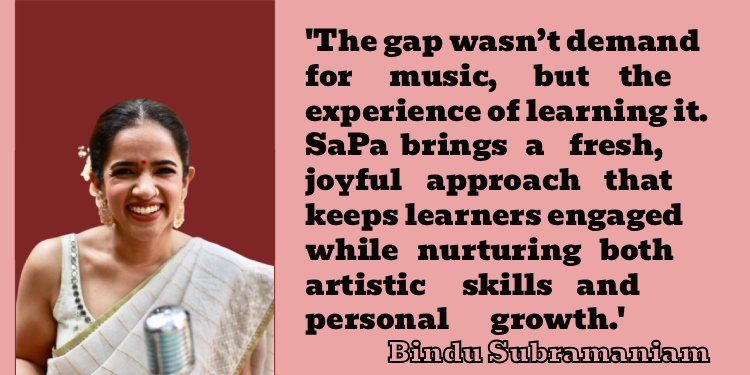
I would say our longest and most successful collaboration has been with the Norwegian Academy of Music. It began as a programme to help train teachers who were going into schools. Through SaPa in Schools, we were developing a curriculum that sought to integrate activities and songs from Indian classical music, global music traditions, and Western classical music, something that hadn’t really been done before in a structured way. And we wanted a methodology that was fun and engaged but didn’t compromise on quality.
Having collaborators like Brit Agot Broske at the table who were deeply experienced in pedagogy, didactics, and teacher training at the highest level, and who were also open-minded, committed, and genuinely excited about the work, was truly game-changing for us. This collaboration has since become a model for several other partnerships within the music education space.
More broadly, we try to stay open and collaborative as an organisation. We often host visiting scholars from different countries and universities, as well as visiting musicians who want to learn more about Indian music and techniques they can incorporate into their own practice. We also have a number of international partnerships in the works that we’re excited to announce soon.
Q. What role does SaPa hope to play to enable music, design, and culture be export industries?
Being from a family of performing artists, export of our culture has been a given. My father, Dr. L. Subramaniam was the first Indian musician to perform in countries like Iceland and Japan. Through SaPa, I think cultural export can be balanced very well with institutional depth. We are creating artists who are technically strong, culturally rooted, professionally trained, and globally conversant.
Our students have performed across the world already, and reach global audiences online too. The thing that is really important is for Indian music or Indian-ness to be seen not just as something exotic, but as contemporary creative capital.
Q.What have been the learnings from SaPa in terms of how purpose-driven entrepreneurship can evolve into institution-building at scale?
I started SaPa with a strong mission, a clear sense of purpose, and very little understanding of what it actually takes to create and run a business. I was so convinced that what I was doing mattered that I was okay hearing “no” ten times a day, every day. At the time, I didn’t think of myself as running a business — I saw myself as someone on a mission, trying to make music accessible to everyone.
In some ways, that mindset helped. But along the way, I also realised that I needed to understand what business is and how it works. I struggled for a while trying to figure all of that out on my own, until I came across the Stanford Seed Transformation Program. That was really where the mental shift happened for me, where I moved from being an accidental founder to a “serious” entrepreneur building a purpose-driven organisation.
Just like in life, in business things don’t always go your way. If you’re making your organisation decisions based solely on a balance sheet, then when things aren’t going well, it becomes much harder to keep going, or even to understand why you should keep going. Having a purpose or mission beyond just profitability is what helps you through the difficult times. More than that, it gives you a vision of something bigger, something better, and something you can continually aspire towards.
For me, the best example of a successful purpose driven organisation is Heads Up for Tails, and I had the privilege of doing the Stanford Seed Transformation Programme with HUFT’s Founder Rashi Narang.
Q. As a female entrepreneur was skepticism a challenge early on?
Most certainly. And when I started I also looked young for my age. Sometimes I’ve gotten mistaken for the EA to the founder, instead of the founder. I’ve also seen an assumption with many female founders that there is a father or husband actually running the business, which isn’t true. I hope our biases around gender and age will go away, but in many cases, they still seem to be alive and well.
 Q.What would you like to see the Government do from a policy perspective to enable the creative economy be India’s Next Growth Engine?
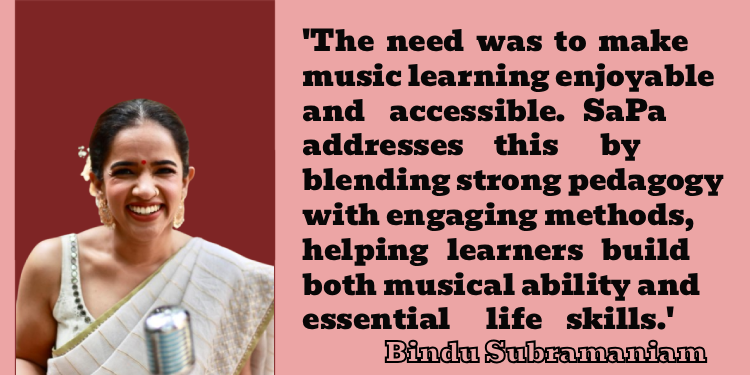
I think ecosystem building is critical at this juncture. If we truly believe the creative economy can be a growth engine, policy needs lead to meaningful investment in arts education, teacher training, and cultural institutions; we need clearer and more accessible IP frameworks for creators; there should easier access to capital for creative MSMEs; and there structured support for cultural exports and international representation.
Q. STN focusses on building collaborative founder communities that accelerate growth, enable cross-border learning, and promote ecosystem thinking over isolated success. What does all this entail?
The Seed Transformation Network is a powerful group of like-minded founders who are willing to admit that they don’t know everything and are keen to evolve and grow. There is a leave-your-ego-at-the-door situation, and it helps people see eye to eye, support each other, partner, learn and bring about positive change at scale.
And it’s great to see the network’s presence at all the world’s major events, from the Global AI Summit to the WEF at Davos, with members as thought leaders guiding discourse.
Q. What role is AI playing in helping STN build founder communities?
I think anything that I say about AI can evolve in a day or week, but I would like to say that the STN is currently leveraging AI in a number of ways, from building shared institutional memory, to facilitating collaborations and building models for scale.
Q. What role can IP creation play as a long-term wealth model?
Intellectual Property allows work to live beyond the moment of creation and create value that endures. As an artist, I’ve seen first-hand how synch rights and publishing create ongoing revenue for existing works.
As an entrepreneur, I’ve seen how IP in the form of books and learning materials create lasting, recurring value. I think it’s critical for every creator and every organisation to have an IP strategy.
 Q. In working within the Stanford Seed Transformation Network (STN) South Asia to create a curated community of high-growth entrepreneurs focused on scale, governance, and global competitiveness what is the big challenge?
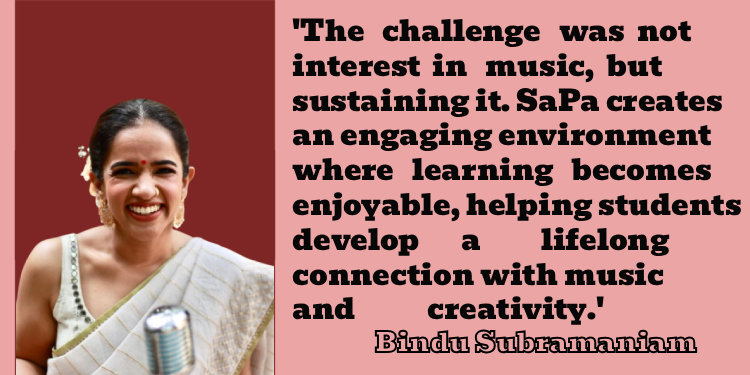
The Seed Programme makes us all think not only about how to do our best for our businesses, and our people, but really for the economy, and the world at large.
I think most founders in the network feel a shared responsibility for the SME ecosystem at large, and we are thinking about how we can do better for everyone, together.
![Beyond Ello, you can expect [x]cubeLABS to lead the transition from generic “chatbots” to Vertical AI Agents: Sridhar Muppidi](https://www.medianews4u.com/wp-content/uploads/2026/03/Sridhar-Muppidi-Ello-350x250.png)