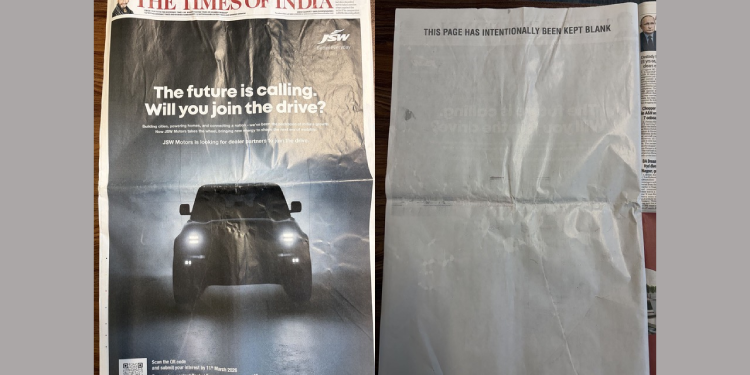
Mumbai: JSW Motors Ltd.’s high-visibility newspaper teaser for its upcoming auto foray continues to draw scrutiny from senior marketing and brand leaders, with several CXO-level voices questioning whether the campaign’s minimalist “blank page” device is strategically misaligned for a new automotive entrant actively courting dealer partners.
The print execution featured a front-page announcement followed by an intentionally blank inner page—an established creative trope used by legacy or luxury brands to signal confidence through silence. However, industry observers argue that for a new-to-market manufacturer without automotive equity, the device risks creating intrigue without conveying business substance.
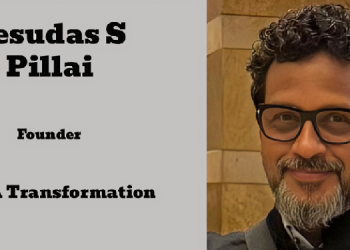
Yesudas S. Pillai, ad industry veteran and co-founder of Y&A Transformation, had earlier framed the move as “attention without direction,” noting that dealer audiences typically expect clarity on fundamentals rather than symbolic theatre.
CXO Voices: “Silence without context says nothing”
Several senior industry leaders echoed similar concerns in response to Pillai’s analysis, highlighting gaps in partner signalling and communication clarity.
Retail and e-commerce leader Vivek Mathur questioned whether the blank page held any communicative relevance in an advertising context. “This text is usually seen in contracts when there is a blank page. It has no relevance in an ad,” he noted, adding that if the page was indeed paid media, the decision appeared “not very clever.”
Brand and digital advisor Ashok Lalla raised a more fundamental effectiveness issue: whether readers would even connect a blank page to the preceding JSW advertisement. “The blank page says nothing. It means nothing. Conviction, certainly not,” he observed, suggesting that even potential dealer partners may miss the intended linkage.
Marketing advisor and innovation facilitator Sanjeev Kotnala termed the execution an “under-utilisation of opportunity,” arguing that given the stakes around product, brand and channel approach, leaving a paid page blank amounted to a strategic lapse.
Former Advertising Club president and media veteran Partho Dasgupta pointed out that the blank-page device itself is not unprecedented, recalling its use by Fox Studios in a New York Times film promotion over a decade ago—though in a very different brand-equity context.
Dealer Lens: Clarity Over Curiosity
Automotive dealer recruitment communication traditionally centres on tangible fundamentals: product roadmap, territory logic, capex and ROI model, service ecosystem, and parent-group backing. A blank page, critics say, addresses none of these.
“Partners don’t respond to mystery, they respond to clarity,” Pillai had argued, suggesting the campaign spent premium media on awareness but failed to articulate why dealers should commit capital and reputation to an unproven mobility venture.
Minimalism Without Message?
Industry observers note the campaign did not need to abandon minimalism to add purpose. Even a sparse execution could have carried a single strategic statement—JSW’s mobility ambition, partner-led ecosystem vision, or manufacturing thesis—thereby anchoring curiosity in meaning.
Instead, the blank page has been interpreted by some as what Pillai termed a “missed handshake” with prospective partners.
The Larger Launch Question
The episode surfaces a broader issue for new automotive entrants: brand theatre versus business signalling. In capital-intensive distribution categories, early communications often double as credibility scaffolding for channel partners, suppliers, and investors.
“If you cannot use a full newspaper page to explain why a partner should bet on you, it raises questions about preparedness for deeper engagement,” Pillai argued.
JSW Motors has not commented publicly on the campaign or the industry reaction at the time of publishing.