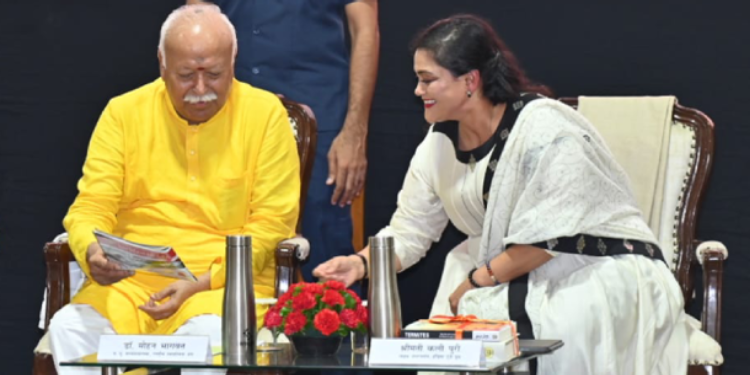
New Delhi: India Today Group Vice Chairperson Kalli Purie has called for stronger representation of women in the leadership structures of the Rashtriya Swayamsevak Sangh (RSS). She made the remarks in the presence of RSS chief Mohan Bhagwat during the launch of “Tan Samarpit, Man Samarpit”, a biography of swayamsevak Ramesh Prakash, published by Suruchi Prakashan.
Purie, reflecting on her engagements with the RSS, highlighted the organisation’s discipline, simplicity, and rare ability to pursue long-term planning through its centennial blueprint. She also spoke about the Panch Parivartan vision and introduced India Today’s Gross Domestic Behaviour (GDB) initiative, which tracks societal attitudes on civic discipline, inclusivity, gender, and corruption. Stressing that corruption must not be normalised as a way of life, she urged for systemic reforms and greater inclusivity in leadership.
Responding to her observations, RSS Sarsanghchalak Mohan Bhagwat addressed the themes of social transformation and women’s participation. On transformation, he remarked: “Change in society will come only when it comes in the life of the swayamsewak. Knowledge alone is not enough. Transformation requires discipline, example, and practice.”
On women’s representation, Bhagwat underlined the role of the Rashtra Sevika Samiti, an all-women organisation founded in 1936, which operates parallel to the RSS. “Wherever there are swayamsevaks, women are alongside. In many regions, women are part of decision-making, invited into core meetings, and their proposals are included. Fifty percent of society cannot be kept outside,” he said.
He further noted that organisational processes vary across states, which he described as a sign of the Sangh’s adaptive and evolving nature. Stressing the need for balance, Bhagwat added: “Rashtra seva should never come at the cost of family duties. The two are complementary, not contradictory.”
The exchange highlighted the growing conversations around inclusivity, gender roles, and systemic reforms within India’s socio-political landscape, offering a rare moment of dialogue between the leadership of India’s largest socio-cultural organisation and voices from the media fraternity.