Wolfzhowl says that it is a behaviour change strategy and tech specialist that work across the brand’s ecosystem. It helps marketing, sales, human resources, digital sales teams. It blends behavioral insight, marketing technology, and orchestration thinking to unlock results across marketing, HR, CX, sales, and innovation. It focusses on impacting behaviour change across the function of a brand’s ecosystem with a slew of end to end services.
WolfzHowl says that it does not just craft brand strategies—it brings them to life with powerful brand creative development consulting and execution. Whether it’s creating a new brand positioning, rejuvenating an existing purpose, or developing a campaign strategy, WolfzHowl has consistently delivered impactful brand narratives across more than 18 categories.
Its expertise it added extends beyond working directly with brands; it also collaborates with creative and digital agencies, integrating seamlessly to enhance their creative output with strategic depth.
It says that the DNA and culture that drives its W:OS – wolves operating systems is:
– The child-like enthusiasm for decoding culture
– The inability to stop itself from connecting the dots
– A passion for uncovering patterns
– An ambi-dexterity between the literal and the lateral
– The hunger for conversations with humans (consumers, KOLs, Influencers, Clients, Economists, Politicians, etc) helps it remain outcome focussed
– An insatiable curiosity while observing human behaviour
– A passion for data
– A greedy gratification of seeing new behaviours triggered
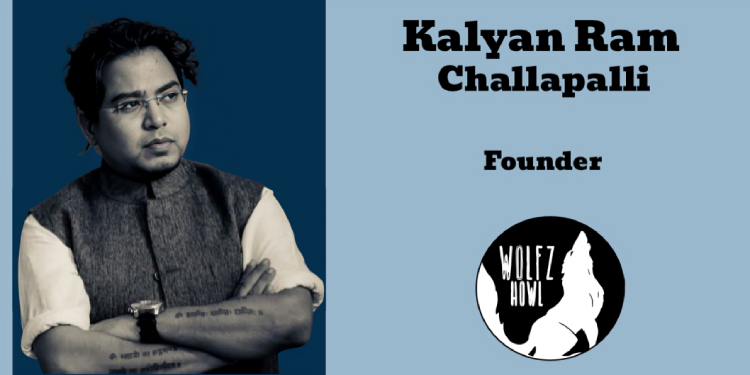
Medianews4u.com caught up with Kalyan Ram Challapalli Founder Wolfzhowl Global
Q. The agency space is seeing consolidation. What are the implications of this for independent agencies like Wolfzhowl?
Consolidation isn’t new: networks constantly absorb brands internally. The Omnicom-IPG merger is certainly a headline-grabbing version and happens once in a few years. The logic is sound: bring scale and expertise under one roof to offer integrated solutions.
But it’s a double-edged sword. In pursuit of comprehensiveness, networks risk becoming indistinguishable from each other. Depth gets traded for breadth. Unconventional thinkers find less room to operate. That gap is where independents thrive through structural differences.
We can be more responsive, maintain agility, and critically, remain a neutral voice unburdened by network imperatives. Our positioning sits right at the intersection of what’s best for clients, not what’s profitable for a holding company’s quarterly earnings.
Q. Is Wolfzhowl open to being acquired or inorganic growth through an acquisition?
We never say never, but understand what you’re acquiring. Wolfzhowl operates beyond standard consultancy norms—intellectually, industry-wide, and at macro societal levels.
Thirteen years of organizational development, rigorous methodology, and strategy work that transcends communication and works across HR, Sales, Marketing and data & intelligence divisions of organizations isn’t easily transplanted into a network structure.
Our clients are addicted to our intent & intensity & also are our biggest advocates and new biz people (infact a lot of ex-wolves also drive equity & business for us). WolfzHowl dosent do pitches.
If an acquirer genuinely comprehends our passion-driven obsession and respects how we cultivate our wolves and can help scale our intent then we’d say yaay. But Good luck with that.
Timing-wise, we’re entering our most prosperous era—AI amplifies capabilities but can’t replicate depth of thinking. Furthermore, we’re already pursuing synergies selectively: like collaborations with Brand Odyssey and a few others we are speaking to at both national and hyper local level for execution.
We are also soon scaling-up WolfSight our super special intelligence agency, as AI has made it so labor free to analyze and also offer our premium strategic research at a lesser cost and quicker to client. We do inteligence consolidation, strategic behaviour change research, phenomenon and trend mapping etc and have superb POC’s/Case Studies. AI has just been a boon of a man Friday for WolfSight.
Apart from this, Strategic partnerships, yes. Absorption into homogenized structures? That’s the long shot.
Q. How is consolidation going to change the relationship dynamics between clients and agencies in areas like the Point Of Contact in an agency?
Consolidation forces clients to re-establish chemistry with new points of contact and adapt to unfamiliar ways of working. Brand-specific expertise built over time can disappear overnight during transitions.
Skills and institutional knowledge don’t transfer seamlessly. Clients absorb the operational disruption of structural changes they didn’t request- rebuilding relationships and navigating new processes while their business objectives remain unchanged.
If agencies actually have a combination of a generic servicing person along with an integrated strategist, the POC based brand management becomes easy. Otherwise my god there is going to be chaos and madness managing clients.
Q. How is AI going to reshape the agency business in 2026?
AI has already absorbed parts of research, brief-writing, content creation, copy editing. 2026 is the reckoning year: not about possibilities, but operational fit.
Where does it replace humans? Where does it augment? What works with basic prompts versus sophisticated ones? Agencies need these answers to reshape service structures intelligently.
Clients will ask harder questions about billing: where is human intelligence actually deployed? Low-hanging fruit: content repurposing, translation, repetitive tasks, gets fully automated. Operationalization matures. But here’s the division: AI handles execution brilliantly; it can’t architect strategic depth.
The agencies that thrive won’t be those using AI most extensively, but those who’ve mapped precisely what it does well, what remains untouchable, and how it integrates without compromising intellectual rigor.
Q. Integrated agencies versus specialist models across India’s competitive landscape. What do clients prefer in 2026 based on discussions?
Large brands gravitate toward networks for replicable global operating models. Unilever, Mondelez need consistency across markets, and integrated agencies deliver that apparatus efficiently.
But when they require specialist knowledge: culture-led insights, behavioral nuance, emotional undercurrents that AI-led frameworks systematically underweigh because they can’t be neatly quantified, they turn to firms like Wolfzhowl.
It’s horses for courses. Standardised approaches and scaled execution? Networks handle that well. Deep specialisation in areas that resist algorithmic reduction? That’s where specialists justify their existence.
Clients in 2026 aren’t choosing integrated versus specialist as ideological camps. They’re architecting agency ecosystems, deploying each model where it demonstrably outperforms the other. The question isn’t preference; it’s precision in matching capability to complexity.
Q. What is the gameplan for 2026 in terms of scaling its stratech philosophy?
2025 was about evangelizing Stratech as pioneers, making brands aware of its necessity and value. That groundwork proved fruitful. 2026 shifts from awareness to validation.
We’re building case studies around actual Stratech execution in real-world client environments. The focus narrows: demonstrating precisely how strategy and technology converge to deliver superior experiences clients demand and value brands require.
It’s no longer theoretical positioning; it’s empirical proof. How does the integration function operationally? Where does it outperform siloed approaches? What measurable outcomes emerge?
This year documents the methodology in practice, not in principle. We’ve established the why. Now we’re systematically proving the how. After all, that’s what scales a philosophy into industry standard: evidence, not evangelism.
Q. Last year Wolfzhowl expanded to Southeast Asia and Australia. So far what progress has been made? Is the agency looking at other markets?
We’re consolidating what we launched. Southeast Asia and Australia are complex markets that require depth, not just presence—that’s the focus for 2026. Expansion continues, but strategically.
The Middle East is on the radar. Eventually US and Europe. We don’t rush geography for the sake of a map with more pins. Markets get added when we can operate at the standard we’ve set, not when opportunity knocks loudly. Expansion without operational excellence is just expensive tourism.
Q. Is fragmentation of attention spans the biggest challenge facing Wolfzhowl in 2026 regardless of whether it is India or abroad?
The bad news: fragmentation is accelerating, not stabilising. Search is moving from browser-based to agentic. Purchases follow the same trajectory.
Brands face exponentially more complex coverage requirements across channels. The winners will be those who anticipate behavioral shifts and architect presence accordingly.
For Wolfzhowl, this isn’t a challenge- it’s ideal terrain. We’re fundamentally a behaviour change consultancy tracking precisely how purchase decisions evolve online and offline. Fragmentation becomes manageable when you anchor to consumer truth first, then design outward.
We’re structured specifically to target this gap: helping brands build codes that stick because they’re rooted in truth, not chasing fragmented touchpoints reactively. The fragmentation others fear is the complexity we’re built to decode.
Q. Gen Alpha does not tolerate mediocrity at all compared to older TGs. As a rule is it harder to help brands connect meaningfully with this TG?
So cute is pre-baby boomer generation (especially the small town ones) with certain modifications seem to have been reborn as Gen Alphas (or atleast a certain percentage of their traits and values are).
Gen Alphas and WolfzHowl:
As wolves: Gen Z & even more Gen Alpha, we are lobing hiring and working with this exact trait of serious passionate intensity is being loved by WolfzHowl about them and them about WolfzHowl ☺
Now on to Gen Alpha as consumers
Gen Alpha’s intolerance for mediocrity stems from mindful consumerism. Environmental factors reinforce this—rising rents mean extended cohabitation with parents, making them more family-oriented than predecessors. They reject mindless consumption outright.
They’re environmentally conscious, continuing Gen Z’s trajectory but deepening it: consumerism with conscience. Interestingly, they resemble Millennials more than Gen Z: minimalism is resurfacing, there’s a pull back to roots.
Does this make connection harder? Only if brands operate on autopilot. Gen Alpha rewards intentionality and authenticity, punishes performative gestures instantly.
For agencies capable of rooting strategy in genuine consumer truth rather than demographic stereotypes, this clarity is advantageous. They’re discerning, not difficult. That distinction matters.
Also can you do intent, integrity in a fun and experiential manner without guilt tripping them for strands of consumerism & indulgence and for acting in contrast to some of their core traits.
Q. Could you talk about the key categories that Wolfzhowl will work with in 2026 like FMCG, Beverages?
BFSI, Luxury, FMCG, Retail, Realty, Automotive, Social Impact, CSR and a few services like Brand Purpose, Personas crafting 0 data and culture led, these are the core categories for 2026. We’ve built authority across these categories proving one principle: behavior change proves to be of immense value regardless of sectoral nuance.
Occasionally we do FMCG and other categories also and B2B is becoming big for us. Hyper Local is driving growth for us too.
Q. In 2026 has a data driven approach become a must in marketing? Will success lie in looking at only set data sets like what Wolfzhowl did for ICICI Bank?
Data has become commoditized. What was once a strategic asset is now ubiquitous, flooding every aspect of decision-making. However, most data misses cultural nuances, analog behaviors, and qualitative depth. Digital signals dominate and sometimes mislead.
Data matters: numbers provide perspective, challenge biases, ground intuition in reality. But our data-driven approach embeds data within the larger system of culture and behavior, combining quantitative rigor with insights that are rooted in real-world behaviour and culture.
The ICICI work demonstrated this integration, but if we executed it today, it would be richer. AI has made data crunching easier, creating space to focus on what machines can’t capture: the underquantified human elements that determine whether strategy works in the market. Data-driven is important. Data-only is myopic.
Q. Is moment marketing going to be an important focus area for Wolfzhowl in 2026?
Moment marketing misses the fundamental question: where do moments come from? They emerge from cultural shifts and trends shaping collective behavior.
The opportunity isn’t reactive participation, it’s understanding which cultural currents create moments worth interjecting into. We’re structured to decode this. Our methodology tracks how culture evolves, identifies inflection points, and architects activations and nudges that leverage those illustrations strategically.
Most agencies chase moments after they’ve formed. We map the conditions that generate them. It’s not about speed to trend; it’s about cultural fluency that anticipates which moments will carry resonance and which will evaporate.
Moment marketing remains relevant for 2026, but only when rooted in rigorous cultural understanding, not social media reflexes. That’s where our approach separates signal from noise.
Q. Wolfzhowl has worked in hospitality. Consumers today use LLMs to experience what brands in this sector like luxury hotels have to offer. They are going beyond Google Search into AI Search. What opportunities does this behaviour present to players in this sector and for agencies like Wolfzhowl?
AI search has become inevitable in the purchase journey, fundamentally altering how consumers research hospitality. Traditional search queries hit brand websites with limited scope.
AI search aggregates content from Reddit threads, review platforms, niche forums, and synthesizes answers to specific questions standard search can’t address efficiently. This creates two imperatives for brands: ensure content architecture aligns with questions consumers actually ask, and recognise that AI handles follow-up queries conversationally.
But there’s a deeper behavioral insight: consumers use AI for reassurance, specific answers, clarity. Understanding what questions people actually ask reveals unmet needs, further informing not just content strategy but product and service design itself.
For Wolfzhowl, where we cover the entire business funnel and not merely communication, the opportunity is dual: architect brand presence across the fragmented content ecosystem AI mines, and decode query patterns to guide experiential offerings.
Make sure the right signals exist where AI looks, then use those insights to shape what brands actually deliver.
Q. Does Wolfzhowl see retail media maturing in 2026?
Retail media is maturing rapidly. Google, Meta, TikTok remain dominant, but Amazon and marketplace players are establishing serious infrastructure, poaching talent from consultancies and media agencies because they recognize the strategic value.
India’s growth trajectory suggests we’re not far behind this evolution. We’re tracking developments closely, and one certainty emerges: behavioral insights will be decisive in unlocking retail media conversions.