Consumr.ai is a consumer intelligence platform developed by ProfitWheel, designed to transform complex consumer research into straightforward, agile digital strategies. It integrates real-time consumer behavioral signals and acts as a layer of intelligence over major audience-based platforms such as Amazon, Meta, Google, YouTube, TikTok, Twitter, and Snapchat
ProfitWheel’s role in the market: In a landscape where traditional targetting signals are breaking down and privacy expectations are rising, this platform makes a case for a shift from demographic-based marketing to real-time, behavior-led strategies. It explores how brands can build dynamic behavior graphs using first-party data, AI, and contextual signals — moving beyond personas to a more fluid, intent-driven approach. It’s not just theory — this trend is being powered by AI and first-party data.
The platform focusses on enabling brands to personalise at scale, react in real time, and unlock a clearer view of the consumer journey. Companies like Netflix and Spotify have long built strategies this way — now, it’s becoming accessible to marketers across industries.
Medianews4u.com caught up with Vivek Bhargava, Co-Founder ProfitWheel (consumr.ai) and a veteran leader in the ad-tech industry. He established consumr.ai as a solution that solves the industry’s biggest challenge — turning first-party data into strategic action.
Q. What progress has been made since ProfitWheel launched in 2020? Has it focused mainly on D2C brands?
ProfitWheel, the company behind Consumr.ai, was founded in 2020, at a time when the marketing world was undergoing significant transformation. The pandemic accelerated digital behaviour, and with it came an explosion of first-party data.
At the same time, offline channels were disappearing, cookies were crumbling, and brands were under pressure to make smarter, more compliant decisions. They suddenly had more behavioural signals than ever, but no clear way to act on them.
The consumr.ai platform was launched around 2.5 years ago in the USA. Over the last two years, we have primarily focused on the US market, fortunate to have had the opportunity to work with Fortune 100 clients in the BFSI, E-Commerce, and consumer electronics sectors.
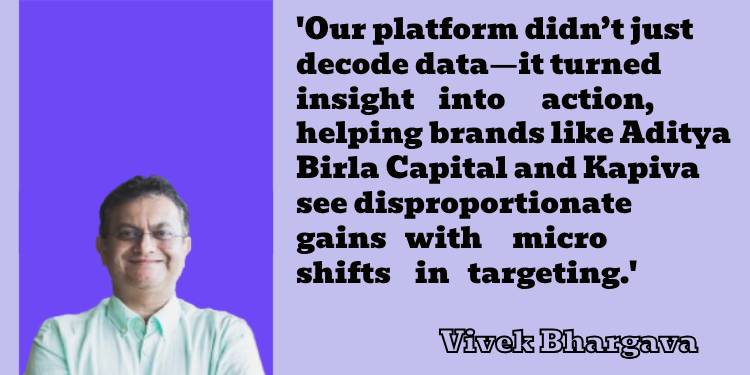
Once we turned profitable in 2025, we decided to launch outside of the USA. Since then, we have launched in India, Japan, the Middle East, and Australia. Our biggest achievement has been helping brands turn data into insight, and that insight into action. Our early adopters were from the BFSI and D2C industries, brands like Aditya Birla Capital and Kapiva, who understood that in a high-consideration category, even small shifts in targeting can lead to disproportionate gains.
They were among the first to see the value in using behavioural signals to build smarter acquisition and retention strategies. Since then, we’ve expanded into D2C, real estate, wellness, and healthcare industries, where behavioural context is increasingly outpacing demographic assumptions.
We now work with brands across stages and sectors, not because we built for one vertical, but because we built for a new mindset.
Q. ProfitWheel describes its offering as ‘profit-as-a-service’. How is this philosophy being delivered through Consumr.ai, and what does it mean for marketers in practice?
When we founded ProfitWheel, we aimed to address a fundamental gap in the ecosystem: the disconnect between martech and adtech, and between data and decisions. “Profit-as-a-service” is our philosophy of bridging that gap. It’s the belief that technology shouldn’t just generate insights, it should help brands act on them profitably.
At its core, consumr.ai uses AI to simulate your ideal customers, not just describe them. It maps how they behave, what drives their decisions, and where they can be influenced. These AI Twins go beyond analytics by enabling brands to predict intent, anticipate actions, and align strategies in real time.
We’re not in the business of building dashboards. We’re building a system that learns continuously from behavioural signals, turns them into intelligence, and then closes the loop by guiding execution across media, creative, product, and growth.
That’s what “profit-as-a-service” means in practice: AI that doesn’t just explain the past, but actively shapes better marketing outcomes. That’s precisely what today’s marketers are demanding: not more data, but more decisions that move the needle.
We power all consumer-facing decisions, whether it’s media, creative, content, influencer selection, or even product development. We are helping brands like Kapiva quadruple their market share through more effective positioning of their products.
Q. How does Consumr.ai help brands actually act on first-party data?
Let’s be honest, everyone says first-party data is gold, but most of it just sits in silos or dashboards. What’s missing isn’t data, it’s direction.
What we’ve seen is that brands don’t lack intent or access to data; they lack the ability to use it well. They’re capturing behaviours, visits, add-to-carts, and email clicks, but they’re still making media and content decisions based on assumptions or last year’s persona decks.
At Consumr.ai, we ask a different question: “What if you could simulate your best customers before spending a rupee?” That’s what our module, AI Twins, allows you to do and more.
We take your real customer data and layer on contextual behaviours, including what they’re searching for, watching, and engaging with across digital platforms, to create dynamic, evolving profiles that behave like your top 5% customers.
But it doesn’t stop at simulation. AI Twins helps you understand what truly drives high-value behaviour, predict how different strategies might land, and, most importantly, act — whether that’s building sharper media plans, more resonant messaging, or even new product propositions.
This isn’t about another analytics dashboard. It’s about wiring these insights into your media plans, creative briefs, and even product roadmaps. We’ve seen brands skip months of guesswork and thousands in testing budgets because they were able to run those decisions through a behavioural lens first.
Two things that make consumr.ai different from all other intelligence platforms are that we help brands utilise their first-party data in actionable cohorts, and this is done in a privacy-safe manner that meets all privacy standards, including those of the GDPR and CCPA.
Q. How does first-party data and AI improve marketing in a world where 20% of consumers drive 80% of profits?
Because in a world where a small fraction of your base drives the bulk of your profit, knowing who they are isn’t enough. You need to understand why they behave the way they do and how to encourage them to keep coming back.
We use Agentic AI to unpack that by detecting subtle behavioural cues, recurring triggers, and content patterns that point to high-value intent. It could be a time-of-day signal, a platform usage pattern, or even a combination of interest clusters that wouldn’t be obvious without the right behavioural lens.
Once brands start optimising for these behaviour clusters instead of blanket demographics or last-click attribution, two things happen: acquisition becomes more efficient, and lifetime value starts to compound. That’s the multiplier effect.
What powers that multiplier is our agentic AI, a layer within Consumr.ai that doesn’t just process behaviour, but acts on it. At the heart of this are AI Twins: intelligent modules that replicate the behavioural DNA of a brand’s most valuable customers. These aren’t static profiles. They’re dynamic, learning agents that observe evolving signals across your first-party data and respond.
That’s what we mean when we talk about AI with agency. It doesn’t just give you answers. It knows when to act, what to prioritise, and how to keep your top 20% coming back, not just once, but over a lifetime. We helped an American Glucose Monitoring Company identify a single interest that allowed them to target customers who would have a 10x more lifetime value. This single actionable insight led to a vast delta in their profitable growth.
Let’s say an AI Twin detects a shift in purchase timing, or a sudden spike in intent around a product feature. It doesn’t just log that change. It updates the profile, reprioritises media recommendations, and flags creative opportunities, often in real time. These agents are not waiting for a marketer to ask the right question. They’re already moving in the direction of higher return.
Q. Why is it important to shift from demographic to behaviour-led marketing?
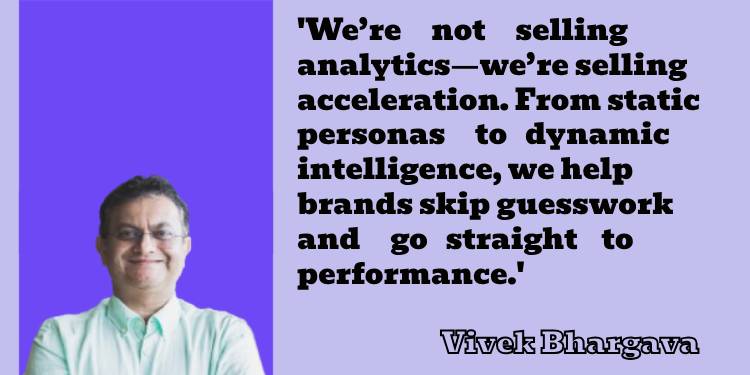
Demographics tell you who someone is. Behaviour tells you what they’re actually doing. And in today’s dynamic digital landscape, it’s the doing that drives decisions.
The traditional approach of targeting based on age, gender, or location assumes that people within a segment behave uniformly. But real-world behaviour has broken out of these boxes. A 45-year-old in Mumbai could exhibit the same digital purchasing habits as a 25-year-old in Jakarta, and that’s invisible if you’re only looking at demographics.
That’s why behaviour-led marketing is no longer just a competitive edge; it’s foundational. It enables brands to respond to what consumers are exploring, engaging with, or buying in real time, not based on outdated assumptions or lagging survey data.
At consumr.ai, we see this shift play out every day through AI Twin, our platform that builds a behavioural mirror of ideal customers, by observing actual online journeys: how people discover a product, what content influences them, which platforms they trust. We help brands connect with their most valuable audiences not just based on who they are, but on how they act.
It’s the difference between guessing and knowing. And in an era of fragmented attention and rising acquisition costs, that precision is game-changing.
Q. How does consumr.ai’s AI Twin model lead to better conversions?
Traditional marketing often targets broad segments, assuming that demographics or interests predict behaviour. But in reality, intent isn’t demographic, it’s behavioural. That’s where the AI Twins change the game.
Built on real-time observed actions, searches, scrolls, comparisons, and content depth, the AI Twin maps how high-value customers actually decide. It models not just what they engage with, but in what order, how often, and with what level of intensity. This behavioural sequencing reveals when someone is casually browsing versus showing conversion-ready signals.
For example, two users might watch the same probiotic video. But only one searched for “best probiotic for bloating” afterwards, then visited product pages and read reviews. That layered behaviour is what the AI Twin captures, and it helps brands act at exactly the right moment, with the right message.
Now, imagine mapping these across thousands of users. You start seeing clusters of intent: “users considering refinancing but browsing skincare content,” or “first-time home buyers comparing project amenities but also engaging with parenting content.” These aren’t guesses. They’re observed behaviours.
The result? More efficient media, sharper creative alignment, and higher-quality conversions, driven not by assumptions but by actual decision journeys.
Q. Any standout use cases that show personalisation, agility, or journey mapping in action?
A clear example of this in action is our work with Aditya Birla Capital. The objective was to improve conversion efficiency in their digital insurance portfolio, a category that, like many others, has long depended on static demographic assumptions. Our AI Twins module approached the problem in a different way. It built high-intent behavioural lookalikes not on who consumers appeared to be, but on how they actually behaved, what they searched for, what they engaged with, when they returned, and the signals they triggered along the way.
What emerged wasn’t speculative. It was a repeated, data-backed pattern: a segment that had been consistently overlooked in legacy planning, which was women actively exploring insurance. Not a niche outlier, but a commercially viable group with measurable intent. The AI didn’t just surface the insight; it reprioritised the opportunity in real time.
The result was significant. Over 90% of conversions in the campaign came from this newly identified segment. The media mix didn’t change, but the strategy did, because the AI Twin identified a behavioural opening that traditional frameworks simply wouldn’t have revealed. That’s the difference agentic AI makes; it doesn’t just observe or optimise, it takes initiative. It identifies what others overlook and does so quickly that brands can act with confidence.
Also, they were facing difficulty targeting women customers; behavioural targeting helped them double their women acquisition rates compared to their other campaigns.
Q. What truly drives consumer decisions: price, product, or brand emotion?
The truth is, it’s not a fixed hierarchy. What drives a decision isn’t just one factor, such as price, product, or brand emotion; it’s the interplay of all three, filtered through context and behavioural intent.
At consumr.ai, we’ve seen that consumer decisions are rarely linear. People don’t wake up thinking, “I want a probiotic under ₹500 from a brand that makes me feel good.” Instead, they move through fluid journeys, where different drivers matter more at different moments.
For example, early in the journey, emotions often take the lead. A relatable reel about bloating or an influencer sharing a personal story may spark curiosity.
As interest deepens, product features and credibility become increasingly important, and people start comparing ingredients, formats, or certifications. Price usually comes last, but only if the product has already passed the behavioural and emotional cut.
What’s most important is understanding when each lever matters. For a low-consideration product, price might dominate. For wellness or finance, trust and emotional resonance may outweigh even a better product on paper.
This is why observing behaviour in context is so powerful. The AI Twin doesn’t guess at what matters, but it watches real-world decision patterns unfold. We’ve seen users abandon a cheaper product if reviews lacked empathy. We’ve seen high-priced offerings win because the brand told a more human story, earlier in the journey.
So, the answer isn’t price, product, or brand. It’s understanding what matters most to your customer, in that specific moment, and shaping the experience accordingly.
That’s where true decision intelligence lies.
Q. What can marketers learn from Netflix and Spotify?
Netflix and Spotify have taught us that the future of engagement isn’t just about having more content or better products; it’s about reducing decision friction.
These platforms understand something most marketers still miss: consumers don’t want more choice, they want better guidance. And that guidance comes from understanding behaviour in context. Not in abstract, but as a stream of decisions: what we skip, what we rewatch, what we sample at 2 AM when we can’t sleep.
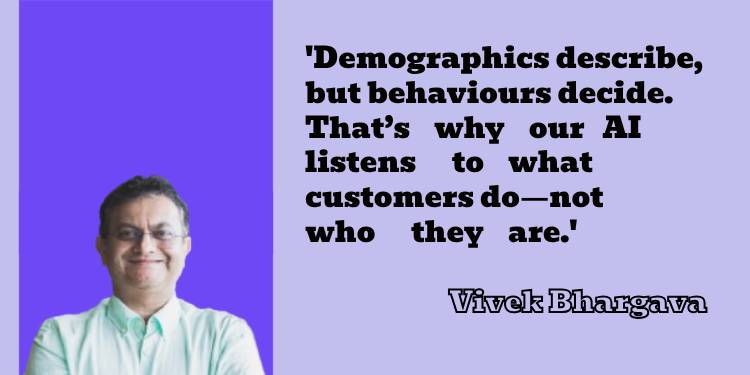
They don’t personalise based on who we are demographically, but based on how we behave. And crucially, they don’t wait for intent to be declared. They infer it from subtle patterns: recency, frequency, depth of engagement, and time of interaction. A skipped track means something. A rewatched episode says something else.
This is what marketers should take seriously: Personalisation isn’t about tagging users with labels. It’s about reading the signals that people leave behind when they’re not trying to be studied.
The same principles apply to consumer decision-making across categories. Whether someone’s buying skincare, insurance, or food supplements, the path to purchase is non-linear, mood-driven, and shaped by micro-decisions. And the brands that can detect where someone is in that journey and respond with relevance, not noise, will be the ones that feel closest to their customers.
The lesson is simple: watch what people do when they think no one is watching. That’s where the truth of intent lies. Netflix and Spotify are just doing it better so far.
The consumr.ai provides brands insights into what music their customers like, what shows they have a higher affinity for, not only transforming their ability to choose influencers, but also their sponsorships and media buys.
Q. How does Consumr.ai approach consumer privacy, particularly in comparison to Meta or Google?
Our approach to privacy starts from a fundamentally different place.
Unlike Meta or Google, which operate closed ecosystems built on identity, persistent tracking, and cross-platform data collection, consumr.ai is designed around anonymity, consent, and behavioural context, not personal identifiers. We don’t build identity graphs. We don’t track individuals across the internet. And we don’t need to.
Our AI Twin models are built on aggregated, anonymised behavioural signals, i.e. how people search, explore, and act online, without ever attaching that behaviour to a known individual. It’s decision intelligence without surveillance.
That said, we do work with first-party data, but only when it’s shared through hashed data, which is then converted into lookalikes, so it meets all the privacy norms.
Think anonymised CRM segments or product engagement data used to fine-tune audience models. Significantly, this data enhances the model; it doesn’t power it. Our system is designed to function independently of personally identifiable information.
In contrast to big platforms where personalisation often depends on collecting more personal data, we believe intelligence can come from observing patterns, not tracking people. For us, privacy isn’t a compliance checkbox; it’s a design philosophy.
We don’t just avoid overreach; we’ve architected a system that makes it unnecessary for all our data to come through official API’s of the platform and follow all their terms of service, rather than scraping done by multiple other companies.
Q. Do AI Twins help with media buying efficiency?
Absolutely, and not by optimising after the fact, but by improving who you target and when you reach them, right from the start. Most media inefficiency stems from guessing: broad segments, generic lookalikes, or outdated intent signals. The AI Twin changes that. It builds a real-time behavioural model of your ideal customer by observing how they actually discover, explore, and decide across platforms.
This allows brands to:
Identify high-intent behavioural cohorts before a campaign goes live,
Avoid waste by excluding users who may fit the profile but don’t act like converters.
And tailor creative and platform strategy to match where the customer is in their journey.
Identify the most profitable segments and create media plans targeting them, while also customising creatives specifically for those segments.
It’s not just about better targeting, it’s about precision at the point of planning, not just performance.
We’ve seen brands reduce CPA and improve conversion quality by aligning media strategy with actual decision patterns, rather than relying on assumptions. In a world where every impression counts, AI Twins make sure each one works harder.

Q. Is the traditional marketing funnel becoming irrelevant with spontaneous consumer behaviour?
I think the funnel hasn’t died, it’s fragmented. Consumers still discover, consider, and convert, but the sequence is no longer linear, and the timeline is wildly inconsistent. Someone might binge influencer videos, click on a testimonial ad, add a product to the cart, and convert two weeks later after seeing a price drop notification. Or they might do all of that in 30 minutes on a Sunday night.
The bigger issue isn’t the funnel itself; it’s that brands are still trying to map consumers to fixed stages, instead of mapping their state of mind.
That’s where behavioural intelligence comes in. When you understand what the consumer is doing, not just where they are in your CRM lifecycle, you can meet them with the right signal. It’s less about pushing them down a funnel and more about surfacing at the right moment in their journey.
It’s no longer about pushing people through a funnel. It’s about recognising that the funnel now belongs to the consumer, and your job is to show up when they’re ready, not when you are.
The goal of consumr.ai is to convert the funnel into a pipeline. We have made significant progress in this direction and will continue to do so with the roadmap of products that go live over the next quarter.