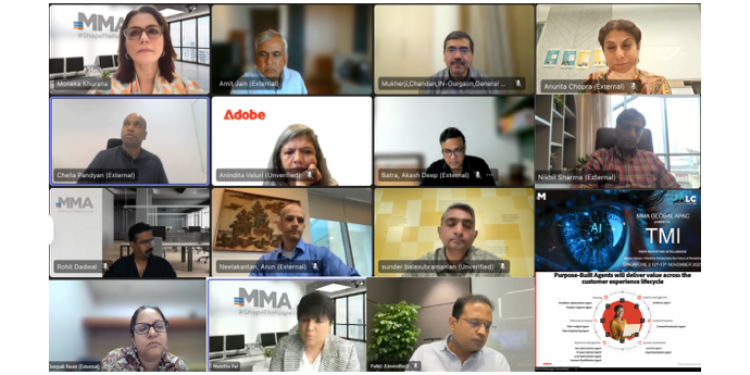
In a world where AI buzz dominates headlines, MMA India’s recent board meeting did something different — it rolled up its sleeves. Held last month in Mumbai, the quarterly boardroom wasn’t just a status check. It was a strategic reset.
Bringing together marketing leaders from Adobe, Nestlé, Myntra, Haleon, Kotak, Jubilant, Snap, CK Birla, and others, the closed-door session focused on a bold agenda: rewiring marketing for the next growth cycle. And the signal was loud and clear — the marketing head is no longer just the brand’s voice. They’re becoming the backbone of growth.
The CMO Recast: From Custodian to Catalyst
A growing consensus among board members is that today’s CMO must think like a CTO, speak like a CFO, and act like a COO. The role now demands fluency in financial outcomes, operational capability, and AI-driven decision-making.
Nikhil Sharma of Perfetti and Chandan Mukherjee of Nestlé underscored the need for marketing leaders to link brand actions directly to business performance. As automation takes over execution, CMOs are being tasked with owning capability modeling, ROI logic, and upstream influence — no longer just storytelling.
From Frameworks to Field Use: Where India Leads
The MMA India board isn’t theorizing — it’s executing. Global MMA frameworks are being adapted for Indian market realities. Nestlé and Jubilant are early adopters of CAP (Consortium for AI Personalisation) and MMGF (Movable Middles Growth Framework), both of which are showing tangible ROI gains through sharper segmentation and personalization.
As one member noted, “We’re not just deploying tools. We’re rethinking marketing operating systems — from org charts to investment models.”
Top Signals from the Marketing Room
1. Agentic AI: The New Workflow Blueprint
Adobe’s session, led by newly inducted MMA India board member Anindita Veluri, sparked vigorous conversation. Her team’s Agentic AI framework revealed how AI agents — like Audience Agent and Journey Agent — are not only generating consumer segments but also orchestrating multichannel journeys and optimizing content, end-to-end.
The takeaway: this is no longer support tech; it’s a structural reimagination. “Brands aren’t just hiring AI. They’re giving it KPIs,” remarked one participant.
Adobe’s global pilots, including with Coca-Cola, have moved from proof-of-concept to active deployment. MMA India itself is now exploring an internal Agentic AI use case to enhance outreach, engagement, and operational throughput.
2. The Movable Middle: Precision Over Reach
The days of chasing mass-reach metrics may be numbered. The MMGF framework focuses on the “movable middle” — segments that are most likely to shift behaviors with the right nudge. Nestlé and Jubilant’s early adoption is proving promising.
In an era of rising media costs and shrinking attention spans, this shift from mass to math is being hailed as marketing’s most overdue correction.
3. Agentic AI = Productivity Reimagined
Beyond strategy, the practical implications of Agentic AI were front and center. From content generation to optimization and measurement, AI agents are freeing up marketers to focus on creativity and orchestration.
Vipul Kedia, COO at Affle and another new board inductee, emphasized the value of agility in today’s fragmented, real-time media environment. AI-driven automation, he said, “allows brands to respond with speed and precision — something manual models can’t scale.”
Concerns remain — around interoperability, model training, and ROI validation — but the sentiment in the room was one of momentum, not hesitation.