In professional sports, mascots have served as an em4blem of tournaments, and team identities. People often remember the 2010 Commonwealth Games, as an event associated with ‘Shera’—The mascot that became the face of that tournament. While these memorable mascots have created a recall value for people, their purpose has never been functional, and only symbolic. In the 18th edition of the Indian Premier League, that distinction quietly blurred and transformed the face of the sports industry.
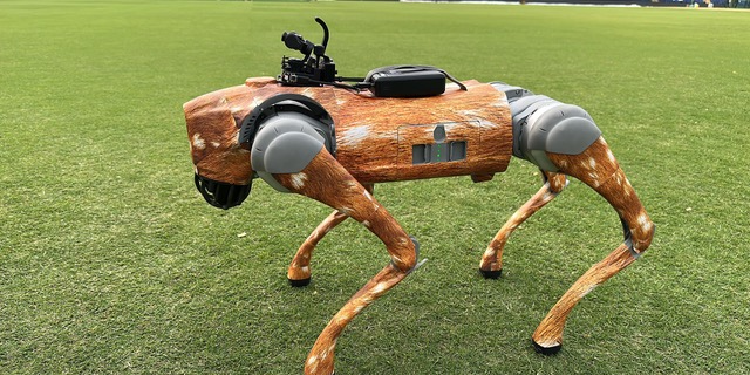
During an IPL match between Delhi Capitals and Mumbai Indians, at the Arun Jaitley Stadium, an innovation revolutionised the visual experience of matches. It was when a four-legged robotic figure entered the stadium, not to perform, but to film. Designed as a camera unit, this dog soon adopted characteristics typically reserved for mascots: physically present, evident expressions, and recall value. Known as ‘Champak’, through a public poll, this machine became not only an astounding surprise, but this season’s most recognisable non-human presence.
This article explores the technical and creative journey of how the robotic dog camera became an epitome of an ideal mascot in the digital era.
Concept behind Champak
Champak was developed through a technical partnership between wTVision, Omnicam, and the Board of Control for Cricket in India (BCCI) as part of a broader initiative to introduce new layers of storytelling to sports broadcasts. The goal was to design a ground-level camera system capable of mobility, stability, and remote operation that could be used without interrupting the match or obstructing sightlines.
A quadrupedal, dog-like structure was used for mechanical efficiency, and emotional accessibility. The chosen form evoked familiarity and reduced the perception of machinery on the pitch. Combined with controlled smooth movement, subtle gestures and ability to record audience reactions, the robot was engineered to capture footage without appearing clinical.
Design and Technical Structure
This 17-kilo robotic dog was built with a 3D-printed, impact-resistant shell, made to protect internal components while maintaining a compact, approachable shape. The idea behind the structure was to create inquisitiveness and fascination towards an adored creature, whilst serving its purpose of being a seamless camera. The system includes a high definition camera, a stabilised camera mounted on a pan-tilt gimbal, remote RF transmission for the camera as well as movement control, an embedded microphone, and a speaker allowing for ambient audio basic playback.
Apart from the capacity of carrying 8 kilos worth of load, Champak comes with pre-programmed gesture capabilities, enabling it to mimic heart signs, bow respectfully, or perform a “Namaste”, representing its Indian roots. The robot’s mobility system also allows adaptive walking on stadium surfaces, managed entirely by off-site operators.
On-Field Use and Behaviour
Champak was never deployed during active play. Instead, it was used during pre-match tosses, breaks in play, and feature segments. The movement path was confined to designated low-traffic zones near the boundary rope. The operators coordinated every gesture, pause, and pan of the robot to suit live broadcast timing.
What began as a tool for acquiring low-angle footage soon became part of the entertainment. Cricketers from Mahendra Singh Dhoni to Sunil Gavaskar interacted with it instinctively, giving it the spotlight for being a creative innovation in the sports industry. Players played with it by offering fist bumps, smiling in its direction, and gesturing back at its prompts. These exchanges were not choreographed, but captured spontaneously which reinforced the robot’s perceived personality.
Audience Response, Broadcast and Brand Impact
After its launch in the IPL, Champak became a sensational social media fixture. An IPL video featured Champak that recorded 5.8 M+ views, 56 K+ likes, and 72K+reshares, making it viral across all social platforms. The audience not only responded to the visual novelty but to the emotional tone of its movements and interactions. Broadcast clips featuring the robotic dog instantly went viral, and fan engagement led to an official naming poll.
The audience was instantly captivated by this new age of sports broadcasting, where innovation was not just behind the scenes, but right on the field. It was a one-of-a-kind machine that bridged both creative appeal and technical brilliance.
A ground-level camera unit, Champak brought unmatched value to the production. It enabled dynamic tracking shots from low, and previously inaccessible angles, added richer audio-visual texture during non-play moments, and introduced a unique on-air presence that kept viewers engaged even during breaks.
This product not only accomplished its goal of connecting with humans and recording intricate moments of a match, but it also became a visual mascot for the league. It reinforces the IPL’s reputation for blending entertainment with sport, and its success suggested a shift in how non-human entities can engage audiences in high-stakes environments without ruining the vibe of an ongoing match.