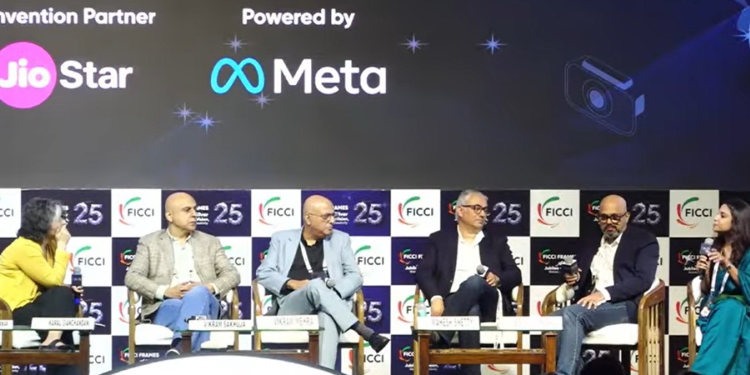
MUMBAI: Vikram Sakhuja, Group CEO of Madison Media, emphasized that differentiation will define future success while speaking at a panel discussion during FICCI Frames. Reflecting on how the media landscape has evolved, he pointed out that four decades ago, brand-building was far simpler with limited fragmentation.
Brands like Nirma gained massive recall through consistent exposure — one TV spot aired daily through the year, a single newspaper insert, or even a cinema slide was enough to make an impact. In contrast, today’s fragmented ecosystem demands greater creativity and sharper positioning to stand out.
“We started worrying about fragmentation in the 90s. That was when we suddenly said, oh my God, it is difficult to reach people. Now that has gone exponentially huge, right now as we speak, in the early 2020s. Where it’s coming from right now is, people still want to consume entertainment. They want the news. They want perspectives. They want self-expression. They want shopping, social media, all other things.”
Media companies he noted are all fighting for a share of their time, their attention, and their wallet. So the people who are going to succeed are going to be the ones who differentiate
He gave the example of the IPL as a differentiated product. “Everybody stops everything. And that still makes sense. If a tentpole film comes, people find the time to go there. You need some heavy duty differentiation. Number two, your platform, whatever it is, brings certain strength. But theater is experience. Your newspaper is definitely a lot of credibility and impact.
“So each medium has its role to play. You should know what your strength is. So I think from a platform standpoint, you need to be understanding platform strength. From a content standpoint, you need some differentiation. and from a marketing, from a consumer standpoint, you need to understand your target audiences.
“But the first principles apply. There’s a way, there’s a hack. Otherwise, you can get lost in this entire overly fragmented environment.”
The points were made during a panel discussion ‘Revenue Rush, Audience Loyalty: Contending with the Rise of Multi-platform Entertainment. This session explored the emergence of new revenue streams and the rise of multi-platform entertainment in Indian M&E over the past 25 years. Speakers explored how commercialisation of content has evolved in response to both supply-side and demand-side trends. The moderator was Vanita Kohli-Khandekar, Columnist & Author, Business Standard.
Kamal Gianchandani, CEO – PVR INOX Pictures Limited & President – Multiplex Association of India (MAI) said that cinema is a very old platform. “We have dealt with technologies. Every decade there has been a new technology and cinema has had to co-exist or compete with that technology. So television, when it came out, there was a lot of apprehension about whether cinema would be able to survive.
“Then VHS, VCD, DVD, they almost killed the industry, at least in India. Piracy became suddenly so easy. But somehow cinema kept thriving while these new technologies were sort of seeping in And were taking away audience interest and time and wallet share. Internet, of course is the same thing. Like even if you go back to 2019-18, while Netflix, Amazon, Hotstar, all of these platforms were doing extremely well and they were investing a lot of money, time, effort, you know, in creating new sort of space within this market. Cinemas actually ended up having their best year in 2018-19.
“So I think on the demand side, it’s quite clear that the audiences differentiate the theatrical experience. It’s the same screen, it’s the same video, but the context matters.”
He spoke about the appeal of being being in a dark room with a communal setting, enjoying a film where you don’t have an ability to multitask, just being in a passive setting where the story is unfolding, people enjoy that experience. “So on the demand side, fortunately, at the cost of sounding a little arrogant, I think audiences have been very receptive, very supportive. We’ve had a challenge on the supply side.
“We were hit by the Pandemic and for two years, like overnight in March 2020, everything changed for us. We were planning to build our next 500 screens, 1000 screens, suddenly we were down to our knees. Two years of cinema shut down happened.
“Producers had to go to streaming platforms to sell their films because they wanted to stay afloat. Understandably so. Our supply side got totally disrupted. And we’ve taken now, post-COVID, first two years, we were shut down, next two years. It’s taken time for us to come back to the regular. And it’s only now in the last 12-13 months where we’re feeling we’re back to the usual.”
In terms of what has really changed in the atmosphere, ecosystem the windows have become shorter. But at the same time, there are also positives. Each time there has been a new technology. Producers, the content creators have found another way to slice and dice their film or content. And make more revenue out of it.
So there is more money, which strengthens the industry. And that he explains augurs well because that money goes back into making bigger and better films. Which is good for theatrical. “We were always investing in new formats. Upgrading our software skills. Training our people. But that piece has got accelerated. The performance of tentpole films, the event films is 3X of what was seen in 2019.”
He noted that since people are becoming more selective the mid-level films have suffered a bit. But the big-ticket films have gone through the roof. Vikram Mehra, Managing Director, Saregama India noted that thankfully his company is a content company. “So technologies come, platforms come, the advertising, subscription mix keeps on changing.
“But a hit that made money 60 years back and still makes tons of money for us today also. But let me address, only one issue right now, which is the demand issue.” He spoke about three social trends One is the GDP of this country is generally growing between 6-7%. When a middle class or upper middle class starts getting more money in their hand then apart from buying a very fancy television, which means that much more content coming in, people also want experiences that means more theater, more live events.
“Because when people have more money in their hand, they want to go out and spend after taking care of their basic needs on entertainment for themselves and entertainment for their family. So, personally, very bullish on content which is going to be running on devices, because everybody wants to buy a fancy device now. I am also bullish on experiences which is theater and the live event business.
“Second, this huge issue socially. We can’t have even 30 seconds when our mind is not stimulated. We immediately move to a phone. Yes, I know everybody is very busy.
“Not everybody is getting a crucial WhatsApp message every 30 seconds. But we need stimulation. Many of us secretly even go on Instagram at that particular time while we are in a meeting because maybe the speaker is not stimulating us enough.
“That means that much more demand for content. This is change number two. Third is a very peculiar phenomenon. People always consider digital to be free. That’s how my generation has grown. Digital never meant that you have to pay for it. That is changing.” With kids micro payments are being done by their parents for things like a shield, a sword, right now in a digital game. “And parents are ready to pay those 5 and 10 rupees, it’s a micro payment, for getting that shield for their kid. This is a massive change.
“It’s telling us that people are ready to pay. We are Indians, we are value seekers. You need to give me a rational justification for my emotional purchase. But I am ready to go out there and pay. Which gives me the confidence, there’s money to be made.”
He noted that for the music business these changes will gradually happen. The key is to show the consumer that spending makes sense. He gave the example of JioHotstar which he said is doing an amazing job on the video OTT side. He noted that YouTube is doing a very good job there. He noted that the likes of Spotify and Saavn are going to go and prove to us, that people are ready to go out there and pay. But give me a rational justification.
“An Indian consumer is ready to pay, provided the money makes sense. This is not a 5 dollar market. This is a dollar per month market.”
Mahesh Shetty, Head of Revenue – Entertainment, JioStar said that the starting point of this entire business that is run is content. And the basics of content continue to be the same. The focus is running powerful broadcast and OTT businesses. ‘Anupama’ continues to be one of the biggest show on OTT platform also besides TV. Consumers choose content that they love and on a platform which is the most convenient to them. “That is the core of which our entire proposition is here.”
On the monetisation front he noted that brands look for reach. JioStar targets three three consumer sets. “So at the top of it, you have the premium consumers who have moved to OTT or have moved from linear to, say, a connected TV. As long as you are able to provide content that they love, they will need global content. Today, a South Bombay family looking for global content on our platform, we have the best lineup of the top four studio content, around 400 plus, any award winning show.
“At the same time, the middle of India looks for everyday daily soaps and that is something that we give on linear as well as on connected TV. The bottom of India we actually serve through our free TV networks. And I think consumers primarily chase content and that is what we serve through different screens, which is the most convenient to them.”
Advertisers he noted are chasing the consumer and JioStar give them all be it large screen or small screen. He noted that CTV is equal to Jio Hotstar because of the kind of content, long form content that it provides. While people do scroll on the phone that need is very different from long form content need.
“We primarily deliver professionally generated content, which has a great amount of retention. So from an advertiser benefit standpoint also, when Sam Balsara spoke about the importance of branding, when brands are looking at building themselves in this country, our platform becomes very strong pillars for them to grow.) And that is on the back of the reach that we provide, the strength of professionally generated content, and the amount of retention we are able to provide to these brands.”
Sweta Jhunjhunwala, Head of Large Partner Solutions & Channel Partnerships, Google India said that the competition today is global, but so is the opportunity. Today, a consumer is probably watching a Korean drama on Netflix and a Brazilian gaming creator on YouTube.
“And our Indian media companies are competing with this.” Trends are also now really global, and technology has ensured that now everyone has access. She noted the growing importance of microdramas noting that in terms of revenue alone, microdrama in China is likely to beat box office revenues. India today has 125 million downloads of microdrama. “And we’re seeing all the large players now invest into this. It’s a global opportunity today.
“It’s not just the competition. And that’s what we’re seeing our publishers do. A lot of our publishers, medium-sized publishers are not looking at just Indian audiences. They’re looking at global. You might build content for Bharat, but there is an audience sitting outside. There are publishers who are building creative content which is specific to markets outside of India.
“Take, for example Pocket FM. This is an audio platform built out of India makes a large percentage of their money today coming from US. That’s the kind of change we’re seeing, right? That it’s very borderless today, and technology is making that available. So that’s, there is where I would say we come in. We work with our publishers to ensure that we’re helping you go to those markets, helping you find, sitting out of Delhi, find an advertiser in London who wants to buy your platform. Technology today can make that available. So that’s one big change that we see.”
The other one she noted is advertising. Advertisers today don’t just want to buy a container. They don’t want to just buy a 30-minute episode. What they want to buy is a moment. And what you can do today is really create moments. You really create a product based on your audience.”
Like a 25 to 40 year old male audience that buys SUVs is way more valuable for an advertiser than just somebody who’s watching a 30-minute episode. “You create that based on context.”
She spoke about formats on Connected TV which are a lot more engaging. They’re a lot more intuitive. They’re a lot less about breaking the flow of content. And that’s the kind of changes being seen in the advertising payout. And that’s what advertisers are interested in paying for.