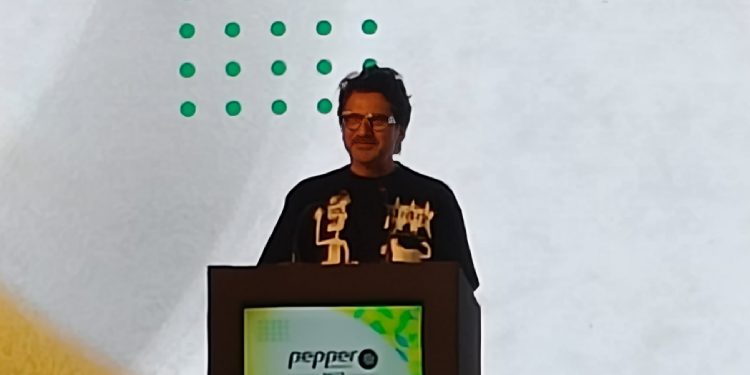
Cochin: At the 19th edition of the Pepper Creative Awards, Sonal Dabral — Founder of Tribha and former Vice Chairman of Ogilvy India — delivered a powerful and deeply personal special address honouring the late advertising legend Piyush Pandey. Speaking as the chief guest, Dabral used the tribute as a springboard to reflect on the state of creativity in an era overwhelmed by information, screens and now, artificial intelligence.
“True ideas don’t live on Google—they live within us.”
Dabral opened by acknowledging the relentless flood of content and data that defines modern life. With the arrival of AI, he said, the volume of information available to creatives has grown exponentially — but so has the risk of losing sight of where original thinking truly comes from.
“As creative people, it becomes very, very easy to forget where true ideas live,” he said. “Our research cannot be on Google. That search has to be within ourselves, within our own stories.”
He urged the audience to “Google their own memories” — the stories from childhood, neighbourhoods, parents and grandparents — because that is where authentic insights reside. These lived experiences, he stressed, bring a freshness to ideas that no amount of online research or AI output can replicate.
Learning from Piyush Pandey: Creativity rooted in life
Dabral revisited some of Piyush Pandey’s most iconic work — from Chal Meri Luna and Hamaara Wala Mera Wala Kareen to Fevicol’s unforgettable lines and Cadbury’s “Kuch Khaas Hai” — pointing out that these campaigns came from observation, not algorithms.
There was no internet in the era when these ads were created, he reminded the audience, yet they remain timeless because they were grounded in real life.
For instance, he cited the Fevicol film inspired by the colloquial chant “Dham Laga Ke Haisha” — a memory rooted in everyday Indian labour culture. Likewise, the Cadbury line “Kuch Khaas Hai” emerged when Pandey observed an elderly couple joyfully playing with a toy at a San Francisco airport store.
“To observe from real life and convert that into insight and then into a line — that’s what one needs to do,” he said.
The discipline of making ideas happen
While celebrating the power of insight, Dabral also warned against the “paralysis of research”. With so much information at one’s fingertips, he said, creatives often risk getting stuck in a loop of analysis instead of execution.
The craft, he insisted, lies not just in discovering an idea but in pushing it through, shutting out the noise and dedicating oneself to shaping it with rigour and speed — a discipline he learned while working with Pandey.
AI is a tool — not a substitute for human imagination
Dabral acknowledged AI as “fantastic” and transformative, capable of making work faster and easier. But he cautioned against over-dependence.
What must not be lost, he said, are the uniquely human capabilities: observation, emotion, instinct, and the ability to extract insights that haven’t yet been digitised.
“For something to be fresh, it cannot come from cyberspace. That space only holds information that has already happened.”
Creativity as joy, not labour
One of the most heartfelt parts of Dabral’s address touched on the emotional demands of creative professions — the subjectivity, the rejections, the blocks. The antidote, he said, is to remember why creatives choose this path in the first place.
“We are in a blessed profession. Imagine someone gives you money to think of stories.”
He urged the audience to find joy in the process — the joy Pandey embodied through his career — whether working on cars, chocolates or toothpaste. That joy, he argued, is essential not only for personal fulfilment but also for producing work that connects.
“Advertising must move hearts.”
In an age dominated by performance marketing and mind-first messaging, Dabral reminded the industry of its deeper purpose.
“Our job is to connect with people’s hearts — not just their minds.”
Pandey’s body of work, he said, is proof that when advertising touches the heart, it naturally drives results.
A moving tribute to a creative giant
Dabral closed his address by calling Piyush Pandey’s career a testament to the emotional power of storytelling in advertising. Generations of Indians, he noted, have felt genuine joy watching Pandey’s commercials — a joy that continues to guide the industry even today.
The session ended with a standing ovation, as Dabral encouraged the audience to hold fast to curiosity, authenticity and craft — values he said define both Pandey’s legacy and the future of creative excellence.