Mumbai: In an interview with Medianews4U, Danish Malik, CEO & Founder of Boomlet Group, offers a sharp perspective on how the influencer marketing industry is undergoing a crucial transformation. With CMOs demanding measurable ROI instead of just engagement metrics, Malik explains how Boomlet is leading the shift from passive impressions to actionable outcomes, whether it’s app installs, brand lift or sales conversions.
He discusses the urgent need for compliance with SEBI and ASCI guidelines, Boomlet’s internal SOPs for financial influencers and their creator-first ethos that includes transparent payment cycles and rigorous vetting systems. Malik also outlines how micro and nano influencers are driving real growth, citing their Guinness World Record-breaking campaign, “No Pain Period,” as a case study in how influencer marketing can spark meaningful cultural change.
As Boomlet expands into international branded content and explores AI-driven simulations and sentiment tools, Malik makes it clear: the future belongs to agencies that blend tech, trust and storytelling to drive both business results and social impact.
1. Companies today expect influencer marketing to drive actual ROI. Deep engagement by itself is no longer enough. How will this approach and attitude impact the influencer industry in the coming three years?
This shift is already reshaping the ecosystem. We’ve moved past the stage where impressions and likes were enough. Today, CMOs expect influencer campaigns to show tangible business value, sales lift, app installs, retention spikes, or sentiment shifts. Over the next three years, the industry will bifurcate: creators who know how to influence action will rise, while passive reach will get deprioritized. It’ll also accelerate tech adoption, agencies will have to integrate attribution tools, UTM tracking and conversion benchmarking into their influencer planning.
2. Is one of the challenges of the influencer marketing industry the fact that CMOs often don’t treat it as a priority or understand it?
Yes, and it’s a layered issue. Influencer marketing still sits in a grey zone for many CMOs, it’s often slotted under performance but expected to behave like branding. The confusion leads to underinvestment or misaligned KPIs. At Boomlet, we spend a significant amount of time helping brand leaders understand influencer marketing as a full-funnel lever from awareness and trust-building to last-click performance. It’s not about replacing ATL; it’s about complementing it with credible voices people trust.
3. What are the agency’s views on SEBI’s guidelines for finfluencers? Will content moderation and algorithms help check if guidelines are violated?
SEBI’s guidelines are essential, especially in a sector where misinformation can directly impact personal finances. Financial content requires greater scrutiny and these regulations push the space toward maturity. While content moderation and AI tools can help detect violations, human oversight remains critical, especially for gray-area content. We’ve developed internal SOPs to vet financial influencers, verify credentials and implement a pre-post moderation filter for all finance-related content. In my opinion, compliance isn’t just a legal checkbox; it’s a reputation safeguard.
4. Influencers often violate ASCI’s guidelines for disclosing paid, sponsored content. Is this a threat to the authenticity of the medium?
It absolutely is. Disclosures aren’t just a tick-box; they’re central to building trust. When they’re skipped, audiences feel misled, and the integrity of the campaign suffers. Hence, we’ve standardized disclosure requirements through our briefs, influencer contracts, and real-time content checks. Along with these, we’ve made necessary internal changes like creating clear SOPs, structured processes, policies and MOUs (a clear work delivery document) wherever required avoiding any guideline violations. We’ve also established a system of periodic checks within the team to ensure both existing members and new joiners remain fully aligned. We don’t leave compliance to chance, but we embed it into our workflow.
5. Is delayed, late payment and unfair remuneration for content creators also an issue for the industry?
Yes, and it’s one of the industry’s ugliest truths. Creators are expected to meet tight timelines, but aren’t always paid with the same urgency. This creates burnout and resentment, especially among micro and nano creators who rely on timely payments. To avoid the same, we’ve built payment cycles into our project workflow. These expectations are set very clearly & crisply with the influencers while giving the campaign confirmation transparently. Also, collaboratively, our accounts & tech team is in the process of launching an internal dashboard for creator payout tracking. A fair ecosystem requires financial dignity for creators, just like any other professional partner.
6. As a result of this, are influencers striking it on their own without an agency to represent them? This helps eliminate commission fees, which are sometimes hefty.
Yes, and it’s a natural reaction. Many creators are bypassing traditional structures to retain control and eliminate middlemen. That said, the right agency doesn’t just take a cut; it adds clarity, filters opportunities, handles compliance, negotiates better, and ensures the creator’s long-term brand alignment. There have been scenarios where influencers left and later returned, which was not because of lower commission, but because of the strategic value we bring. Agencies need to evolve beyond brokering deals to building careers.
7. Macro versus micro and nano influencers. Where is the growth coming from in 2025?
The growth is being driven by micro and nano influencers, without a doubt. Brands are investing in deeper, more authentic community engagement. Micro-influencers bring niche authority and higher engagement rates. They feel real, relatable, and responsive, especially in Tier 2/3 markets. Macro influencers still play a role, particularly for brand storytelling and mass awareness, but the growth engine is firmly in the hands of smaller, trust-first voices.
In fact, we’re seeing increased interest in ‘community pods’ where brands activate 20-30 nano influencers in one geography or subculture. With this in mind, I’d proudly highlight one of our recent campaigns, “No Pain Period” for Saridon Woman, which earned a Guinness World Record for creating the largest online video album. Over the span of 30 days, we activated 5,000+ creators, each showcasing a hand gesture to express period pain, transforming a taboo into a movement. Another standout case study is with a leading automobile brand, where we mobilized 10,500+ influencers in just 10 days. We set up a full-fledged war room and command centre, activating a noise-first strategy powered by micro and nano influencers. The campaign generated 9.5K+ curated UGCs, over 21K comments and ultimately led to 300+ confirmed bookings.
8. How did the Guinness World Record-winning campaign, ‘No Pain Period’ come about?
‘No Pain Period’ wasn’t just a campaign. It was a movement. Saridon Woman approached us with a clear but bold ask, breaking the silence around period pain. Together, we conceptualized a digital-first awareness initiative that wasn’t just another one-day post. The idea was to normalize the conversation and spark visual participation. We activated over 5,000 creators in 30 days, from a longlist of 8,000+ creators producing an average of 172 videos per day. Each creator used a specific hand gesture to visually express period pain. The result? We created the largest online video album and earned a Guinness World Record for it. But more than that, we created a ripple effect across social platforms, schools, and workplaces. This was a testament to what’s possible when influence meets intention.
9. Is this a good example of how influencer marketing can break taboos through this marketing vehicle?
Yes, and it’s a proof point that influencer marketing isn’t just about brand placements, it’s cultural narrative-building. With ‘No Pain Period,’ we saw influencers go beyond scripts. They talked about discomfort, shame, and real-life stories without any hesitation. The campaign reached millions, but more importantly, it shifted the tone of the conversation. We believe campaigns like these show the true power of influencer marketing; to humanize, normalize, and advocate for change, not just clicks. Where again we “Boomlet Group” take all the pride and claim to be an integrated influencer advocacy agency – Architects of Influence, Creators of Captivating Content and Guardians of Brand Reputation.
10. What other work is the agency working on that is expected to stand out?
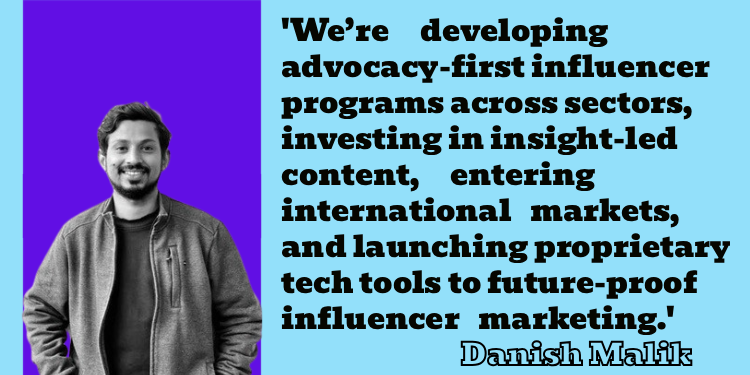
We’re working on advocacy-first influencer programs in sectors like finance, tech, auto, home decor, lifestyle, and luxury primarily. We’re also investing in social listening-led campaigns, where insight precedes content and not the other way around. Moving ahead, we are aggressively getting into international branded content and also developing a tech tool. More details will be shared soon.
11. Beyond the number of followers, what are the metrics that Boomlet Group looks at before working with influencers and partnering them with brands?
We go deep on quality over quantity. Some of the key metrics we evaluate include:
● Audience Authenticity
● Engagement Consistency
● Topical Alignment
● Sentiment Mapping
● Past Brand Saturation (if they’ve endorsed too many brands too quickly)
12. What role will AI play in the influencer marketing industry through things like creating digital avatars which can influence purchasing decisions? How has Boomlet Group integrated AI into its operations?
AI is already reshaping how we identify, plan, and measure influencer campaigns. From detecting fake followers to optimizing post timing, it’s augmenting human judgment with precision. At Boomlet, we’ve integrated AI into:
● Influencer Audit Pipelines using Machine Learning Filters
● Sentiment Analysis across Campaign Feedback
● Trend Spotting Using Social Listening Data
We’re also exploring avatar-led simulations, where AI-generated personas test campaign messaging before it goes live. But our approach is rooted in balance. AI can automate, but it’s human insight that crafts real stories. The future of influence isn’t either/or, it’s both.