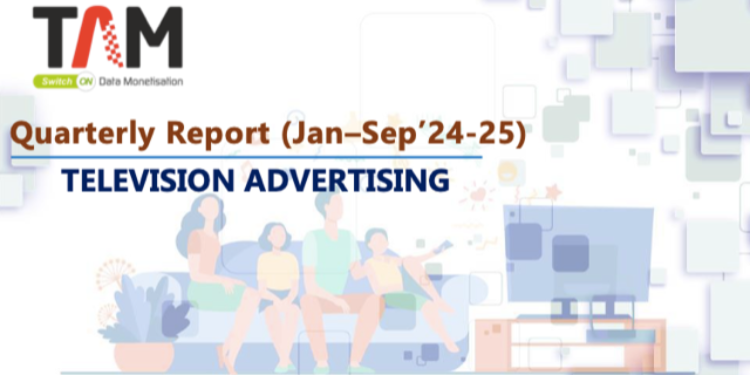
Mumbai: Television advertising in India witnessed a marginal slowdown during the first nine months of 2025, with overall ad volumes dropping 10% year-on-year, according to the latest TAM AdEx Half-Yearly Advertising Report on Television (Jan–Sep 2025). Despite the dip, the medium remains a key pillar for advertisers, particularly in the FMCG, e-commerce, and personal care sectors.
TAM AdEx, which monitors over 600 television channels, highlighted that Food & Beverages continued to dominate with a 21% share of total ad volumes, followed by Personal Care/Personal Hygiene at 16% and Services at 14%. Collectively, the top five sectors retained their rankings from the previous year and contributed nearly 88% of all television ad volumes.
FMCG and Hygiene Categories Continue to Shine
The report underlined the sustained dominance of FMCG players on television. Toilet Soaps retained the top spot among categories with a 6% share, while Toilet/Floor Cleaners emerged as the fastest-growing category, posting an 18% increase in ad volumes over 2024.
Other high-growth segments included E-commerce – Online Shopping (+25%) and Corporate/Brand Image advertising (+49%), reflecting rising investments in digital-first and corporate reputation campaigns.
Interestingly, newer categories such as Chocolates, Aerated Soft Drinks, and E-commerce Media/Entertainment made notable entries into the top 10 list, signaling a diversification in television advertising portfolios.
Advertisers: HUL and Reckitt Benckiser Lead the Pack
Among advertisers, Hindustan Unilever (HUL) and Reckitt Benckiser (India) maintained their leadership positions, followed by Godrej Consumer Products, Cadbury India, and Coca-Cola India.
The top 10 advertisers collectively accounted for 42% of total TV ad volumes, demonstrating a continued concentration among established FMCG giants.
New entrants to the top advertiser list included Nestlé India and Star India, reflecting renewed momentum from the packaged foods and media sectors.
Reckitt Benckiser Dominates Brand Rankings
Reckitt Benckiser emerged as the clear leader at the brand level, with five of the top ten brands belonging to its portfolio — including Harpic Power Plus 10x Advanced, Dettol Toilet Soaps, and Lizol All-In-1.
Hindustan Unilever also featured prominently with Surf Excel Easy Wash and Close-Up Ever Fresh among the top advertisers.
The report noted that the top ten brands together contributed 10% of total television ad volumes.
E-commerce, Auto and Education Among Fastest Risers
Beyond the FMCG-heavy sectors, television advertising growth was also buoyed by E-commerce, automotive, and education and vocational training brands.
The education category, in particular, recorded a fourfold increase in ad volumes year-on-year, suggesting a revival in career-oriented advertising after a pandemic-induced slowdown.
GECs and News Channels Retain Dominance
From a channel perspective, General Entertainment Channels (GECs) and News channels remained the preferred genres, jointly accounting for 57% of all TV ad volumes in the first nine months of 2025.
While GECs saw a modest increase in their share—from 30% to 32%—the News, Movies, and Music genres experienced slight declines. Overall, the top five genres contributed over 92% of total advertising seconds aired on television.
Digital Disruption Yet TV Remains Core Medium
Industry analysts interpret the 10% dip in television ad volumes as a reflection of ongoing budget reallocations toward digital and connected TV platforms. However, TAM AdEx noted that television continues to play a central role in mass brand-building, particularly for FMCG and household product advertisers.
“Television remains a critical storytelling platform for advertisers, offering unmatched reach across India’s diverse audiences,” the report stated, adding that the medium continues to complement digital investments rather than compete with them.
Outlook
As India heads into the festive and sports-heavy final quarter of 2025, advertising experts expect a rebound in television ad spends, particularly from FMCG, retail, and e-commerce players. While digital continues to grow rapidly, television remains the cornerstone of national media strategies, driven by its unmatched reach and consumer trust.