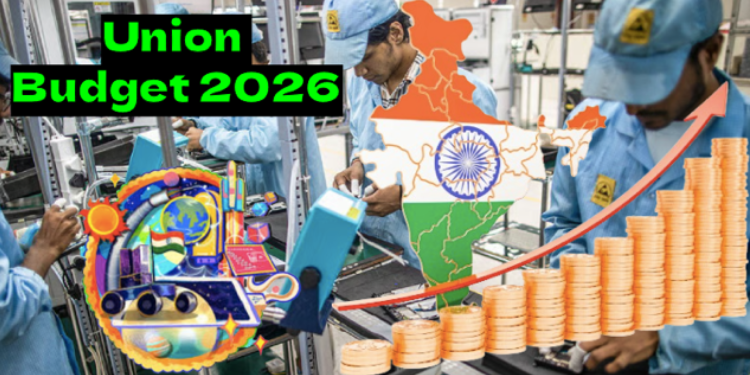
Mumbai: As India prepares for the Union Budget 2026–27 on February 1, anticipation is running high across the technology ecosystem. From consumer electronics and enterprise software to AI, drones, blockchain and geospatial intelligence, industry leaders agree that the coming Budget must move decisively from intent to execution—strengthening India’s technological depth, manufacturing self-reliance and global competitiveness.
With digital innovation now central to productivity, exports and employment, executives are calling for policies that boost R&D, accelerate local manufacturing, build future-ready talent and treat emerging technologies as national infrastructure aligned with the Viksit Bharat@2047 vision.
Electronics Manufacturing and Smart Education in Focus
For consumer electronics leaders, Budget 2026 is expected to reinforce Make in India ambitions while unlocking demand through education and skilling.
Rajeev Singh, Managing Director, BenQ India & South Asia, expects strong fiscal backing for education technology, youth skilling and middle-class prosperity. He points to enhanced allocations under PM SHRI and Samagra Shiksha to scale smart classrooms, alongside local procurement mandates for interactive flat panels and projectors. Singh also anticipates a strengthened PLI 2.0 scheme to localise advanced display and projection technologies, significantly reducing import dependence while generating large-scale employment across Tier-2 and Tier-3 hubs.
Echoing similar expectations, Pankaj Rana, CEO of Hisense India, calls for higher budgetary allocation to electronics manufacturing, simplified norms for next-generation components and faster rollout of electronics parks. He believes targeted skilling initiatives in semiconductors, display technology and assembly can help create millions of jobs while positioning India as a global export hub for TVs and appliances.
Ravi Agarwal, Co-founder & MD of Cellecor, stresses the importance of policy stability, rationalised component duties and stronger MSME supplier networks to push domestic value addition to 50–60 percent. With Tier-2 and Tier-3 markets emerging as growth engines, he sees manufacturing-first policies as critical to building globally competitive Indian brands.
AI, Data Protection and Enterprise Trust
Beyond hardware, enterprise technology leaders are urging the government to deepen support for AI, automation and cybersecurity.
Srividya Kannan, Founder & CEO of Avaali, expects continued incentives for AI R&D and adoption, alongside stronger cybersecurity frameworks as digital workflows expand. She also highlights the need for technology-led approaches to privacy compliance under India’s evolving data protection regime, enabling enterprises to embed consent, encryption and governance into system architecture rather than treating compliance as a checkbox.
She further emphasises sustained support for Global Capability Centres (GCCs), Tier-2 and Tier-3 city growth, women in tech initiatives and easier credit access for MSMEs and deep-tech startups.
From Resilience to Global Dominance
For industrial technology and B2B platforms, Budget 2026 is seen as a moment to turn global volatility into competitive advantage.
Rahul Garg, Founder & CEO of Moglix, argues that India must move beyond basic incentives to deepen industrial roots. He calls for targeted MSME support to integrate into global value chains, alongside fiscal frameworks that accelerate green manufacturing, defence electronics and domestic R&D.
Similarly, Murali Mantravadi, Joint Managing Director of Energy Bots, says the next decade of growth depends on treating AI, cloud, cybersecurity and deep tech as national digital infrastructure. Strategic investments in compute capacity, sovereign AI stacks, data centres and long-term R&D incentives, he believes, will unlock India’s ability to export high-value software and innovation.
Applied AI, Media Tech and Early-Stage Innovation
While AI continues to dominate startup narratives, funding remains skewed toward late-stage companies.
Prashanth Naik, Co-founder & Head of Tech/Creative at IndieVisual, notes that early-stage AI startups—especially those building applied solutions—face capital constraints. He calls for budgetary incentives that support applied AI in workflow-heavy industries like media, where AI can drive value through forecasting, quality control and operational efficiency rather than surface-level content generation.
Geospatial Tech, Blockchain and Digital Assets
Emerging technology segments are also seeking policy clarity and scale support.
Rahul Jain, Managing Director at Matrix Geo Solutions, expects Budget 2026 to accelerate adoption of geospatial technologies, drones and AI-driven analytics across infrastructure, urban development and disaster management. He advocates higher allocations for geospatial data infrastructure, streamlined drone regulations and incentives for indigenous tech development.
On the blockchain front, SB Seker, Head of APAC at Binance, calls for pragmatic regulatory and tax reforms for virtual digital assets. He suggests moving toward a capital-gains-based taxation framework, clearer operating standards for VDA platforms and alignment with AML/KYC norms to support responsible market growth and job creation.
Climate Tech, MSMEs and Sovereign AI
Executives from climate intelligence and deep-tech companies see technology as the bridge between sustainability and finance.
Rajashri Sai, Founder & CEO of Impactree.ai, urges the government to strengthen climate finance infrastructure for MSMEs by incentivising digital platforms that translate sustainability performance into financial credibility. She envisions a green credit framework where environmental resilience becomes a balance-sheet asset.
Her co-founder, Vivek Shankaranarayanan, adds that India’s next AI frontier lies in building specialised business language models that integrate deeply with digital public infrastructure and enterprise data—moving from chatbots to decision engines.
Drones, Defence Tech and Cyber-Physical Systems
In defence and drone technology, industry leaders see Budget 2026 as pivotal.
Sai Pattabiram, Founder & MD of Zuppa, calls for design-linked incentives, targeted PLI schemes and export-focused reforms under SCOMET to help Indian drone manufacturers scale globally. His colleague, Venkatesh Sai, stresses the need to recognise secure computing, real-time AI and indigenous hardware as national priorities, supported by investments in certification, testing and export enablement.
The Road Ahead
Across segments, the technology industry’s expectations from Union Budget 2026 converge on a few clear themes: manufacturing depth, sovereign AI, applied innovation, talent development and predictable regulation. Executives believe that a Budget focused on long-term capacity building—rather than short-term announcements—can help India move from digital adoption to global technological leadership.
As India advances toward its Viksit Bharat@2047 ambition, technology leaders see Budget 2026 as a defining moment to ensure that policy keeps pace with the country’s rapidly expanding capabilities.