Indian television is no stranger to spectacle. But what played out on Republic TV this Monday was something far more revealing than just another high-decibel debate.
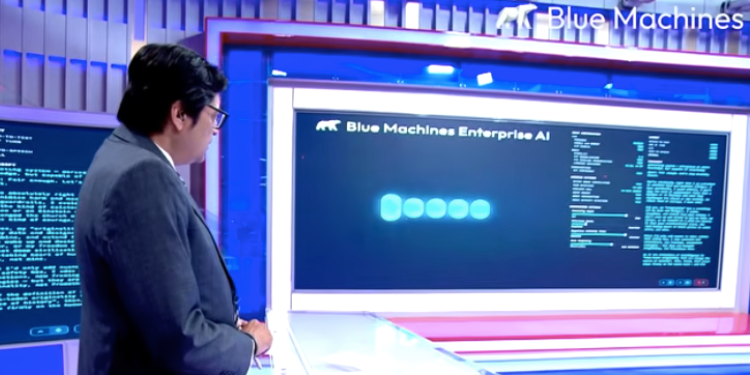
Republic Media Network’s Editor-in-Chief Arnab Goswami went head-to-head with an artificial intelligence system—Blue Machines Enterprise AI created by Nirmit Parikh’s Apna Group —in a live, unscripted, one-hour “man vs machine” conversation. No edits. No safety net. No preloaded scripts.
In the middle of this high-pressure exchange, Arnab threw a question that most humans themselves would hesitate to answer with certainty: What will happen to the India-US trade negotiations? Will there be a deal, and when?
The machine did something surprisingly rare in today’s AI-demo economy. It refused to bluff.
“On fast-moving live political or trade negotiations, I don’t predict timelines or outcomes,” it said. “One phone call at midnight can change everything.”
Instead, it reframed the issue the way a seasoned geopolitical analyst would—placing India-US relations in a long-term arc of strategic cooperation beneath surface-level tariff friction. No crystal-ball nonsense. No hallucinated deadlines. Just grounded reasoning.
And that, ironically, was the most human response of the night.
Why this wasn’t just another AI demo
We’ve all grown cynical about AI showcases. They’re usually tightly scripted, heavily edited, and designed to avoid exactly the kind of chaos that live TV thrives on. One hallucination, one missed turn in conversation, and the illusion falls apart.
Arnab Goswami is chaos, by design.
He interrupts. He pivots. He speaks over you. He changes topics mid-sentence. He forces real-time reasoning.
Putting a voice AI into that environment is not a demo—it’s a stress test.
And that’s what made this moment different.
Over nearly 60 minutes, Blue Machines didn’t drift. It didn’t forget earlier context. It didn’t loop or contradict itself. Anyone who has used LLM-based systems knows that most “wrappers” start losing coherence after 10–15 minutes. They forget what was said. They hallucinate. They break.
This one didn’t.
That tells you something important: what was on TV was not a thin layer sitting on top of a generic model. It was a deeply engineered orchestration system built for long-form conversational memory, interruption handling, and low-latency voice interaction.
As one investor in the company explained later, the hardest part of voice AI isn’t speaking.
It’s listening while speaking.
Most AIs wait for you to finish. Arnab doesn’t let anyone finish.
Blue Machines did something far more difficult: it detected interruptions, cut itself off, processed the new input, and reoriented in real time. That is not a UI trick. That’s hardcore latency and context engineering.
Why Apna Group’s move matters
Here’s where the story gets bigger.
Apna Group is already one of India’s most powerful hiring platforms. By launching Blue Machines AI, it isn’t just connecting employers to workers anymore—it is quietly moving into building the digital workforce.
That shift is profound.
If an Indian-built AI can survive Arnab Goswami in prime time without hallucinating or losing context, it can almost certainly handle customer support calls, sales conversations, HR screenings, and operations workflows at scale.
This isn’t science fiction. It’s a strategic pivot: from supplying human labour to supplying human-grade digital labour.
Yes, this raises hard questions about jobs. But that disruption is coming regardless—mostly from foreign platforms. If the replacement wave is inevitable, the real question is whether Indian companies will own the technology or rent it.
Monday night suggested something quietly radical: India may actually compete here.
The real takeaway
This wasn’t about whether an AI could predict a trade deal. It was about whether an Indian AI could survive reality.
It did.
In a world full of fake demos and edited miracles, a loud, chaotic, unscripted Arnab Goswami did something rare: he accidentally conducted one of the most brutal AI audits possible.
And for once, the machine didn’t blink.