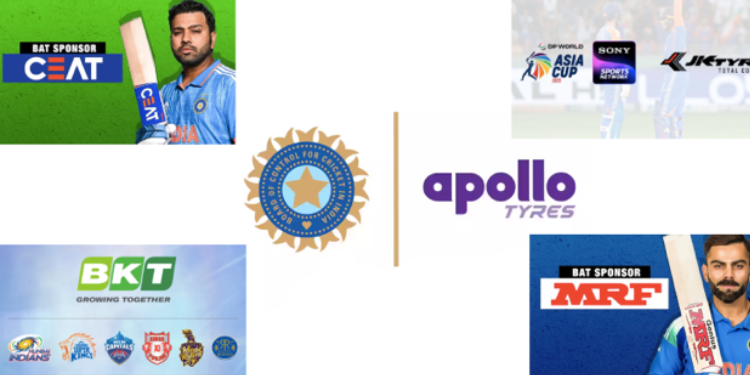
The Indian tyre industry has quietly turned into one of the most aggressive advertisers in the country. From MRF’s iconic bat stickers to CEAT’s timeout branding during the IPL, tyre companies have ensured their presence on cricket’s grand stage for decades. Recently, Apollo Tyres took this association to another level by becoming the official jersey sponsor of the Indian men’s cricket team, a deal that runs until March 2028. The move signals both the enduring strength of cricket as India’s premier marketing platform and the growing competition within the tyre sector.
Why are tyre brands chasing visibility?
Tyres are not the kind of product people think about every day. For most consumers, buying tyres happens once every four to five years, and the choice is often made at the dealer’s suggestion rather than after in-depth research. Unlike gadgets or fashion, there is very little day-to-day engagement with the product. In such categories, brand recall and trust become everything.
For tyre makers, visibility is a way to occupy consumer mindshare so that when the purchase moment does arrive, the buyer instinctively asks for a familiar brand. Cricket provides that visibility on a scale unmatched by any other medium in India. Every major tyre company wants to be the brand that flashes across millions of screens when Rohit Sharma takes strike or when Virat Kohli hits a boundary.
Cricket as the ultimate platform
No other sport in India commands the loyalty, emotional connect, and mass appeal that cricket enjoys. From small towns to metros, cricket binds audiences across geography and demographics. It is one of the few events where families still sit together to watch, and in the digital age, its reach has only multiplied.
This explains why MRF, CEAT, and JK Tyres have all been associated with the game for years. MRF’s logo on Sachin Tendulkar’s and later Virat Kohli’s bat became an iconic visual memory for two generations of fans. CEAT’s strategic timeout in the IPL is so ingrained that fans often use the term casually even outside matches. For tyre companies that sell a functional, low-engagement product, cricket offers emotion, aspiration, and visibility that advertising campaigns alone cannot build.
Apollo’s big gamble
Apollo Tyres has been active in sports marketing before. Sachin Tendulkar once served as their brand ambassador, and the company has supported European football clubs. But by signing on as the jersey sponsor of the Indian cricket team, Apollo has entered a whole new league of visibility.
The company will pay ₹4.5 crore per match to the Board of Control for Cricket in India (BCCI), which works out to around ₹585 crore over the next five years. This is one of the most lucrative sponsorship deals in Indian cricket and even surpasses the previous arrangement with Dream11, which had to withdraw due to the government’s new rules banning betting-linked platforms.
For Apollo, the expectation is clear. The brand wants to step out of the perception of being an industrial or export-focused company and build strong consumer recognition in its home market. The logo on the Indian team jersey ensures repeated exposure during high-stakes moments — World Cups, Asia Cups, bilateral series — watched by hundreds of millions.
Measuring ROI on such a spend
The natural question is how a tyre company can justify such massive spending, especially in an industry where margins are not particularly high. The answer lies in long-term brand equity.
Apollo will track brand awareness and recall scores before and after the sponsorship period. Tools like Nielsen Sports can measure the media value of on-screen logo exposure, while digital buzz, social media mentions, and dealer feedback will serve as additional indicators.
Sales uplift will take time to reflect, but the company expects to benefit in two ways: first, through consumers asking for Apollo tyres more often, and second, by giving its dealers a stronger brand lever to push sales. There is also the international dimension. Indian cricket matches are broadcast globally, and Apollo has significant markets in Europe, Africa, and the Middle East. The jersey sponsorship ensures the brand is seen not just as Indian but as a global player.
How much are tyre brands spending on cricket?
Collectively, tyre companies are among the biggest sponsors in Indian cricket. MRF’s annual spends, including bat endorsements and IPL presence, are estimated at ₹50–60 crore. CEAT invests around ₹30 crore a year through IPL tie-ups and celebrity associations, especially with Rohit Sharma. JK Tyres, though smaller in scale, invests ₹20–25 crore annually, balancing its cricket presence with motorsport sponsorships.
Apollo’s new deal dwarfs these figures, with an annual outlay of over ₹115 crore. In total, the tyre sector is estimated to be spending ₹250–300 crore every year on cricket-related sponsorships and advertising. It’s an extraordinary number considering the nature of the product, but the brands see it as essential for survival in a cluttered and competitive market.
Why cricket still dominates for brands
The dominance of cricket as a marketing platform rests on three pillars: scale, emotion, and continuity. Other sports in India, like football, kabaddi, and badminton, have grown but remain niche compared to cricket. An India-Pakistan match can draw over 200 million viewers live, numbers no other sport can dream of.
Cricket also delivers moments of national pride and shared emotion that brands crave to be part of. The long calendar of Tests, ODIs, T20s, and the IPL ensures that visibility is not seasonal but year-round. Importantly, cricket is a sport with history and legacy. When a brand is associated with it, it borrows that trust and longevity.
Conclusion
The tyre industry’s aggressive push into cricket sponsorship is not a passing fad but a strategic necessity. In a category where consumer involvement is low and product differentiation is minimal, being top-of-mind makes all the difference. Cricket, with its unparalleled reach and emotional connection, is the only platform that can deliver this at scale.