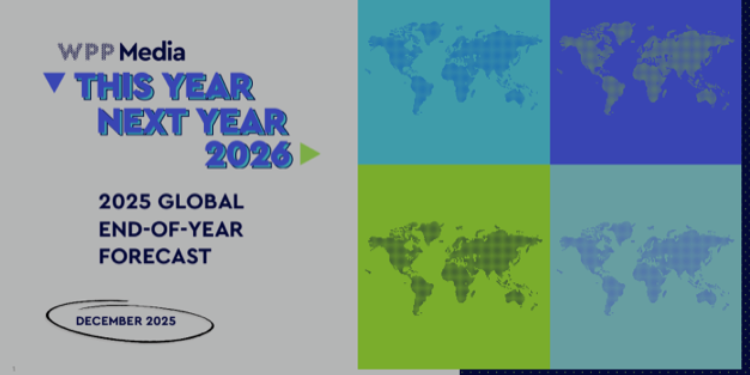
Mumbai: WPP Media TYNY 2026: India Ad Market to Grow 9.7% as AI, Commerce and Content Ecosystems Reshape Industry
India’s advertising industry is set to expand 9.7% in 2026 to ₹2,01,891 crore, adding ₹17,844 crore over 2025, according to WPP Media’s latest This Year Next Year (TYNY) forecast. Digital will account for 68.1% of total ad revenue, while commerce-led advertising is projected to be the fastest-growing segment at 24.2%.
Beyond topline growth, the TYNY 2026 report and forecast together point to a deeper structural shift: advertising in India is moving from channel-based spending toward AI-driven, commerce-integrated ecosystems where discovery, transaction and engagement converge.
India’s ad market growth outpaces global peers
WPP Media positions India among the world’s top 10 advertising markets, with ad spend equivalent to about 0.5% of GDP and rising alongside per-capita income and digital formalisation. At nearly 10% growth, India remains one of the fastest-expanding major markets globally.
Parveen Sheik, Head of Business Intelligence India at WPP Media, said the 2026 outlook reflects both scale and maturity. “India’s advertising market demonstrates dynamism and maturity.
At 9.7% growth, we are one of the fastest growing among top markets. The story of 2026 is one of convergence – where media, technology, and commerce become homogenous to deliver for brands,” she noted, adding that AI, data intelligence and privacy-first strategies will determine which brands capture disproportionate growth.
Digital dominance deepens; commerce media surges
Digital advertising—including extensions across TV, print, audio and OOH—will contribute 68.1% of revenue in 2026. Within digital, commerce-led formats spanning retail media, quick commerce and social commerce will grow 24.2%, far outpacing other segments.
Other digital channels (excluding search and commerce) are expected to expand 11.1%, while intelligence-driven formats such as AI search, voice and agentic discovery grow 8%. Location-based media like OOH and cinema will rise 8.9%.
Among traditional media, print is forecast to grow 4.4%, supported by government advertising price increases and sectoral relevance, while television will expand 3.1% on connected-TV and addressable formats. Audio will grow 1.5% on streaming adoption.
The shift underscores the emergence of commerce platforms as media ecosystems—one of the structural trends highlighted in the TYNY report.
AI, commerce and privacy reshape consumer connection
Prasanth Kumar, CEO South Asia, WPP Media, said India’s advertising transformation is being driven by the convergence of AI, commerce and privacy.
“India today stands at a pivotal crossroads where artificial intelligence, commerce, and privacy converge to redefine the very nature of consumer connection. With digital commanding nearly 68% of advertising expenditure, it has become an epicentre of connections, fuelling an ecosystem that is driven by outcomes rather than mere impressions,” he said.
Kumar added that future growth will depend on brands orchestrating value across the entire consumer journey—from discovery through purchase to post-purchase engagement—rather than focusing on isolated transactions.
This perspective aligns with the TYNY report’s core thesis that marketing effectiveness will come from integrated ecosystems rather than discrete campaigns or channels.
Outcome-driven formats and quick commerce at inflection
Ashwin Padmanabhan, COO South Asia, WPP Media, emphasised the role of AI-enabled engagement and commerce platforms in reshaping media choices.
“The advertising landscape in 2026 will be defined by outcome and intelligence. AI-powered consumer engagement is accelerating outcome-driven formats. Quick commerce is at a point of inflection, moving from a sales channel to an important media choice. Our success will be driven by our ability to capture consumers at the intersection of discovery and transaction,” he said.
The TYNY report similarly identifies quick commerce convergence with retail media and marketplaces as a defining shift in India’s advertising ecosystem.
From campaigns to ecosystems: the structural shift
Beyond growth projections, the TYNY report outlines ten structural transformations reshaping advertising in India. These include AI-driven marketing systems, answer-led search, creator communities, commerce media, micro-content storytelling and privacy-first data strategies.
Collectively, they signal a move from campaign-led advertising to continuous, data-driven engagement loops. Brands are expected to deploy interconnected AI agents to manage marketing workflows, while humans focus on strategy and governance.
This transformation effectively turns marketing into an always-on operating system rather than periodic campaigns.
Content, creators and commerce converge
The report also highlights a shift in content creation: humans define cultural meaning while AI scales production across languages and platforms. Influencer marketing is moving from celebrity reach to community trust, especially in India’s regional markets.
At the same time, short-form “micro-drama” storytelling and live experiences are evolving into continuous engagement platforms linked to commerce and data capture.
These trends reinforce the forecast’s emphasis on commerce-driven advertising growth, as brand content increasingly integrates with purchase journeys.
Category drivers and demographic shifts
On sectoral demand, SMEs, technology and telecom, realty, automotive and education are expected to drive ad growth in 2026. A sustained rural consumption recovery could add further momentum.
Demographically, Gen Z and Gen Alpha are emerging as dominant digitally native audiences shaping brand strategies through preferences for immediacy, personalisation and purpose-led engagement. These cohorts accelerate adoption of AI-mediated discovery, social commerce and creator ecosystems.
India as a fast-forward advertising market
Taken together, the TYNY forecast and trend analysis position India as a high-velocity version of global advertising transformation. The same forces reshaping marketing worldwide—AI automation, privacy regulation, commerce media and creator platforms—are unfolding in India at accelerated scale due to mobile-first consumers and platform innovation.
In areas such as quick-commerce media and regional influencer networks, India may even lead global evolution rather than follow it.
The new growth engine
WPP Media concludes that future demand generation will depend on integrated systems where AI, data, creativity, commerce and trust operate together.
For brands, this means building omnichannel journeys that unify discovery, purchase and post-purchase engagement. For agencies and media companies, it implies a shift toward AI orchestration, commerce partnerships and data ecosystems.
As Kumar noted, the momentum ahead will be defined not by transactions alone but by transformation in how businesses and consumers interact.