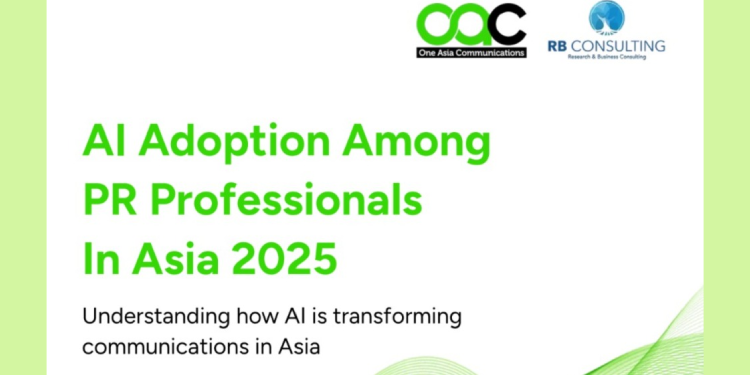
New Delhi: India’s communications and marketing sector is accelerating AI adoption at an unprecedented pace, with 92% of teams now using artificial intelligence for content creation. However, this enthusiasm is not matched by organisational preparedness, according to AI Adoption Among PR Professionals in Asia 2025, a new white paper by One Asia Communications (OAC).
Drawing insights from over 300 communications leaders across 12 Asian markets, the study reveals that while India is among the most optimistic adopters of AI in the region, it remains significantly underprepared for the emerging Generative Engine Optimisation (GEO) era.
India: High AI Use, Low Structural Readiness
The report highlights a growing “readiness gap,” where communicators are actively using AI but lack strategic frameworks to support long-term adoption. Key findings from India include:
- 68% of respondents view AI positively
- 75% of small organisations (<200 employees) rely heavily on free tools and deploy AI without a formal strategy
- Only 29% of large organisations have comprehensive AI guidelines
- Skills gaps (32%–67%) and budget constraints (25%–50%) remain the biggest barriers
- Investment in proprietary AI models, GEO-focused content systems and advanced monitoring tools is still limited
Together, these issues form what OAC describes as India’s emerging “GEO gap” — high usage but low optimisation for a future where generative engines will shape brand discoverability.
Why GEO Matters Now
GEO — Generative Engine Optimisation — is rapidly becoming central to modern communications, as generative engines increasingly determine how audiences discover, understand and engage with brands.
Ong Hock Chuan, Managing Partner of Maverick Indonesia and a founding member of the OAC network, said, “If your brand does not exist in the generative ecosystem, it may not exist at all. Communicators must design for discoverability, not just visibility.”
Despite 50%–58% of Indian respondents acknowledging that AI-powered search influences brand reputation, very few have begun preparing their content or communication frameworks for generative environments.
The Evolution of India’s Communicator
AI is reshaping communicators’ roles — shifting focus from execution to judgement, insight, and strategic counsel. India is already accelerating in this direction, with over 80% of teams using AI for research, insights, and audience interpretation — higher than the Asian average.
Siwon Hahm, Chairperson of One Asia Communications and CEO of Hahm Partners, noted, “AI is transforming communicators into insight generators and trust builders. We are moving from doing the work to directing how technology supports human understanding and truth.”
In India:
- Smaller organisations use AI primarily for content scaling and quick research
- Larger companies are adopting AI for crisis strategy, predictive analysis, and integrated campaign development
- Across the board, professionals expect AI to redefine PR roles within five years
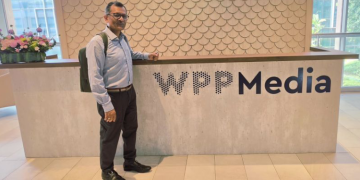
Chetan Mahajan, Founder and CEO of The Mavericks, OAC’s India partner, said, “GEO represents the single biggest growth opportunity for India’s integrated marketing communications industry. When communication becomes AI discoverable, personalised and anchored in ethical clarity, PR does not become less relevant. It becomes even more essential. However, while there is tremendous excitement around AI in India, our preparedness and investment in proprietary AI capabilities are not keeping pace. The organisations that close this GEO gap fastest will shape the next era of influence.”
What India Needs Next
The report highlights four urgent priorities for India to strengthen its AI and GEO readiness:
- Structured AI training, requested by 57%–83% of respondents
- Affordable, high-quality AI tools for scalable deployment
- GEO-ready content and measurement frameworks that reflect generative search ecosystems
- Clear AI governance and ethical guidelines, largely absent in most organisations today
As AI adoption surges, India’s communications industry sits at a pivotal inflection point — enthusiastic, fast-moving, and highly creative, yet in need of deeper strategic, technical, and governance foundations to thrive in the GEO-driven future.