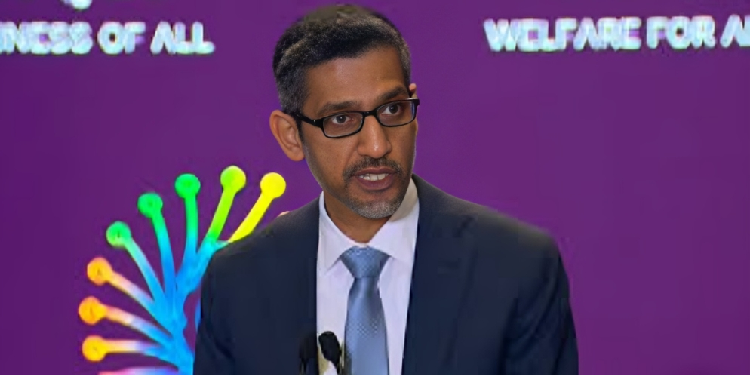
Mumbai: Addressing global leaders at the AI Impact Summit in New Delhi, Sundar Pichai, CEO of Google and Alphabet Inc., outlined an ambitious vision for artificial intelligence, describing it as “the biggest platform shift of our lifetimes” and a catalyst for inclusive growth and scientific breakthroughs.
In his keynote, Pichai reflected on India’s rapid transformation, recalling his student days traveling on the Coromandel Express from Chennai to IIT Kharagpur, passing through Visakhapatnam — now the site of Google’s planned full-stack AI hub. The facility forms part of Google’s $15 billion infrastructure investment in India and will include gigawatt-scale compute capacity and an international subsea cable gateway.
Pichai positioned AI as a force capable of accelerating discovery and enabling emerging economies to leapfrog legacy constraints. “And no technology has me dreaming bigger than AI,” he said, calling on governments and industry to pursue innovation boldly while ensuring responsible development.
Highlighting scientific advances, he pointed to breakthroughs from Google DeepMind, including AlphaFold, which addressed the decades-old challenge of predicting protein structures and is now used by millions of researchers globally. He also referenced Isomorphic Labs, which is applying AI to accelerate drug discovery.
Beyond research, Pichai emphasized AI’s practical applications in public services and agriculture. He cited collaborations in India that enabled AI-powered monsoon forecasts for farmers and initiatives in countries such as El Salvador to expand affordable healthcare access through AI-driven diagnostics.
At the same time, he underscored the need for responsible AI deployment. “We cannot allow the digital divide to become an AI divide,” he said, noting investments in compute infrastructure, subsea connectivity and workforce training. Google has trained 100 million people in digital skills globally and is launching a Google AI Professional Certificate to help workers integrate AI into their careers.
Trust and transparency, Pichai added, remain central to adoption, highlighting tools such as SynthID, designed to help verify the authenticity of digital content.
Calling for collaboration, Pichai urged governments, technology companies and enterprises of all sizes to work together to unlock AI’s potential. He stressed the dual role of governments as regulators and innovators, encouraging responsible frameworks that enable innovation while mitigating risks.
“We have the opportunity to improve lives at a once-in-generation scale,” Pichai concluded. “Now we must do the work, together.”