
What if Context-Driven AI could make extremely engaging content without you creating endless prompts?
If you’ve found yourself rewriting prompts repeatedly just to come up with an acceptable AI-generated response, then you’re not all on your own. For many years it was our belief that having more precise prompts would yield more effective outcomes. However, as AI is evolving and improved, this notion is being tested.
Today Context-driven AI is changing how content is produced. Instead of relying on prompt-heavy instructions, it concentrates on understanding the intention, target audience, and the purpose of the content. It has proven that, in some cases the use of less input will result in superior results.
In this blog, we’ll discuss the concept of Context-Driven AI and how it operates to increase engagement, and the reasons why companies and creatives are shifting away from complex prompting in favor of smarter, more context-driven workflows.
What is Context-Driven AI?
Context-Driven AI is a term used to describe artificial intelligence systems that recognize and preserve context, such as the tone of a brand’s branding as well as audience intentions, past interactions, and goals for content-before creating responses. Instead of relying upon multiple detailed prompts, this strategy utilizes context in order to create relevant real-time, precise, and human-like content.
Traditional AI systems respond to individual instructions. In contrast, Context-Driven AI focuses on understanding the larger picture that allows it to create coherent and relevant content, without the need for constant prompting.
This is vital for SEO as well as content marketing writing and for storytelling for brands where reliability and consistency is more crucial than the quantity of content.
Important Indicators of Context-Driven AI
- More relevant content that is aligned with the user’s expectations.
- Better engagement metrics, such as reading time and page speed.
- Consistent brand voice across all content.
- Reduction in the need for repeat or complicated prompts.
- The editing process is minimal and speeds up creation of content
Reasons Why Fewer Prompts are Better
At first, having fewer prompts could sound like risky. However, here’s the reason they are more effective with Context-Driven AI:
- Confusion reduced: Too many prompts may contradict one another.
- Clear intention: AI understands goals instead of following instructions
- Consistent output: Communication and tone stay on the same page
- Time efficiency: Less editing and reworking.
When AI understands context, it doesn’t need micromanagement. It anticipates what you need and provides content that is believable and natural.
How Context-Driven AI Enhances Content Engagement?
Engagement in content isn’t just about keywords. It’s about connection. Context-driven AI can help achieve that through:
1. Understanding Audience Intent
When it recognizes who the content is aimed at, AI adapts its language as well as tone and structure. This increases AI engagement with the content through making users feel valued and be addressed more personally.
2. Assuring Brand Voice
Instead of rearranging styles between sections, Context-Driven AI ensures consistency across the content, that builds trust and credibility while enhancing brand recognition.
3. Inspiring Flow and Coherence
Context-aware technology avoids the need for abrupt changes and repetition that result in smoother reading, more clear messaging and improved information retention.
4. Reduced Over-Optimization
Instead of stuffing keywords unnaturally, context-drive AI can integrate the keywords organically, increasing SEO performance without affecting the readability or the user experience.
Context-Driven AI vs Prompt-Driven AI
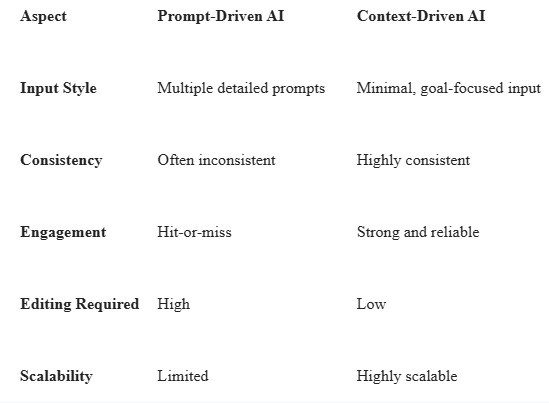
This is a good example of why AI that is based on context is rapidly becoming the standard approach for blogs, long-form articles and even branded storytelling.
The Role of Context Awareness in Modern AI
Context awareness is at the heart of context-driven AI. It enables systems to incorporate:
- AI examines content previously published to ensure consistency in the flow, tone and message.
- It adjusts to the preferences of the user including the style of writing, formatting preferences and even specific instructions.
- AI integrates industry-specific, accurate language and specialized terminology when required.
- It aligns content to SEO goals, which includes key words and search objectives.
- The AI creates content based on clear goals for content, such as engagement and education or conversions.
This goes beyond simple prompt engineering, allowing AI to function more like a collaborative writer, rather than a reactive tool.
If the context is established correctly, the AI doesn’t require any more guidance. It already “knows” what the definition of success is.
Real-World Use Cases for Context-Driven AI
Here’s how creators and businesses use AI that is context-driven effectively:
- Content Marketing: It includes blog, landing pages as well as case studies.
- SEO Writing: Keyword-rich but reader-first content.
- Email Marketing: Individualized campaigns using fewer inputs.
- Social Media: Consistent captions and brand messaging.
- Knowledge bases: Structured, context-aware documentation.
In all instances, fewer prompts leads to greater engagement and faster creation.
Why Context-Driven AI is the future of Content Creation?
As AI develops the quality and efficiency are progressively becoming interdependent. Context-driven AI assists in this process by:
1. Reduce dependence on complicated instructions:
Context-aware AI needs fewer prompts but still delivers reliable and accurate results.
2. Enhancing human collaboration by using AI:
It is able to quickly adjust to feedback, making the collaboration of AI and humans more efficient and more effective.
3. Providing content that is aligned with the strategic goals:
AI is focused on the business goals and ensures that content is in line with branding and growth.
4. Scalability can be increased without sacrificing quality:
The production of high-volume content is possible in a consistent manner without losing quality or clarity.
If you’re a brand looking to create quality, high-volume content, context-driven AI isn’t necessary, but it’s ESSENTIAL.
Best Practices to Using Context-Driven AI Effectively
To maximize the benefits of AI-driven context:
- Set clear goals in the beginning.
- Establish the context for the project once.
- Concentrate on the outcome Not on instructions.
- Review for alignment, not errors.
- Let AI manage flow and structure.
These steps enable the AI to work at its peak while keeping human creativity under the control.
Conclusion
“Great content doesn’t begin with more instructions -it starts by gaining a better understanding.”
Context-Driven AI is revolutionizing how we approach the creation of content. Instead of bombarding AI with numerous prompts and corrections we’re moving towards systems that can understand the audience, intent and their purpose right from the start. If the contextual information is clear then the output is naturally aligned, consistent and relevant.
With fewer demands, creators are able to focus their efforts on strategies and innovation instead of endless editing. The result? More engaging storytelling, stronger engagement and content that resonates with readers.
As the demands for content increase, and attention spans diminish and attention spans shrink, context-driven AI provides an intelligent, more human-centric approach to engage with audiences. It helps reduce friction in the process of creating and transforms AI into a partner in collaboration instead of a reactive tool.
Frequently Asked Questions
1. What is it that makes context-driven AI different from conventional AI?
It can recognize the tone, goals, and the context of the audience, allowing it to produce more consistent, relevant, and focused content.
2. Does it work as SEO-related web content?
Yes, it incorporates keywords naturally into the content to ensure readability and improve the visibility of search results and user engagement.
3. Do I still require prompt engineering?
The minimum effort required since the system relies on existing context instead of repeating or complicated instructions.
4. Does it work with long-form blogs?
It ensures smooth flow, consistent structure and more clarity throughout extended long-form content.
5. Is it beginner- friendly?
Yes, it can reduce the complexity and effort required to learn creating content easier and efficient for those who are just beginning.
(Views are personal)