Boing proudly calls itself a small-sized big agency. Small in the sense that it is a boutique setup, with a close-knit team of passionate professionals who believe in delivering big results. Big, because its people have worked on some of India’s most iconic brands, bringing with them a wealth of experience from top agencies.
The mission? To channel that expertise into nurturing challenger brands—those with big ideas and bold ambitions, but in need of a little extra push. Boing added that it blends the agility of a small agency with the strategic depth of an industry giant, creating powerful campaigns that make a real impact.
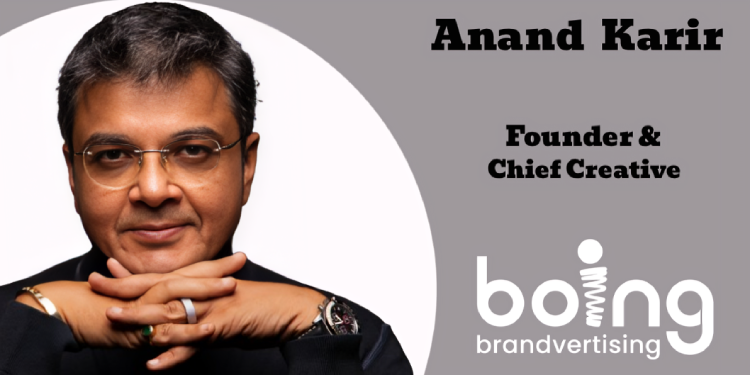
Medianews4u.com caught up with Anand Karir Founder and Chief Creative Boing Brandvertising
Q. The media and creative agency space is seeing consolidation. Are rapid tech advances the key reason for this?
Tech is definitely one of the catalysts, but not the only reason. Clients today want integration: media, data, content, commerce… all talking to each other. Large networks can offer scale and systems. Technology makes that integration easier and faster, so consolidation becomes a natural outcome.
But I don’t think tech alone is driving it. The bigger driver is accountability. When clients want sharper ROI and faster turnarounds, holding fewer partners feels simpler.
Q. How will this consolidation impact independent agencies like Boing Brandvertising?
It actually sharpens our advantage. Independent agencies like Boing Brandvertising, offering services across media and platforms, can also move faster. While we bring to table the same kind of great talent and experience like large networks do, we don’t have layers of approvals across continents. We sit closer to founders, CXOs, decision-makers.
That proximity helps us build braver work. Basically, consolidation creates scale and independence creates sharpness. And Boing Brandvertising thrives on sharpness.
Q. In 2026 what are the important things you would like to see in creativity?
In advertising creativity, I would like to see more substance. Work that respects attention instead of hijacking it. Stories that are emotionally intelligent, not just algorithm-friendly.
Also, I would love to see craft coming back in advertising, in a big way. In a world flooded with content, the brands that obsess over detailing in writing, music, sound design, visual grammar will stand out. Spectacle is easy. Soul is harder. I’d like to see more soul.
Q. For 2026 what goals have been set by Boing Brandvertising and what is the gameplan to get there?
The goal is simple: build work that outlives media plans. We want to create fewer but more iconic campaigns. Expand deeper into our storytelling.
Strengthen our AI print, film and post-production capabilities. And partner with brands at an earlier stage in the brand journey; not just at campaign, but at positioning stage.
The gameplan?
– Invest in talent.
– Build hybrid teams who understand both craft and performance metrics. – Make AI an even stronger tool to amplify our output.
Q. Are we in a situation where today no campaign is launched without a clear line of sight to business outcomes?
Almost. And that’s healthy. Creative romanticism without business clarity doesn’t survive today. But the reverse is also true- performance marketing without brand imagination plateaus rather quickly.
The best campaigns now are those where creative ambition and business ambition are aligned from day one.
Q. In commanding a fair remuneration does the agency have to completely understand the business outcome that the client is aiming for?
Absolutely. If we don’t understand what success looks like for the client – market share, penetration, recall – how can we price our value?
Fair remuneration comes from shared clarity. When we know the stakes, we can take accountability. And clients are willing to pay for accountability.
Q. How is AI being integrated into Boing Brandvertising to deliver better creative work? At the same time is there a danger that too much use of AI will result in sameness of ad copy in the industry?
We use AI as an amplifier, not as a replacement. It helps us in pre-visualisation, music experimentation, alternate edits, etc. It reduces the number of iterations by making our briefs sharper. This frees time for deeper thinking. But yes, there is a real danger of sameness if you over-depend on AI.
Because if everyone prompts the same way, you get the same tone, same metaphors, and perhaps same rhythm. Hence, one can say, originality still depends on human taste. AI can generate options. It cannot generate instinct.
Q. Boing Brandvertising focusses on immersive storytelling, meticulous craft, and cinematic scale. How will this focus help brands stand out in the competitive festive season in 2026 where everybody will be shouting?
When everybody shouts, the brand that whispers beautifully wins. Festive clutter is real. So instead of louder, we go deeper. Strong music. Visual richness.
Emotional payoff. People don’t remember offers. They remember feelings. Cinematic scale helps us create a unique memory, not just messaging.
Q. Could you talk about the process of reimagining Nirma through a TVC that looked to balance modernity and nostalgia?
The challenge was ‘respect’. Nirma isn’t just another brand. It’s memory. And its jingle is a strong cultural memory. So we didn’t want to replace it. We wanted to reimagine it. We first studied how it lived in people’s lives and minds.
Then we built a film that kept the emotional familiarity intact, but felt visually and sonically contemporary. It was less about reinvention and more about evolution.
Q. Did tech play an important role in bringing the warmth associated with the original jingle?
Yes, but in an invisible way. We used modern sound design and mixing tools to retain the analog warmth, while improving texture and depth.
The goal was not to make it sound new. The goal was to make it relevant. Technology helped us enhance nostalgia without over-polishing it to death.
Q. How much research goes into creating stories that feel fresh, relevant, and emotionally alive? Any recent examples that stand out.
A lot, but not always in the traditional sense. We believe in cultural research. Conversations, observing behavior, listening to how people actually speak.
For example, in recent BFSI work, instead of talking about interest rates and returns, we are focussing on FOMO — that universal “I wish I had invested earlier” emotion.
That insight is shaping the entire narrative. Emotion is research. If it doesn’t feel true, it won’t travel.
Q. What work can we expect in the coming months? Which are the key categories like FMCG, BFSI that the agency will focus on?
Boing Brandvertising has some very interesting brand launches lined up in FMCG, real estate and electricals categories. Besides, there are some interesting pieces in the pipeline in consumer durable and BFSI space. You’ll also see more long-format brand films from us.
We’re also in talks with some mobility and emerging D2C brands. Our focus is not category-first. It’s ambition-first. We want to partner with brands that are ready to build memory, not just market share