Channel Factory is a global technology and data company that optimizes business performance and protects brand reputation across walled gardens. Utilising proprietary AI and contextual targeting technologies, Channel Factory ensures ads are placed on brand-safe, contextually relevant content across YouTube, CTV platforms, and social media, including Meta and TikTok.
Through its conscious media planning, Channel Factory is committed to promoting sustainability, diversity, and positive content, helping brands achieve their goals while fostering a healthier digital ecosystem. Channel Factory has a presence in 54 countries across the Americas, Europe, the Middle East, Asia, and ANZ, providing advertisers with IAB standard category lists and customized content options in 50+ languages.
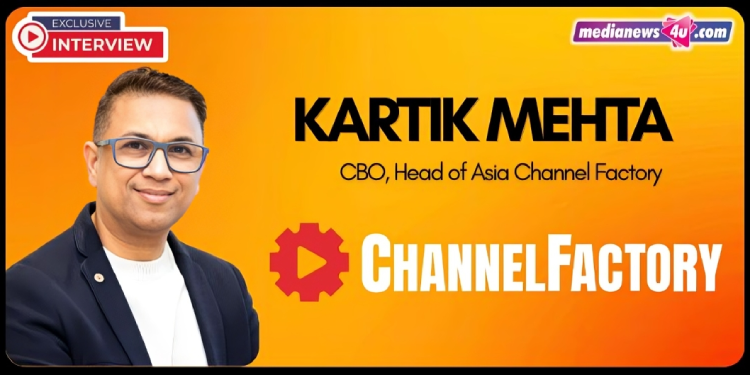
Medianews4u.com caught up with Kartik Mehta, CBO, Head of Asia Channel Factory
Q. What trends does Channel Factory expect to see in the digital ad landscape in 2026? How will it leverage these trends?
Three trends define 2026 for us. AI is moving from a supplementary tool to the core infrastructure of marketing — driving real-time creative testing, automated buying, and predictive optimisation. Short-form vertical video has become the default language for capturing shrinking attention spans. And most importantly, brands are shifting from mass reach to contextual suitability — wanting ads in environments that genuinely reflect their values. This is exactly where Channel Factory is built to lead.
Q. Can you take us through your Mental Health Initiative Focused on Young and Vulnerable Audiences Impacted by Social Media?
Our Mental Health Initiative is a direct extension of our Conscious Advertising philosophy. Advertisers fund the internet — and the internet they fund shapes the world young people grow up in. At the heart of the initiative are our Positive Mental Health Inclusion Lists — expert-validated content environments that actively support resilience, confidence, and digital well-being in young audiences. Every piece of content is validated by a multidisciplinary panel including Dr. Dan Reidenberg and Dr. Sameer Hinduja, mapping to ten recognised dimensions of mental well-being. Our global research found that 50% of consumers believe social media negatively impacts youth mental health, and two in three believe advertisers have a responsibility to act. We are giving brands the tools to do exactly that — while still delivering strong campaign performance.
Q. As third-party data becomes less important, will we see more creativity in digital advertising in 2026?
The decline of third-party data is one of the best things to happen to advertising creativity. When you can’t rely on surveillance-based targeting, you’re forced to do the more interesting work — understanding context, crafting messages that resonate in specific environments, building genuine relevance. At Channel Factory, we’ve always believed contextual intelligence is the superior strategy — not just ethically, but commercially. Our data shows up to 82% higher ROAS when brands align with the right content environments. Creativity and context go hand in hand, and 2026 will prove that.
Q. Last year, Channel Factory unveiled AI tools to boost ad ROI and precision. How much R&D went into this, and what impact has it had so far?
Channel Factory Intelligence is the result of a multi-year investment in proprietary machine learning models — not something built overnight. The suite includes our Media Intelligence Hub and our Chatbot Assistant, the first personalised AI data analyst embedded within our ActivateIQ platform.
An independent PwC verification study found we’ve reduced media waste by over 20% and achieved 99% accuracy in content categorisation. In India, we’ve been building a dedicated team of AI specialists, and this year campaign planning, reporting, and bidding will all be AI-led — with human oversight built in at every stage to ensure quality and accountability.
Q. What further innovations from Channel Factory can we expect in 2026?
We’re deepening our AI capabilities around contextual intelligence — making it faster and more actionable for clients. Our Positive Mental Health Inclusion Lists will become more granular, with customisable subtopics including healthy sleep habits, body image confidence, and healthy eating.
We’re also expanding our AI slop detection and Signal vs Noise Intelligence framework across APAC markets, helping brands not just avoid bad environments but actively own premium ones. The through-line across all our innovation remains the same: proving that the most responsible media choices are also the most effective ones.
Q. What role will AI Search play in shifting the dynamics of where spends go towards things like CTV?
AI Search is disrupting traditional search economics fast. With AI-generated overviews delivering answers directly on the results page, click-through rates are falling — the rise of zero-click searches is real. This is pushing budgets toward channels that offer genuine attention, and CTV is the primary beneficiary. Up to 50% of streaming advertisers are expected to redirect budgets from search and social to CTV in 2026.
CTV offers what AI Search increasingly cannot — a premium, brand-safe, high-attention environment with completion rates consistently above 94%. Channel Factory’s contextual intelligence capabilities apply powerfully here, helping brands show up in the right content on the right screens.
Q. Over 100 Indian AI Startups are shifting base to San Francisco’s Bay Area. Is this bad news for India when it comes to AI innovation? Can more progressive Government policies help, or will India be left way, way behind the US and China in the AI Race?
It’s a serious trend and the funding gap is stark — American AI companies raised $159 billion in 2025, compared to $1.3 billion raised by Indian AI startups in the same period. The pull of the Bay Area — capital density, customer proximity, talent ecosystems — is rational, not sentimental. However, India is not out of the race. It is the world’s largest live testing ground for large language models, with over 700 million mobile users actively engaging with AI products.
India’s structural advantages in deeptech, regional language AI, and enterprise services are real and growing. Progressive government policy can accelerate this — but capital alone won’t replicate Silicon Valley. What India needs is faster regulatory frameworks, stronger industry-academia collaboration, and more support for founders who want to build global businesses from India. The window is still open — but it won’t stay open indefinitely.
Q. Does the digital dashboard have a trust deficit when it comes to AI-driven insights?
Yes — and it’s one of the most important conversations in our industry. There is a growing gap between what dashboards report and what advertisers experience on the ground. 82% of ad executives believe consumers feel positive about AI-generated ads — nearly double the 45% who actually do. That disconnect is a trust problem. Many AI optimisation systems operate as black boxes, making it impossible for brands to understand the decisions being made on their behalf. At Channel Factory, our AI is designed to act as a “second brain” — delivering precise insights while maintaining complete visibility. Transparency is not a feature. It’s a design principle.
Q. How will Channel Factory help clients deal with ad fraud, which exists in things like bots, risk misalignment?
Our position is clear: AI is not the enemy. Slop is. And navigating this requires more than a blocklist — it needs a quality-led intelligence layer built for the AI age. We deliver this through Signal vs Noise Intelligence — real-time scoring of content quality, not just safety categories. Through APAC-Native Suitability — market-specific frameworks across Singapore, SEA, India, and Greater APAC, because global settings cost you both reach and trust. And through Placement Transparency — showing clients exactly where their brand ran, not just what was blocked.
We also help clients clean the signals feeding their measurement, because AI slop pollutes data upstream of every decision. If you can’t trust the signal, you can’t trust the decision. Avoiding slop is the floor. Owning the signal is the prize.