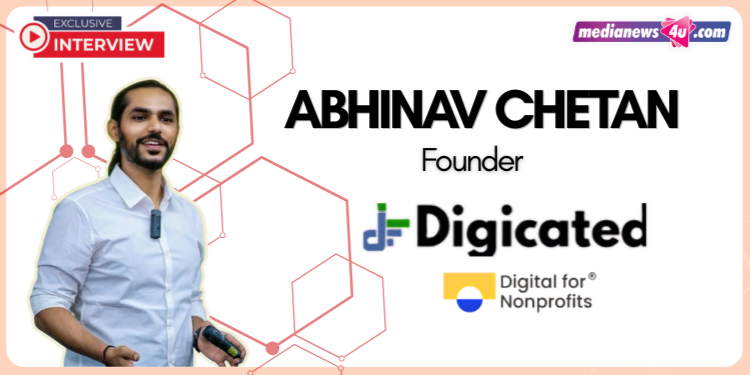
Abhinav Chetan spent 12 years at Google working across operations, performance marketing, and product, enabling Google Ads and Analytics for leading advertisers in India and globally. Over time, a question stayed with him: what if the rigour, measurement, and systems thinking used by global brands were applied to organisations solving society’s toughest challenges?
That question led to two ventures. Digital For Nonprofits (D4NP) works with social impact organisations to access technology grants, build digital marketing capability, and adopt generative AI with the self-reliance of a well-resourced brand. Digicated.ai, his advisory practice, partners with startups and progressive brands to accelerate GenAI maturity and drive measurable outcomes.
Across both, his philosophy centres on leverage—often referencing Archimedes’ idea of moving the world with the right lever and fulcrum. For Abhinav, GenAI is that lever, strengthened by measurement and method. Through D4NP, he has unlocked over $10 million in ad grants and trained 10,000+ professionals.
Medianews4u.com caught up with Abhinav Chetan, Founder Digicated.ai and Digital For Nonprofits to understand how the social impact sector is navigating its most consequential digital shift yet.
Q. Digital For Nonprofits was created to close the digital capability gap in the social impact sector. What progress has been made so far?
The gap we set out to close is real, and it is wider than most people realise. When we analysed over 100 top nonprofits in India for our State of Nonprofits Digitization report, what we found was striking. Most organisations had some form of digital presence: a website, a social media handle, some level of tracking and occasional campaigns.
What they did not have was the system behind the presence, this reflected in their average score of 5 out of 10 across sectors. The report got covered in 20-plus publications and earned significant media traction for the quantitative digital maturity benchmark we created for the sector and the insights from that initiative.
With every nonprofit we start with an in-depth assessment and then move to acquiring technology grants because that is the first unlock. The most significant of these is Google Ad Grants, i.e. $10,000 per month of ad credit to qualified nonprofits in addition to other tools like Canva, OpenAI, Claude subscriptions at low or no cost.
Till now we have unlocked over $10 million in ad grants across nonprofits we have partnered with and have educated and worked with 100-plus nonprofits. The nonprofits we partner with score 35 percent more than the sector’s digital maturity benchmark.
But grants and scores are only part of the story. The most critical pillar for us is embedding GenAI into nonprofits, something we have been doing for the past three years. For instance, as a result of GenAI-driven efficiency, The All India Disaster Mitigation Institute (AIDMI) expanded from two digital channels to nine. Their newsletter readership grew fourfold. Online event participation tripled, and this is just one organisation.
We have now taken the GenAI narrative to over 100 nonprofits across India. From our on-ground experience, when we build digital and GenAI awareness, adoption follows and as a result digital maturity accelerates. I have seen this repeatedly in practice.
 Q. For 2026, what goals have been set and what is the gameplan to get there?
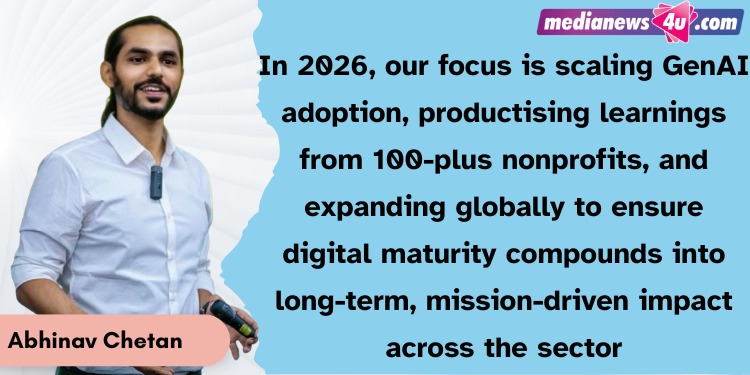
In 2026, the focus shifts from building to compounding. The first phase was about getting nonprofits onto the right foundations: unlocked ad grants, optimised websites, and installed deep analytics with GenAI at the centre. That work continues but the ambition this year is much larger.
Within digital marketing maturity, we are now emphasising GenAI adoption at scale. Not tools for the sake of tools, but embedding AI into how nonprofit teams function, communicate with donors, report to funders, and run campaigns. We want every team member in our partner organisations to be GenAI fluent, so that technology becomes a daily productivity multiplier.
Alongside this, we are condensing everything we have learned across 100-plus nonprofits into an education product: a structured resource that any nonprofit can use to understand how GenAI applies to their specific mission. The sector should not have to figure this out from scratch. We have done the hard work of mapping what works and we want to make that accessible.
We are also taking deliberate steps toward internationalisation. The digital maturity gap in the social impact sector is not unique to India and we are working towards partnerships outside the country that can extend this mission further.
And perhaps most importantly, we are planning an in-person event this year bringing together nonprofits, technology companies, industry bodies and donors to have a direct, unfiltered conversation about how GenAI and digital marketing maturity can accelerate nonprofit missions.
The sector has had enough webinars. It is time for the people who fund, build, and run these organisations to sit across from each other and align on what is actually possible.
Q. Brands sell products. Nonprofits sell emotions. Do nonprofits need a different marketing playbook compared to FMCG or fintech brands?
Nonprofits need marketing more than any other kind of organisation. That may be counterintuitive but over time I have realised this is a fact. The fundamentals of marketing do not change for nonprofits.
You still need to understand who you are talking to, what they care about, what action you want them to take, and whether your message is reaching them at the right moment. Those rules apply whether you are selling detergent or fighting child malnutrition. What changes is the nature of the transaction, and that difference determines your approach.
In FMCG, fintech or related verticals the exchange is functional. I give you money, you give me some product or service and the transaction is complete. With a nonprofit, what the donor receives in return is entirely emotional. They are not getting a product or a service. That is a far more sensitive transaction to manage and requires a great degree of skill to sustain. Also it is much easier to break than it looks.
A PhonePe campaign can lead with three product features and call it done. That product-led approach does not work for a nonprofit. What works is consistent storytelling built around impact, sustained over a long period of time. If you do those two things well, you will build something that a product brand rarely achieves: genuine, lasting loyalty rooted in shared belief.
The currency of the nonprofit donor relationship is trust. Everything in nonprofit marketing has to be oriented around earning it, protecting it, and never taking it for granted.
CanKids Kids Can is a good example of this done right. They started a newsletter and built regular campaigns like their Cycle for Gold marathon around storytelling and visibility. This resulted in a growing community of people who feel genuinely connected to the mission. To engender a strong emotional bond and then convert it into trust, nonprofits need a well-designed conversion path which a majority of the sector does not think about.
Q. How is GenAI giving social impact organisations a boost in getting their message across more effectively?
GenAI has become a powerful tool for adding efficiency at all levels for social impact organisations. Whether it is creating multi-modal content across text, image, audio, and video, conducting deep research, analysing complex datasets, or building communications infrastructure, it is a great lever to do more with less.
The same kind of activities would previously have required significant time and specialised resources. This is where GenAI can make a tremendous impact. For nonprofits operating with lean teams and tighter budgets than most, that is genuinely transformational.
But here is the uncomfortable reality sitting underneath the excitement. According to the 2026 Nonprofit AI Adoption Report by Virtuous and Fundraising.AI, 81 percent of nonprofits use AI on an individual, ad hoc basis. Only 4 percent have documented, repeatable AI workflows.
That gap between casual use and structured adoption is exactly where the opportunity is being lost. The organisations seeing real results are the ones that have embedded GenAI into how their teams actually work, day to day.
Here is an example: before structured GenAI adoption, SEWA Bharat, one of India’s largest organisations working with women in the informal economy, had a fragmented digital presence and inefficiencies across internal processes. Today more than 50 members of their team including senior leadership use GenAI on a daily basis for various tasks across communication, research, and analysis among others.
A standout example is how they managed to semi-automate their annual report production using GenAI, saving up to 75 percent of the time. For a team stretched across multiple threads, that is hundreds of hours returned to mission-critical work.
That is really what GenAI does at its best in the nonprofit context. It augments the capabilities of human resources rather than replacing them. Nonprofit teams are some of the most committed people I have worked with anywhere. GenAI gives them the leverage to do more with the same energy, and to spend that energy on what truly matters.
Q. In terms of how they use various media channels, what would you like to see nonprofits do to build trust in 2026?
Let us start with an assessment of where nonprofits actually sit in the media landscape. Television and large-scale broadcasts are largely out of their reach. Most organisations in the social impact sector do not have large marketing budgets and they never will.
A handful of well-funded nonprofits could afford broadcast visibility but the vast majority have to build trust through more efficient means. The good news is that digital, when done well, can serve as the optimal medium for nonprofits.
The challenge is that most nonprofits have not fully made that shift. A significant amount of time and budget still goes into events, newsletters, brochures, PR and offline collateral. These are good vehicles, but they do not behave as compounding assets. Whereas digital does. The organisations that will build the most trust in 2026 are the ones that embrace digital wholeheartedly rather than treating it as a supplement to their offline activity.
What I would most like to see change from a trust perspective is how nonprofits think about their on-ground stories. Most of the organisations I have worked with have incredibly powerful stories sitting in the fields. A beneficiary whose life changed. A community that organised around a crisis. A programme that delivered against impossible odds. These stories exist. But most nonprofits do not have a system to capture them adequately, communicate them consistently, or connect them to a broader narrative that builds trust over time.
Another aspect nonprofits could change is to stop treating every channel as a broadcast tower and start treating some of them as listening posts. Most nonprofits use digital channels to push messages outward. This happened. We did this. Please donate. Please share. Very few use digital channels to understand what their community is thinking, what their donors are questioning, what their beneficiaries actually need. That listening function is where trust is built, not in the one-way announcement.
For 2026, I would recommend three things specifically. First, move decisively from offline-led channels to digital and treat it as your primary trust-building medium. Second, build a system to capture and communicate on-ground stories consistently, not just when a campaign demands it. Third, use feedback mechanisms across WhatsApp, YouTube, and email to actively listen to what your community is telling you, and let that shape what you say next.
Q. Are fragmented digital efforts and inconsistent storytelling the biggest challenges facing nonprofits today?
They are the most visible challenges. But underneath them is a root cause that does not get discussed enough: the absence of leaders and teams who genuinely understand and own digital.
Fragmented efforts and inconsistent storytelling are just symptoms. The actual challenge is an organisation where digital is treated as a function rather than a strategy. The communications team runs social media. The fundraising team runs email. Neither talks to the other.
There is no shared content calendar, no unified donor journey, no one asking whether the sum of these parts is building something. And at the top of the organisation, the leader often does not align teams to work together. Digital is the first budget line to get cut when funds are tight and the last to get measured when things go well.
I have seen this repeatedly across our portfolio. Talented, committed execution teams produce fragmented, inconsistent output not because of any failure on their part, but because there is no shared direction coming from the top. You cannot fix a leadership problem at the execution level.
When the founder or CEO starts asking questions about digital maturity in their board meetings, when they want to understand what the data is saying, when they treat digital as a core organisational capability rather than a communications task, everything downstream changes. That shift in ownership is what separates the organisations making real progress from the ones running in circles.
Sivananda Yoga Ashrams is a compelling example of what leadership owning digital actually looks like in practice. Their leaders invested time in understanding digital and GenAI, took the decision to invest in tools, and now use them regularly across the organisation.
Members across all teams are now using GenAI almost daily. That top-down conviction is what allowed adoption to move from experimentation to integration. The result is visible in how they communicate, how they report, and how they show up digitally as an organisation.
This attitude enabled them, a 60-year-old yoga ashram, to build a meaningful digital presence rapidly and sustain it well beyond any single moment of urgency.
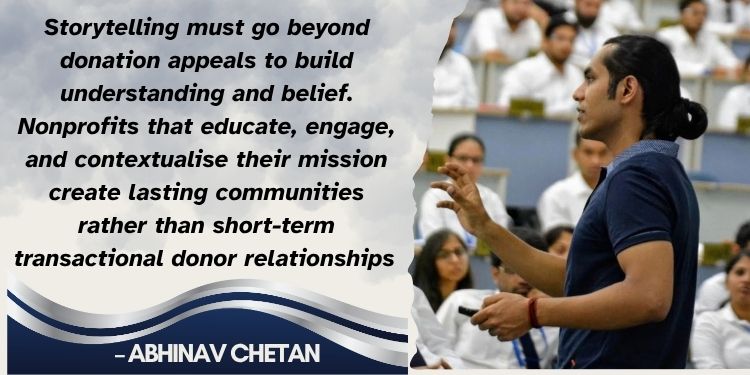 Q. Does storytelling for nonprofits need to go far beyond basic fundraising appeals?
Absolutely. And nonprofits that reduce their storytelling to fundraising appeals are slowly training their audience to tune them out.
Think about how a fundraising appeal actually lands. Someone gets an email. There is an image. There is a number. There is a donate button. The first time, they might respond. The fifth time, it is background noise. The tenth time, they have unsubscribed. What you have built is not a donor relationship. You have built a transaction that exhausted itself.
The storytelling that creates durable relationships is the kind that informs, challenges assumptions, shows the complexity of the problem, and makes the audience feel like an intelligent stakeholder. For example, a nonprofit working on education should be helping its audience understand why learning outcomes are declining in certain geographies, what systemic factors are at play, why their particular approach addresses the root cause and then back this narrative with real stories of change. This develops trust and when it is done consistently, it creates a community of believers who fund you because they are convinced in your mission.
The degree of difficulty in storytelling also varies enormously depending on the cause, and this is something nonprofits do not talk about enough. Getting donations for educating a child is relatively intuitive. The emotional connection is immediate. But getting consistent funding for conservation is a fundamentally harder storytelling challenge.
Why should someone care about the migratory patterns of a rare bird? The answer is that they will not, until they understand why it matters. WWF-India understands this well. They have built storytelling, merchandising programmes and community events that go well beyond the donation ask. This creates ongoing engagement that keeps their audience connected and willing to fund causes that are not immediately visceral.
That is the lesson. The more abstract or complex your cause, the more heavy lifting your storytelling has to do. It has to build understanding before it asks for action. Nonprofits that skip the understanding step and go straight to the ask will always struggle with donor retention, because they are asking people to fund something they have not yet been given a reason to care about deeply enough. Storytelling is not a nice-to-have in nonprofit marketing. For continuous, sustainable funding, it is the whole game.
Q. Most nonprofits are digitally active. Few are digitally mature. What tactics should they adopt to reach maturity? Do they need a 24×7 attitude toward digital?
The 24×7 question is a trap and I want to address it directly. Digital maturity is not about always-on activity. It is about always-on systems. There is a significant difference between the two. A nonprofit that posts every day but has no analytics, no audience segmentation, and no mapped donor journey is digitally active. It is not digitally mature. Maturity is not measured in volume. It is measured in intelligence. The path to maturity follows a continuous cycle of three things: Assessment, Education, and Adoption. And then repeat.
Assessment comes first. You need to understand where you actually stand relative to your peers. Not where you think you stand, but where the data says you stand. What channels are you on? What is your analytics infrastructure? How does your digital presence compare to the benchmark? This is where our State of Nonprofits Digitization report has been genuinely useful. It gives organisations a mirror rather than an aspiration.
Education comes next. Once you know the gaps, you build the capability to close them. This might mean fixing your analytics setup, expanding to channels you have been avoiding, or adopting GenAI fluency into your team. Capability building is not a one-time workshop. It is a sustained commitment to understanding what these tools can do and how they apply to your specific mission.
Adoption is where most nonprofits stall. They learn something, experiment briefly, do not see immediate results, and move on. But digital maturity is a marathon, not a sprint. Nonprofits show extraordinary persistence when it comes to their core mission. That same persistence needs to be applied to digitisation. Without sustained effort and continuity, digital initiatives never move beyond experimentation into genuine leverage.
When Assessment, Education, and Adoption become a continuous loop rather than a one-time project, things start to change. Take the Museum of Art and Photography (MAP) as an example: with a well-meaning, committed and digitally savvy team, they have established MAP as the go-to art museum in Bangalore, all through sustained digital activity. That is what maturity can do for your organisation.
Q. How can predictive analytics help nonprofits ensure on-ground activities effectively complement digital platforms like WhatsApp and YouTube?
This is one of the most underutilised capabilities in the social impact sector, and what makes it particularly interesting is that nonprofits are actually better positioned to benefit from it than most brands realise. Unlike brands that spend significantly to acquire first-party data, nonprofits already have it in abundance.
Every camp, every distribution drive, every community event generates attendance records, geography data, demographic information, and engagement patterns. The problem is that almost none of it gets deployed to surface predictive insights. It sits in a spreadsheet, filed away, and never connected to anything.
What predictive analytics allows you to do is bridge that gap. Connect your owned data to your digital behaviour data and, when done right, patterns start to emerge that fundamentally change how you communicate. Which volunteers who attended an on-ground event went on to become monthly donors? Which geographies show high field engagement but low digital reach? Which donor segments respond to video impact stories versus written reports? These are not hypothetical questions. They are answerable with tools that are already accessible.
Platforms like Google Analytics 4, Google Tag Manager, and Hotjar, combined with even a basic CRM, can surface deep and meaningful insights without a data science team. SEWA Bharat found that a significant proportion of their visitors were reading translated versions of their content. That single insight changed their content strategy. They prioritised multilingual options and the results were immediate: visitors now spend two to three times longer on the Hindi and Gujarati versions of the website compared to the average user browsing the same content in English. That kind of engagement happens when you let the data tell you what your audience actually needs.
The tools are available, many of them at low or no cost. The barrier is the habit of asking the question in the first place. When nonprofits start treating their first-party data as a precious resource, they can build a feedback loop between online and offline sources, between first-party and third-party data. That loop, once established, is where the real leverage is.
Q. What inspired the creation of Digicated.ai, and what specific problem is it solving?
Digicated.ai was born from something I observed repeatedly across my 12 years at Google, and that was a gap between adoption and maturity.
Look at the top advertisers in any market and you will see what digital tools are genuinely capable of when they are used with sophistication, structure, and intent. The top five percent of brands and spenders are extracting enormous value from the technology available to them. They have the teams, frameworks, and measurement to compound their advantages year on year.
What struck me was how sharply that dropped off the moment you moved beyond that top tier. The remaining 95 percent of the ecosystem had access to the same tools but were using them at a fraction of their potential. Not because of a lack of willingness, but because of a lack of maturity.
That gap did not close over time. If anything, it widened. And when GenAI arrived, the same pattern repeated itself almost immediately. Most brands adopted GenAI tools quickly. Very few built the systems to use them consistently, repeatedly, and in ways that compound into real business outcomes.
There is a significant difference between a team that uses GenAI tools occasionally and an organisation that has documented, repeatable GenAI workflows embedded into how it actually operates. The first is adoption. The second is maturity. And maturity is what drives results.
Digicated.ai was built to accelerate GenAI maturity for brands and MSMEs that are ready to move beyond adoption, through our three-stage approach of Assessment, Adoption, and Advisory. The goal is to take the kind of exponential leverage that the top brands enjoy and make it accessible to the organisations that need it most.
Q. How does Digicated.ai’s approach differ from traditional digital consulting or marketing agencies?
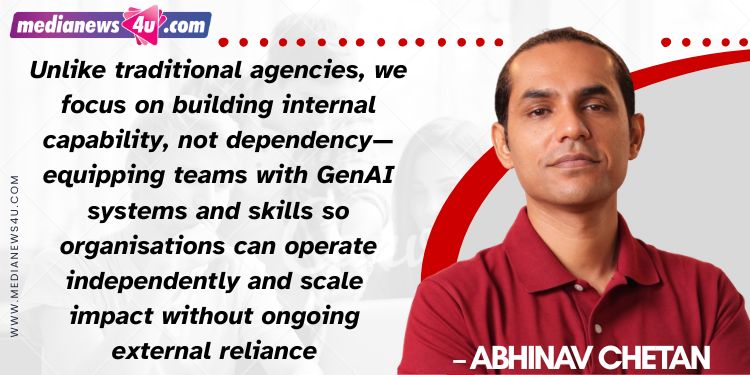
The most fundamental difference starts with incentives. A traditional agency’s business model is built on you remaining dependent on them. The retainer continues as long as you need them to fulfill the requirements of a task. Their shared intelligence, extended teams, and execution capability, all of it is rented to you in exchange for a repeat fee. The moment you build that capability internally, the engagement ends. That is not a model designed to empower you. It is a model designed to retain you.
GenAI is dismantling this model faster than most agencies are willing to acknowledge. According to Gartner’s 2025 CMO Spend Survey, 39 percent of CMOs plan to cut back on agency budgets, and 22 percent say GenAI has already enabled them to reduce their reliance on external agencies for creativity and strategy. The intelligence and expertise that used to sit exclusively with specialists can now be embedded directly into your own team. Work that was being outsourced is increasingly being done internally, faster and at a fraction of the cost, when teams are properly equipped.
The question is no longer whether your organisation can do this work. The question is whether you are willing to build that capability inside your organisation. That is exactly what Digicated.ai was built to do. We are not an extended team. We are a capability multiplier, here to augment your team with GenAI and simplify your workflows so that the dependency the traditional agency model relies on never forms in the first place.
Our engagement follows three stages: assessment, adoption, and advisory. We begin by understanding where your organisation genuinely sits in terms of its GenAI maturity, through audits and interviews. We then work through adoption together, building capability through education, skill building, and system design so that the frameworks we create are owned by the client. Finally, we advise on the trajectory forward, connecting your current state to a clear path of compounding impact. We come in, build the capability, set up the systems, and leave. The goal is always for our partners to need us less, or not at all, over time.
 Q. How is Digicated.ai leveraging AI, automation, and data intelligence to help organisations scale impact more sustainably?
The word I would use is compounding. GenAI, when embedded well, makes the output of today better than the output of yesterday, and that gap widens over time. But getting there requires understanding something important: this is as much a learning, development, and change management exercise as it is a technology exercise. Possibly more so.
Over three years of working with GenAI and taking our learnings to brands, the pattern has become very clear. GenAI technology is not the hard part. If anything, it keeps getting easier. The hard part is orienting teams to be open to new ways of working.
Building genuine awareness of what these tools are capable of. Establishing the right context so that GenAI assistants and workflows are set up in ways that actually serve how teams operate. That human-centred work is what separates organisations that see results from organisations that run a few workshops and go back to their old habits.
The process we follow reflects this. We build awareness first, followed by skills, and then systems. Then we give teams the capability to keep improving those systems themselves. Because GenAI keeps evolving, the real asset is not any specific workflow we build. It is the organisation’s ability to learn, adapt, and compound its advantage over time.
University Living is a good illustration of what this looks like in practice. We helped the student accommodation startup enable over 50 employees to integrate GenAI into their daily workflows. The result was a 30 to 40 percent reduction in task time across the team. But the more meaningful outcome was what that reclaimed time was redirected toward. Teams that had been spending half their day on mechanical content production, reporting, and research were now spending that time on strategy, customer conversations, and deeper product thinking. The leverage was in what the efficiency unlocked.
That is the sustainable impact model. GenAI allows teams to do more with less by removing repetitive work and freeing up human energy for higher-value outcomes. Our goal at Digicated.ai is to build GenAI maturity across organisations so that technology becomes a true growth multiplier. The organisations that build this capability now will not just be more efficient. They will be structurally different from their competitors in ways that become progressively harder to close with every passing quarter.