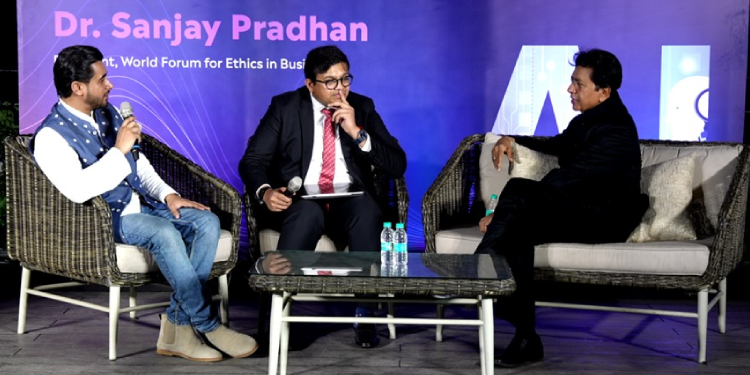
Mumbai: The International Advertising Association (IAA) and Artificial Intelligence Association of India (AIAI), in association with The Free Press Journal, hosted an edition of IAA Conversations featuring Sanjay Pradhan, President of the World Forum for Ethics in Business (WFEB), at Free Press House in Mumbai. The event brought together industry leaders and professionals to discuss the growing need for ethical frameworks in the development and use of artificial intelligence.
Addressing a packed audience, Pradhan emphasised that while AI is transforming industries and accelerating innovation, it also raises serious ethical challenges that require collective action from businesses, governments and individuals.
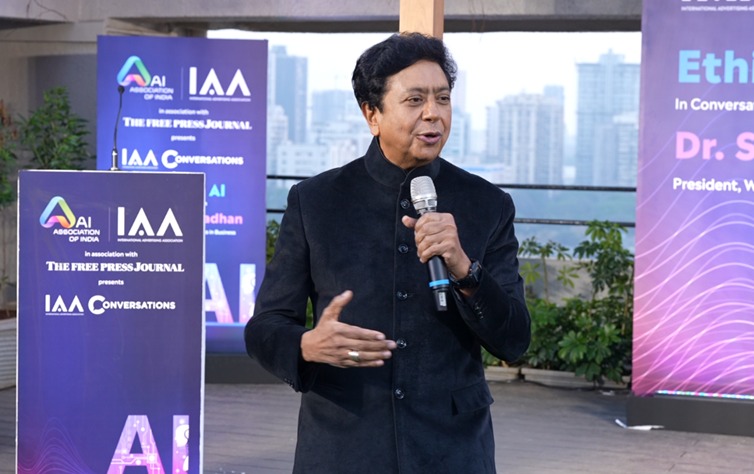
Dr Pradhan said “Artificial intelligence has rapidly become one of the most powerful technologies that humanity has ever created, It is unlocking breakthroughs in medicine, science, and creativity at a pace unimaginable just a few years ago.” However, he cautioned that the same technology could create significant risks if not governed responsibly. “The same technology that can transform lives can also inflict profound harm. It can turbocharge disinformation faster than truth can travel. It can steal our privacy, deepen injustice, and rob hundreds of millions of people of their livelihoods,” he said, citing concerns raised by AI pioneers including Geoffrey Hinton.
Highlighting the urgency of ethical oversight, Pradhan added, “The question is no longer whether AI will shape our world. It already has shaped our world. The real question is whether we will shape AI with ethics, humanity, and wisdom.”
The session outlined WFEB’s emerging AI Ethics Partnership, a global initiative aimed at promoting responsible AI development. Pradhan structured his address around four guiding questions — why, what, how and who — and identified disinformation, bias and discrimination, data privacy, and job security as the four major challenges that must be addressed.
Using a metaphor, he described ethical AI as a three-layered cake: the outer layer representing visible social and business outcomes, the middle layer representing organisational culture moving from ethical codes to ethical practices, and the innermost layer representing the conscience of individual leaders.
Drawing from Indian philosophical thought and referencing WFEB co-founder Sri Sri Ravi Shankar, Pradhan quoted, “Artificial intelligence can only reproduce what is stored. Absolute intelligence is boundless. Absolute intelligence is the all-pervading wellspring of conscience, creativity, and compassion.”
He argued that practices such as breathwork and meditation can help leaders develop the clarity and calm necessary for ethical decision-making. Encouraging organisations to prioritise responsible AI practices, Pradhan urged stakeholders to collectively support companies that demonstrate ethical leadership.
“Let us rise in a magnificent murmuration of conscience,” he said, “to ensure that artificial intelligence is guided by absolute intelligence, that technology reflects our deepest human values and not merely the cold logic of algorithms.”
The discussion also featured industry leaders including Maninder Adityaraj Singh, Chief of Staff and Head of Innovation at Rediffusion Brand Solutions, and Yash Johri, lawyer at the Supreme Court of India. The event opened with remarks by Abhishek Karnani, President of the IAA India Chapter.
Commenting on the initiative, Dr Sandeep Goyal, Managing Director of Rediffusion and National Convenor of AIAI, said, “AI has to be befriended and understood. Its ethical use and application will determine whether it will become a friend or foe. Dr. Pradhan’s lecture covered vast ground, focused on many dilemmas and enumerated many examples. AIAI treated this as a pre-launch event and we are happy we partnered with IAA on this”.
The session highlighted the growing need for cross-sector collaboration to ensure that technological advancement remains aligned with human values and responsible innovation.