Two months ago, this publication carried an analysis of India’s digital ad fraud losses the scale, the sectors most exposed, the platforms where the leakage is highest. The numbers were alarming. What has changed since? The industry’s response: almost nothing.
India’s advertising market crossed ₹1,55,105 crore in 2025 and is projected to reach ₹1,74,605 crore in 2026, with digital commanding nearly 64% of that. Every major forecast agrees on the direction: up, fast, and increasingly digital.
This is the number the industry celebrates. There is another number. It does not appear on conference slides.
India loses ₹30 crore every single day to digital ad fraud. That is ₹10,000 crore annually, gone to bots, fake clicks, and synthetic impressions that pass every platform check and deliver nothing.
Industry estimates for fraud leakage vary between 5.5% on premium inventory and 12% across total digital spend, rising to 30-40% in open-auction programmatic, the channel most often sold to clients as the efficient option. The range reflects methodology, not disagreement on the existence of the problem. The problem is real, quantified, and accelerating as AI-powered fraud learns to mimic human behaviour with precision that legacy detection systems cannot match.
And the industry’s response to this verifiable, ongoing loss? Only 5% of Indian advertisers demand independent third-party verification of their campaigns. The other 95% accept reports produced by the same platforms and agencies that have a direct financial interest in those reports looking favourable. They are reading an exam paper written by the person who also marked it.
This is not a technology problem. It is a will problem. And it sits at the centre of everything that is not working in Indian digital advertising.
The Discourse That Fills the Gap
In the absence of honest outcome data, the professional discourse fills with something else. Medium debates. Platform evangelism. Confident declarations about which screen is winning, which format is the future, which AI tool is transforming planning.
Each position has a spokesperson. Each post receives validation from people who agreed before reading the first line. What is almost never published is this: we ran this campaign, here is what we expected, here is what happened, here is what we learned. Outcome transparency, the most basic professional accountability, is nearly absent from an industry that sells outcomes for a living.
The medium debates are not wrong conversations. They are the wrong first conversation. They are execution discussions happening before the strategy question has been answered and in that vacuum, thousands of crores leak out annually while the feed debates which screen is winning.
Three Structural Failures Behind One Number
The brief problem. Agencies carry much of the accountability burden in public discourse, but the brief is written by the brand. When a brief demands mass impressions for a niche product, mandates a digital allocation because a previous agency ‘did digital well,’ or defines success in reach terms when the business problem is conversion — the agency is being asked to execute a strategy that does not exist. In that situation, every recommendation is a guess dressed as strategy. The real failure is upstream: the marketing question has not been answered before the advertising question is asked.
The approval dynamic. When a brand approves a new format on an agency’s recommendation, accountability for outcomes is shared. If it works, both claim credit. If it underperforms, it becomes an experiment, valuable learning, emerging medium, iterating. The budget is absorbed without consequence. This dynamic is not cynical in intent, but it is real in effect. And it means the party whose interest is most served by asking hard questions, the brand, is structurally the least incentivised to ask them.
The verification incentive gap. Third-party verification, independent audit tools that sit between the campaign and the platform reduces reported numbers. Verified reach is lower than platform reach. Clean viewability falls below dashboard viewability. Every metric used to celebrate a campaign gets smaller when independently checked. An agency compensated on delivered impressions has a structural disincentive to introduce a tool that shrinks impression counts. Platforms that measure their own inventory have no incentive to surface what independent audit would reveal. The entire system is rationally aligned against the one thing that would tell the brand whether its money worked.
What 95% Silence Actually Costs
At India’s current digital ad scale, the conservative fraud estimate of 5.5% translates to ₹2,500–3,800 crore in wasted spend annually. The broader 12% leakage figure puts it significantly higher. Either number, applied to a market heading toward ₹1,12,000 crore in digital spend by 2026, represents a loss larger than the total annual advertising budget of most major Indian brands.
But fraud is only the visible cost. The invisible cost is the corrupted data that fraud leaves behind. Bots do not just consume budget, they distort campaign signals, pollute conversion models, and cause brands to optimise toward invalid behaviour. The dashboard looks healthy. The next brief is written on the assumption that the last campaign worked. The cycle repeats.
This is not a marginal issue that can be managed at the edges. It is a structural integrity problem at the heart of India’s largest and fastest-growing advertising channel.
And fraud is only half the story. Even the spend that reaches real human beings is failing them. Research published this week shows that 71% of Indian consumers report receiving repetitive ads despite the industry’s much-celebrated personalisation capabilities. 84% want fewer, more relevant ads. The data exists. The AI tools exist. Yet nearly half of all digital advertisers cannot confidently attribute whether their campaigns delivered results, even as they continue to spend on them. The budget that escapes fraud lands in front of real people. And still does not work.
The system is losing money at both ends. Fraud takes what never reaches a human. Poor execution wastes what does.
The Question This Market Owes Itself
A ₹2 lakh crore advertising market deserves an ecosystem that can answer — with evidence, not narrative,— whether the money is working. It deserves brands that write briefs with defined business outcomes before choosing channels. It deserves agencies willing to be measured on verified results, not delivered impressions. It deserves independent audit to be a contractual standard, not an optional add-on that inconveniences everyone in the room.
The industry is not short of money. It is not short of platforms. It is not short of people willing to declare on stage that AI is transforming everything or that their medium is the future of brand building.
What it is short of is the collective will to install the one thing that would tell us whether any of it is actually true. The question is simple. Prove it.
About the Author
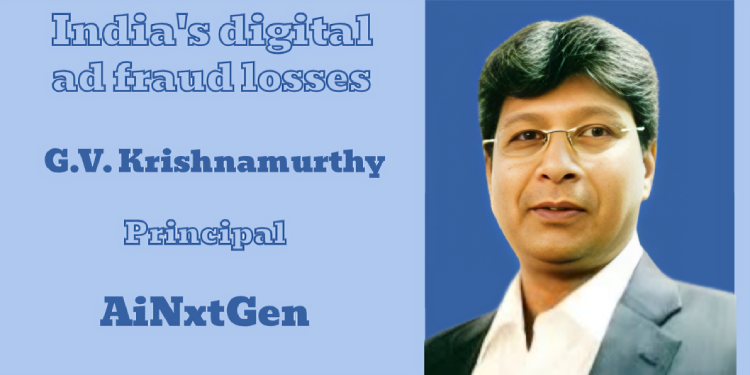
GV Krishnamurthy (GVK) is Principal at AiNxtGen and a veteran media strategist with over three decades of experience analysing India’s advertising landscape. A committee member of the Advertising Club Bangalore, GVK brings a practitioner’s perspective to questions of effectiveness, accountability, and the structural gaps that large-scale investment tends to obscure. Views expressed are personal.
(Views are personal)