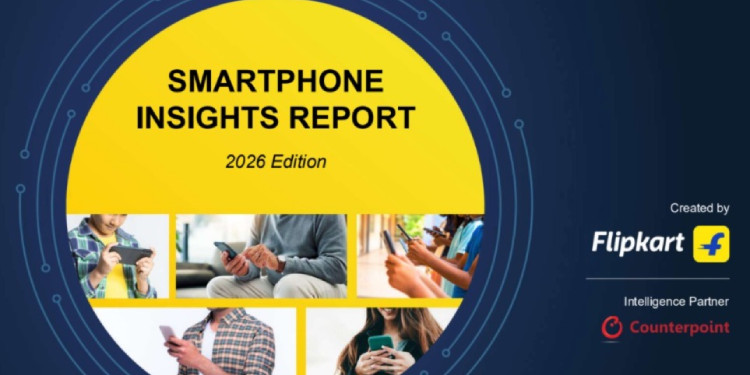
Mumbai: Flipkart, in collaboration with Counterpoint Research, has unveiled the Smartphone Insights Report 2026 at the Flipkart – India’s Favourite Smartphone Awards, highlighting a significant shift in consumer buying behaviour across the country.
The report reveals that Indian consumers are moving beyond spec-led upgrades toward more deliberate, experience-driven purchase decisions, with artificial intelligence (AI), performance, and affordability emerging as key drivers.
AI Emerges as a Core Purchase Driver
According to the findings, AI is becoming central to smartphone decision-making, with nearly 89% of users indicating that AI features influence their purchase choices. From voice assistants and search to content creation and personalisation, AI is increasingly shaping everyday smartphone usage.
The report also highlights varied adoption patterns across demographics—Gen Z leveraging AI for content creation and entertainment, millennials for productivity, and women users for lifestyle and daily assistance—signalling widespread and use-case-driven adoption. Notably, AI is now extending into mid-range devices, particularly in the ₹15,000–20,000 segment, where it is fast becoming a baseline expectation.
Rising Expectations Redefine the Category
As the smartphone category matures, baseline expectations are rising. Features such as performance, camera quality, and battery life are no longer differentiators but essential requirements. Consumers are increasingly prioritising seamless, end-to-end experiences over individual specifications.
The study shows that 45% of users are willing to pay more for better performance, while 57% prioritise superior camera capabilities. Larger displays, higher storage, and longer battery life are also emerging as standard expectations, driven by increased content consumption and app-heavy usage.
Value and Affordability Shape Decisions
Despite rising expectations, affordability remains a key consideration. Around 60% of consumers cite price and value for money as the primary purchase driver, followed by brand trust (57%) and online reviews (56%).
With smartphone prices rising due to premiumisation and increased component costs, affordability mechanisms such as EMI schemes are gaining traction, with 33% of users opting for instalment-based purchases. At the same time, replacement cycles are extending from 3.5 to 4 years, reflecting more deliberate upgrade decisions.
Design and Personalisation Gain Importance
The report also points to a growing emphasis on design and self-expression, with 64% of consumers preferring colourful devices and many willing to pay a premium for preferred finishes and materials. This trend is particularly strong among Gen Z, women users, and consumers in Tier 2 markets.

Commenting on the findings, Kanchan Mishra, Vice President, Flipkart Mobiles, said, “Consumers today are seeking smartphones that deliver a combination of performance, intelligent features and everyday reliability. At the same time, accessibility is becoming increasingly important as more users look to upgrade to higher-spec devices. Deeper penetration among Gen Z and non-metro consumers is reinforcing more deliberate, experience-led purchase decisions. At Flipkart, we are focused on enabling this shift by expanding our selection, strengthening affordability options and enhancing delivery capabilities to make these innovations available to a wider set of consumers.”

Tarun Pathak, Research Director, Counterpoint Research, said, “India’s smartphone market is undergoing a transition in how consumers evaluate devices, with growing emphasis on camera capabilities, performance and AI-driven features. What stands out is the increasing intent among users to make more considered upgrade decisions, driven not just by new launches but by tangible improvements in everyday usage. This is indicative of a more mature and informed consumer base, which is pushing brands to focus on delivering consistent, high-quality experiences across price segments.”
As the market evolves, the report underscores that future smartphone adoption in India will be driven by how effectively devices deliver on performance, AI integration, imaging capabilities, and affordability—making overall user experience the defining factor across segments.