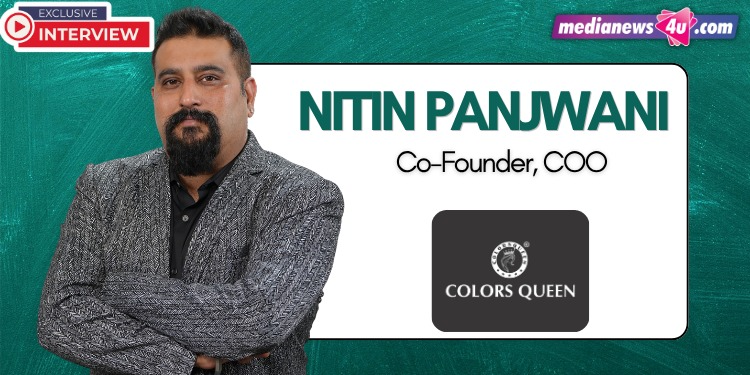
Colors Queen, is an Indian beauty brand known for its affordable and inclusive makeup offerings.
Founded in 2014, Colors Queen Cosmetics has built a strong presence in the Indian beauty market with a focus on delivering high-quality, trend-forward products tailored for diverse Indian skin tones. Under Nitin’s leadership, the brand has scaled significantly—from an initial portfolio of 12 products to over 800 SKUs across categories including face, lips, eyes, nails, hair, and skincare, with a distribution network spanning 300+ cities across India.
With over a decade of experience in marketing, brand building, and retail operations, Nitin has played a pivotal role in shaping Colors Queen’s growth journey. His vision centers on making beauty accessible, innovative, and inclusive, while ensuring product safety, performance, and cruelty-free standards.
MediaNews4U.com caught up with Colors Queen Co-Founder, COO Nitin Panjwani
Q. What was the gap seen in the market that led to the launch of Colors Queen?
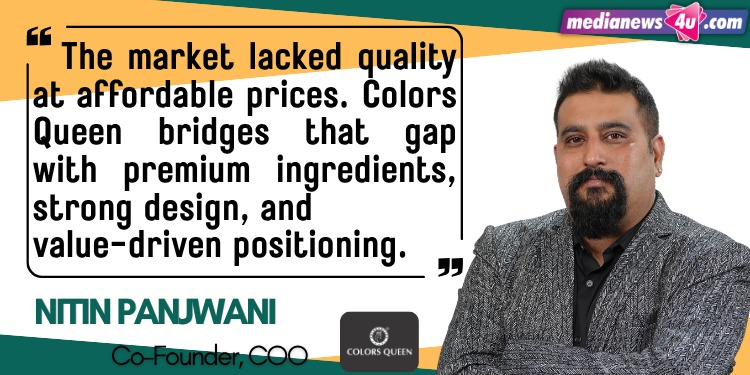
The gap identified in the market was the lack of high-quality and affordable beauty products. Many products with lower price points often compromise on the quality of the ingredients and the packaging, leading to bad consumer experience. We recognised that affordability should not come at the cost of quality.
With this vision, we launched Colors Queen – a brand which delivers premium ingredients and aesthetically appealing packaging at accessible prices so customers receive the best value without compromise.
 Q. Could you shed light on your entrepreneurial journey and lessons from building Colors Queen Cosmetics?
When Dilip and I started Colors Queen, our vision was very clear – to bridge the gap between affordability and quality in the beauty market and the journey has been both challenging and rewarding. Entering a highly competitive market was not easy, but staying focused on our core values helped us grow steadily.
One of the biggest lessons I’ve learned is the importance of truly understanding customer needs. Listening to feedback and continuously improving our products has been crucial. Another key takeaway is that consistency and patience are essential because building a brand doesn’t happen overnight. There were challenges around sourcing the right ingredients, maintaining quality standards, and creating appealing packaging at an affordable cost, but overcoming these helped strengthen the brand.
I’ve also learned that innovation and adaptability are vital in this industry. Trends change quickly, and staying relevant requires constant evolution.
Q. From a P&L perspective, what is the big challenge going to be in 2026?
The ongoing geopolitical and economic tension can affect the P&L in 2026. The biggest challenge in 2026 will be maintaining healthy margins and also providing high-quality products at affordable prices.
Rising input costs, packaging and logistics are expected to put a little pressure on gross margins. At the same time, increasing competition in the beauty industry will require higher investments in marketing, branding, and customer acquisition, impacting operating expenses.
Q. How has affordable and inclusive beauty in India evolved over the past decade?
In the last 10 years, affordable and inclusive beauty in India has changed a lot. Earlier, “affordable” mostly meant low-quality ingredients and basic packaging. But now, customers expect good quality even at a low price and brands are delivering that. Online platforms and D2C brands have made beauty more accessible. People now have more options, better awareness and can compare products easily.
Inclusivity has also become very important. Before, there were limited shades and less representation. Now, brands are focusing on Indian skin tones, different undertones and even gender-neutral beauty. Consumers today are also more aware about ingredients – they want safe, clean, and effective products.
People in smaller cities are equally interested and experimenting more. Overall, the market has shifted from just “cheap products” to “good quality at a fair price,” along with real inclusivity—and that’s the biggest evolution.
Q. In building a large-scale cosmetics brand for diverse Indian consumers, what tactics have worked for Colors Queen?
As a brand we focussed on giving good-quality products at affordable prices, understood different Indian skin tones and needs, made our products available both online and offline, kept up with trends and launched products fast, all the while building strong relationships with retailers and distributors, listening to customer feedback and kept improving, and managed costs properly so we don’t compromise on quality while keeping prices low.
Q. What are the trends expected to shape the mass and mid-segment beauty market in 2026?
In 2026, the mass and mid-segment beauty market will be shaped by skin-first approach instead of makeup-first, more demand for high-quality products at affordable prices, rise of hybrid products like makeup + skincare, a strong focus on ingredients and clean formulations, growth of online and D2C channels, bold and expressive makeup trends along with minimal everyday looks, increasing demand from Tier 2 and Tier 3 cities and an overall shift towards value, performance and trust in brands.
 Q. According to predictive analytics, does the whitespace for growth lie in tier 2 and tier 3 towns and cities?
For Colors Queen, predictive analytics strongly suggests that the whitespace for growth lies in Tier 2 and Tier 3 towns and cities, where rising disposable incomes, increasing digital penetration, and growing beauty awareness are driving demand for affordable yet trendy cosmetics.
Data indicates that consumers in these markets are highly influenced by social media trends but remain price-sensitive, creating a strong fit for Colors Queen’s value-driven positioning. Additionally, lower competition from premium brands and expanding retail and e-commerce access make these regions attractive for deeper market penetration.
By using predictive insights to tailor product assortments, pricing, and distribution strategies, Colors Queen can effectively capture this untapped demand and accelerate its growth trajectory.
Q. Is the goal of marketing in 2026 going to revolve around building trust?
Yes, in 2026 marketing will mainly revolve around building trust. Customers are now very aware of ingredients and what brands show on packaging, just doing online marketing is not enough anymore. People will trust only those brands that are honest and transparent since everything is available in one click.
Customers can easily compare products, so brands need to clearly show real ingredients, real formulations and real results. Therefore, authenticity and truth will matter more than just promotion.
Q. What marketing campaigns and innovations can we expect in the coming months?
Campaign related to New product launch, campaigns focusing on makeup trend and Campaigns to capture attention of Gen z will be upcoming campaigns for Colors Queen
Q. Will the theme of sustainability be important in marketing activities?
Yes, sustainability will be important in marketing. Overtime customers are becoming more conscious about what they use and how it impacts the environment, they look at packaging, ingredients and brand values, so brands need to show eco-friendly practices, responsible sourcing and less waste, but it also has to be genuine, not just for marketing, overall sustainability will help in building long-term trust and connection with customers.
Q. Is a fixed percentage of revenue dedicated to the marketing function?
Yes, for the overall business we do we have marketing budgets aligned for the same. For the NPD GTM and new customer acquisition we utilise almost 40-45% of our marketing budget
Q. Could you shed light on the strategy to strengthen regional language content and partnerships with micro-influencers who resonate with their communities?
Since we are available pan-India, we have started focussing on a lot of regional content, we have tapped micro-influencers from different regions of India. The idea is to create content in their local language so it connects better with them.
This helps us reach consumers without facing any language barrier. Micro-influencers also have strong trust within their communities, so the engagement and relatability is higher, overall it helps us build deeper connections across different markets.
 Q. What is the advantage of micro-influencers over macro-influencers?
Micro-influencers (typically 10K–100K followers) tend to have:
- More active and loyal audiences
- Better likes, comments, and saves per post
- The audience of Micro influencer is more relatable , trustworthy
Q. How has Gen Z completely reshaped the beauty landscape through a better understanding of products and by seeking value alignment? Are they forcing marketers in the category to rethink the playbook?
Gen Z has completely reshaped the beauty landscape. They’re informed and deeply value transparency and quality. They understand ingredients, care about skincare benefits in makeup, and prefer brands that align with their values rather than just aesthetics.
At Colors Queen, we take these evolving preferences seriously. We’ve been consciously developing products that blend makeup with skincare benefits and formulas that not only look great but also nourish the skin. Be it hydrating bases, lightweight textures or clean and skin-friendly ingredients, we ensure every product speaks to Gen Z’s love for conscious beauty.
Q. How much effort will go into packaging in 2026 to strengthen product connectivity and drive repeat orders?
Packaging will play a very important role in 2026, a lot of effort will go into making it more attractive, functional and user-friendly. It will help create a strong first impression and better product experience.
At Colors Queen, we will focus on clear information about ingredients and usage, more premium-looking designs at affordable pricing, and also try to make it more sustainable. We have found that good packaging helps customers feel connected to the product and increase repeat purchases.
Q. What role is AI playing in enabling innovation and product expansion to drive growth?
At Colors Queen, AI plays an increasingly important role in driving innovation and product expansion by enabling the brand to respond quickly to evolving beauty trends and consumer preferences.
By leveraging AI-driven insights from social media, customer behavior, and market data, we can easily identify emerging trends, predict demand, and develop new products more efficiently. It further enhances R&D by optimizing formulations and reducing development time, while improving marketing effectiveness through targeted campaigns and influencer selection.
Overall, AI acts as a catalyst for faster innovation, smarter category expansion, and scalable growth for Colors Queen.
 Q. What is the strategy to scale distribution and retail presence across India? Is an omnichannel approach being followed?
There are still untapped cities in Tier 2 and Tier 3 markets where we want a robust distribution channel which will be the prime focus for offline explanation.
The brand kiosks available in Tier 2 malls attract a lot of consumers and we shall be focusing on expanding them this year.