Primebook India is a deep-tech startup building an Android-led computing ecosystem for the next generation of users.
Primebook is reimagining personal computing for young India by combining the familiarity of Android with the productivity of a laptop. At the core is PrimeOS, its indigenously developed operating system that delivers a seamless desktop experience with multi-window multitasking, native Android app support, and advanced features such as keymapping, Cloud PC, Gemini AI Assistant (Companion Mode), and Operator AI.
With a growing product portfolio including Primebook 2 Neo, Primebook 2 Pro, and Primebook 2 Max, the brand focuses on delivering accessible, high-efficiency devices for students, creators, freelancers, and early professionals.
Founded in 2017 by IIT Delhi alumni, Primebook gained national visibility following its appearance on Shark Tank India Season 2 and has since expanded its footprint across India and select international markets, including South Asia and Africa.
The company’s vision is to build an AI-first, OS-driven computing ecosystem tailored to evolving user needs.
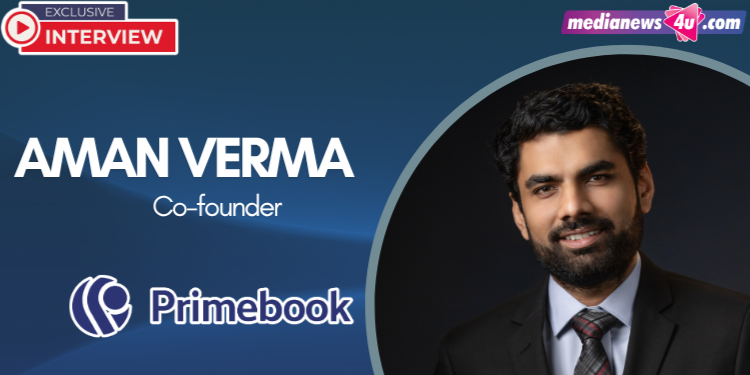
Medianews4u.com caught up with Aman Verma, Co-founder Primebook India
Q. Primebook India has focused on Performance and User Trust to build its presence. In 2026, what tactics will be adopted to build on these two areas?
At Primebook, we see performance and trust not as product features, but as user expectations that compound over time. And in 2026, we’re doubling down on a simple idea. Trust is built through consistency, not just communication.
On performance, the shift is from specs to everyday reliability and responsiveness. Users do look at RAM and processors, but what ultimately matters is how the device responds in real use. How quickly it opens apps, how smoothly it runs multiple tasks, and whether that experience stays consistent over time.
This means performance is not just about ‘benchmarks’, but also about ‘time to outcome’. That’s where our focus is: Deeper OS-level optimisation and evolving PrimeOS into a more intelligent, agentic AI-powered operating system. Here, AI is not an add-on, but built into the core to reduce friction and actively enhance productivity.
On trust, the relationship doesn’t end at purchase. It begins there. We’re strengthening post-purchase trust by expanding our after-sales infrastructure to 450+ cities, covering over 18,000 pincodes. Along with pick-and-drop services, users can now also walk into service centres, making support both faster and more accessible. At the same time, initiatives like Tech Buddy continue to play a critical role in helping users get the most out of their devices, making the laptop not just usable but truly useful.
From a brand standpoint, we’re also shifting from messaging to evidence. We are investing in high-quality content that reflects real product experience, not just claims. Because ultimately, performance earns attention, but consistency earns trust. And that trust is built across the entire ownership journey, not just at the point of sale.
 Q. What goals have been set for 2026 in areas like revenue growth, P&L, growing marketshare across tier one, tier two towns and cities and what is the gameplan to get there?
Our focus for 2026 is to scale rapidly while keeping business fundamentals strong. We’re targeting ₹150 crore in revenue, with a clear emphasis on improving P&L through tighter supply chain efficiencies, optimised product configurations, and disciplined cost management.
When it comes to market share, we don’t look at India through a strict Tier 1, Tier 2, or Tier 3 lens. That framework is increasingly reductive. What matters more is the access gap and the digital behaviour within each segment. Even within Tier 1 cities, there are multiple layers of users with very different needs, while Tier 2 and 3 cities have highly aware, tech-literate consumers who prioritise real utility over marketing noise.
So our approach is PAN India, focused on users who are looking for meaningful computing at the right price-performance equation.
Today, in the under ₹20,000 laptop category, we hold around 5% market share. Our goal for 2026 is to take this to 10%, which translates to selling 1 lakh units annually in a market of roughly 10 lakh devices.
The game plan is built across multiple growth engines. We are expanding across retail and B2B channels to improve reach and accessibility, while strengthening our presence on marketplaces. In parallel, we are evolving our brand identity and communication to build stronger recall with end consumers and drive demand pull.
Global expansion is another key focus. Starting in June, we will launch on Amazon US, positioning Primebook for a global audience, supported by collaborations with global creators.
Overall, the approach is to scale across channels and geographies while ensuring that growth is backed by strong unit economics and a clearly differentiated product narrative. Because market share is not just about reach, it’s about relevance at scale.
Q. In reimagining personal computing for young India by combining the familiarity of Android with the productivity of a laptop what is the big challenge?
The biggest challenge is changing perception.
Users have traditionally associated laptops with complexity and Android with simplicity, but not necessarily with productivity. That perception comes from a deeper mindset. For a long time, productivity has been tied to traditional desktop operating systems, which have gradually shaped what users expect from a computing device.
So the shift is not just about building a capable system, it’s about redefining what users believe a computing device can be. Bridging that gap is not just about technology; it’s about helping users move from seeing Android as consumption-first to trusting it for real work.
At the same time, it’s also about expectation design.
When you combine the familiarity of Android with the productivity of a laptop, users come in with two very different mental models. On one hand, they expect the simplicity, speed, and ease of use they associate with smartphones. On the other hand, they expect the capability, flexibility, and output of a traditional laptop.
Bridging this gap is where the real work lies. It’s about ensuring that the experience feels intuitive from the first interaction, but still scales when the user wants to do more. That means rethinking how apps behave on larger screens, how multitasking works, and how input methods like keyboard and touch come together seamlessly.
At Primebook, we’re addressing this by combining the familiarity of Android with a more structured, desktop-like experience, while continuously optimising PrimeOS for productivity at the system level. This includes building capabilities like operator AI with PrimeAGNT, where the system can actively assist users, reduce manual steps, and make everyday workflows more efficient.
Over time, as users experience this in their daily use, the perception begins to shift. And that’s when the product moves from being an alternative to becoming a natural choice for personal computing.
Q4. India is a price-sensitive market. How effectively has the company tackled this issue by staying below Rs. 25,000?
India is often described as a price-sensitive market, but when it comes to electronics, it is fundamentally a value-conscious market.
Users are willing to spend, but only when they see clear, tangible value. At the same time, we’re operating in a global environment where component costs, especially RAM and storage, are rising due to increasing demand from AI data centres and servers, which impacts pricing across the industry.
Despite this, our focus has been to keep Primebook as accessible as possible while delivering the best value in its segment.
Staying below ₹25,000 is not just a pricing decision; it’s a result of how we’ve built the product. Our deep integration of hardware and software allows us to optimise performance more efficiently. By building PrimeOS in-house and optimising it for real-world usage, we reduce dependency on high-end hardware while still delivering a smooth and reliable experience.
Even with ongoing supply-side pressures, the approach remains the same. Balance accessibility with performance, and ensure that users get maximum utility at a price point that makes sense for them. Because in a market like India, it’s not about offering the lowest price. It’s about delivering the most value for what users choose to spend.
 Q. What role is AI playing in helping improve the PrimeOS that delivers a seamless desktop experience with multi-window multitasking, native Android app support, and advanced features such as keymapping, Cloud PC, Gemini AI Assistant (Companion Mode), and Operator AI?
AI is central to the future of PrimeOS. With PrimeAGNT, our Operator AI, built directly into PrimeOS, we are building a more intuitive computing experience where users can perform tasks using simple prompts instead of navigating multiple apps. From productivity workflows to everyday actions, the goal is to reduce friction and make computing more natural and efficient.
At a broader level, AI is helping us shift the role of the operating system itself. Instead of the user adapting to the system, the system begins to adapt to the user. It understands context, assists in execution, and reduces the number of steps required to get things done.
This builds on what we introduced earlier with Companion Mode powered by Gemini AI Assistant and AI-powered Global Search in our Primebook 2 laptops. These features allowed users to interact with on-screen content more contextually and search across apps, files, and the web in a unified way. With PrimeAGNT, we are taking that a step further by enabling the system to not just assist, but also execute tasks more proactively.
This integrates seamlessly with core PrimeOS capabilities like multi-window multitasking, native Android app support, and keymapping. AI doesn’t replace these features; it makes them easier to use and more aligned with how users actually work. Cloud PC further extends this by giving users access to more powerful environments when needed, without adding complexity.
Overall, AI is not being treated as an add-on. It’s becoming a core layer within PrimeOS that simplifies interactions, enhances productivity, and moves the experience closer to outcome-driven computing.
Q Could you talk about marketing campaigns and innovations that one can expect from the company in the coming months?
We’re fundamentally rethinking how we approach marketing, with a clear shift towards building a more continuous cultural presence.
For us, that starts with moving away from high-budget, low-frequency campaigns to a more consistent, content-first approach powered by AI. This allows us to create both long-form and short-form content at scale, experiment faster, and iterate based on real audience feedback, which is critical for staying relevant with a fast-moving Gen Z audience.
Most brands still treat marketing as messaging. We see it as presence. That means showing up in the moments that matter to our audience, not interrupting them.
In terms of where we head from here, our campaigns will focus strongly on category creation and education. A big part of this is helping users understand how Primebook is different from traditional laptops, through narratives built around real use cases, productivity, and how a new generation approaches computing.
We’re also moving towards high-impact, idea-led campaigns instead of just ad films. The focus is on building concepts that can travel across formats, whether it’s reels, YouTube, or larger cultural moments. Alongside this, we’re collaborating with creators not just for distribution, but for co-creating content that feels native to each platform.
The larger goal is to build Primebook not just as a product, but as a distinct point of view on the future of personal computing.
Q. Does the company do a lot of on-ground activities in schools, colleges? Kindly elaborate.
Yes, we actively engage with schools, colleges, and institutions through on-ground activations, demos, and partnerships.
These interactions allow users to experience Primebook firsthand, which is critical for a product that introduces a new way of computing. It’s not something that can be fully understood through specs or advertising alone. Hands-on exposure plays a key role in building both familiarity and trust.
Our approach goes beyond one-time activations. We focus on creating meaningful touchpoints where students can explore real use cases, whether it’s learning, productivity, or everyday workflows.
We’ve already built partnerships with 250+ educational institutions, and this continues to be an important part of how we drive awareness and adoption at scale.
At the same time, these engagements act as a feedback loop. They help us understand how users interact with the product in real-world scenarios, which directly informs both our product development and communication.
Q. What role will experiential marketing play through having a presence at tech events, malls etc?
Experiential marketing plays a critical role for us because Primebook represents a fundamentally new way of computing, something users understand best when they actually experience it.
We’ve already executed activations at both local and global levels, including platforms like DIDAC India, SHIVIR, Global Sources Hong Kong, and GITEX Singapore. These have helped us showcase the product to diverse audiences and validate its appeal across markets.
We’ve also invested in deeper campus engagement. During our Gen 2 launch, we ran a campus ambassador program across 14 campuses in cities like Delhi, Pune, Mumbai, and Bangalore, in collaboration with Under 25, enabling peer-led discovery and more contextual adoption.
Going forward, we’re expanding our presence across malls, tech events, and campuses to enable more hands-on discovery. While experience helps users understand the product better and therefore drives conversion, for us, these touchpoints are equally important as a feedback loop. They give us direct insight into how users interact with the device, what feels intuitive, and where we need to improve. That learning feeds directly back into both product development and communication, allowing us to refine the experience continuously as we scale.
 Q. Online what work will the company do with tech, gadget, lifestyle influencers to get the message across? How will it leverage the creator economy”
We see the creator economy as a core growth engine, not just a distribution channel.
Our approach is to work with creators as collaborators rather than just promoters, co-creating content that feels native, authentic, and aligned with how audiences actually consume content today.
This reflects in how we work across categories. With tech creators, the approach is more direct, focusing on unboxings, reviews, and detailed breakdowns to clearly communicate the product’s capabilities. With lifestyle and other creators, the integration is more organic, where the product becomes part of their everyday content through use cases, storytelling, or formats like skits and to-camera pieces.
We’re also building a strong mix of micro, mid, and emerging creators who have deeper engagement within niche communities, especially among students and young professionals. This helps us drive relatability and trust at scale, rather than relying only on reach.
Going forward, we’re expanding into newer sub-genres like AI, B-boying, food, and other culture-led categories. The idea is to adapt the product narrative based on the creator’s expertise, so the integration feels relevant to that specific audience.
At the same time, as we expand globally, especially into markets like the US, we’re working with international creators to translate our story across geographies and cultures, positioning Primebook as a globally relevant product.
Q. AI is having a big impact on Search marketing. Is this allowing the company to go beyond keywords?
AI is fundamentally changing how we approach search. Earlier, search engine strategy was largely about identifying the right keywords and optimising around them. Today, with AI-led search experiences, the shift is clearly towards understanding user intent and delivering the most relevant, contextual answer.
For us, this shift started early, well before AI-led search became mainstream. In the consumer electronics category, where search typically revolves around spec sheets and product pages, we reimagined it as a cultural content ecosystem for India’s youth. Instead of focusing only on product discovery, we mapped long-tail search behaviour around what young users are actively searching for, from exam preparation and college discovery to creative growth and career exploration.
This led us to build a structured editorial framework spanning tech trends, student-focused resources, credible insights on colleges and exams, real user experiences, and practical how-to content. We also focused on creating content that surfaces within discovery-based environments, allowing users to engage with Primebook content even before they actively search, which strengthens authority over time.
AI has accelerated this approach. Optimisation today is less about keyword density and more about clarity, structure, and depth, so that AI systems can easily interpret and surface our content. We’re also leaning into conversational formats and video-led discovery to ensure we show up meaningfully across both traditional and AI-driven environments.
Internally, we’ve built a multi-agent AI system for SEO rather than a single tool. It includes specialised agents across roles like writing, editing, trend research, technical optimisation, and keyword strategy, all connected through a central structure that spans intelligence, strategy, content creation, optimisation, research, distribution, and continuous learning. This system runs 24/7 to monitor performance, identify gaps, and improve in real time, allowing us to move far beyond traditional, slower cycles.
Overall, search is no longer about being found. It’s about being chosen. AI is enabling us to move beyond keywords and build a more intent-led approach, where Primebook shows up not just as a ranked link, but as both a relevant answer and a facilitator that helps users move forward in their computing journey.
Q. The vision is for users to be able to perform complex tasks using only voice commands or prompts, such as booking tickets directly through the OS. How will Voice impact marketing activities done by brands?
We believe prompts and voice will redefine how users interact with devices. With PrimeAGNT, we are already enabling a future where users can execute tasks, whether it’s searching, creating, or completing actions, through simple commands.
From a marketing standpoint, this doesn’t change everything overnight, but it does change how decisions get made. When a user is booking something or asking for a recommendation through voice, they’re typically presented with very limited options, sometimes just one.
That shifts the role of marketing from driving visibility to ensuring selection.
In practical terms, this means brands will need to focus more on reliability, strong brand recall, and meaningful integrations, rather than just traffic. It’s no longer enough to be discoverable; you need to be trusted enough for the system to recommend you in that moment.
Traditional channels will continue to play a role in building awareness and recall, but the final conversion layer will increasingly depend on whether the system considers your brand relevant and credible enough to surface.
Q. The plan is to expand to 30–40 partners across the country to cover different touchpoints. What tactics work in finding platforms willing to support ‘challenger channel partners’ like like Vijay Sales?
For us, the approach to partnerships is not limited to finding specific “challenger” platforms, but to building a strong, PAN India distribution network across both national and regional retailers.
India is a highly diverse market, and reach cannot be built through a single channel. That’s why we focus on working with both large national retail chains as well as strong regional partners who have a deep understanding and influence in their respective markets.
Regional retailers, in particular, play a critical role in driving accessibility and trust at a local level. We’ve already partnered with groups like PAI International and Sangeetha Mobiles across Andhra Pradesh, Telangana, and Karnataka, which helps us strengthen our presence in key southern markets.
At the same time, we continue to expand with national partners to ensure broader visibility and consistency across the country.
The focus is to build coverage across multiple touchpoints so that users can discover and experience the product wherever they are. For us, distribution is not just about scale, but about relevance and accessibility across regions.
Q. How important will the festive season be in 2026? Does the company see itself as also being an important gifting product?
The festive season is critical for us, not just from a sales standpoint, but also for brand visibility.
It’s a period when purchase intent is naturally higher, and categories like personal computing see a meaningful spike. We see strong traction during this time and plan to leverage it with targeted campaigns, sharper communication, and relevant offers.
At the same time, Primebook fits well as a gifting product, especially for students and young professionals. What makes it different is that it’s not just a device, but an asset. It enables learning, productivity, and access to opportunities, which makes it a more meaningful and long-term gift.
This also extends beyond traditional festive windows. We actively look to leverage key moments like the back-to-college season, along with occasions such as Mother’s Day, Raksha Bandhan, or transitions like starting college or a new job. These moments are often tied to themes of empowerment and progress, which aligns closely with what Primebook enables for the user.
So while the festive season remains a key moment for scale, we also see gifting as a broader, year-round opportunity, where the product is positioned not just as a purchase, but as something that adds real value to someone’s journey.
 Q. Could you shed light on the expansion plans in Southeast Asia, the Middle East and North Africa and South America?
Our global expansion is rooted in the fact that Primebook has been built and validated in India, one of the most demanding and diverse computing markets. Building for this environment has helped us create a product that is highly optimised, efficient, and value-driven, which we believe translates well across other markets.
We have already taken early steps internationally in markets like Zimbabwe, Bhutan, South Africa, and Saudi Arabia. These markets have given us valuable insights into how the product performs across different user segments and geographies.
Building on that learning, our next phase begins with the US, where we are launching on Amazon US starting this June. This is a key step in taking an India-built product to a global audience at scale. Following this, Europe will be our next focus as we expand into developed markets with evolving computing needs.
As we scale further, regions like Southeast Asia, the Middle East and North Africa, and South America remain important. Our approach in these markets will be to build strong local relevance via partnerships while leveraging the strengths of a product designed for a highly dynamic market like India.
At a broader level, our ambition is to build a differentiated, deep-tech computing category globally, one that combines accessibility with innovation. We see a growing set of users across markets who are looking for more practical, value-driven computing solutions, and that’s where Primebook fits in.
To support this, we will also collaborate with global creators and influencers to translate our story across geographies and cultures in a way that feels locally relevant.
Over time, the goal is to expand across multiple regions while continuing to represent and scale India-built technology on a global platform.